
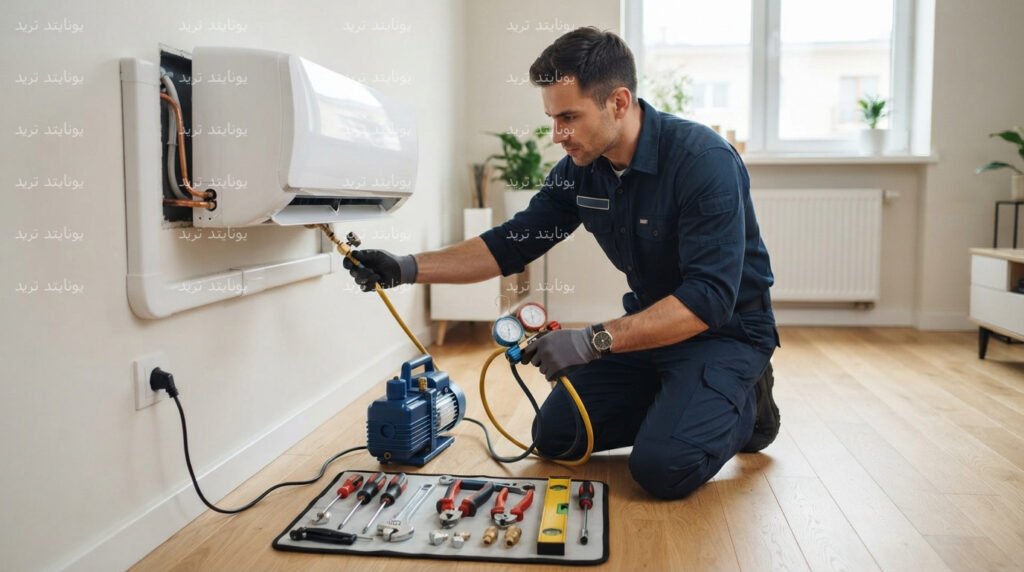
practical Air conditioning installation My home requires high technical precision to ensure that the device operates with maximum efficiency throughout the years of service. The performance of your device depends directly on the quality of the field installation; Technical reports confirm that neglecting basic steps reduces cooling capacity by up to 40% [1]. By following the correct engineering standards, you will be able to reduce energy consumption and maintain the life of your compressor as long as possible.
Why advance planning is essential for a successful installation
Successful planning begins with Air conditioning installation Determine the thermal capacity required for each room with extreme accuracy. Spaces in hot regions such as Riyadh require approximately 500 to 600 British thermal units (BTU) per square meter to ensure optimal coverage [4]. Choosing a power that is not proportional to the space is the main reason for rapid compressor wear and excessive electricity consumption.
❓ Determine the ideal geometric location of the units
The indoor unit must be installed at a height of 2.2 to 2.5 meters above the ground to ensure even air distribution. It is also required to leave a distance of at least 15 cm between the unit and the ceiling to allow air to circulate smoothly and prevent annoying noise. Moreover, the external wall requires a hole slanted at an angle of 5 to 10 degrees outward to ensure the drainage of condensation water and prevent its backflow [2].
Essential equipment and tools for a professional air conditioning installation
The use of specialized tools ensures tight connections and prevents Freon gas leakage, which extends the life of the device. The following list shows the tools that the installation technician must have to ensure quality performance:
- Vacuum Pump to extract moisture and air from pipes.
- Torque Wrench for tightening nuts with the appropriate pressure.
- Copper pipe cutter (Tubing Cutter) to ensure clean edges of connections.
- Gas pressure measuring device (Manifold Gauge) to check charge levels.
Implementation steps to ensure efficient performance
The vacuum process is the most important step in... Air conditioning installation Split the talk. The presence of air or moisture inside the refrigeration cycle leads to chemical reactions that harm the oil and compressor. Air must be drawn in for at least 20 minutes using the pump before opening the gas valves to ensure that the system is completely free of moisture [1].
A comparison between operating technologies and their impact on electricity
Cooling efficiency varies based on the type of technology used in the device, with inverter devices excelling in sustained performance. The following table summarizes the basic differences between traditional devices and inverter devices:
| Standard | Conventional air conditioning | Inverter air conditioning 🏆 Editor's choice |
|---|---|---|
| Electricity efficiency | ✗ Average | ✓ High (save 40%) |
| Compressor control | ✗ Play/Disconnect | ✓ Variable speed |
| Thermal comfort | ✗ wiggle | ✓ Stability |
| Overall evaluation | ★ 7.5/10 | ★ 9.8/10 |
Inverter technology intelligently regulates the compressor speed instead of repeatedly disconnecting and starting, which reduces electricity consumption by up to 40% [3]. This option is the ideal long-term investment, despite the slightly higher initial cost compared to traditional models.
❓ Advantages and disadvantages
Features:
- Noticeable savings on your monthly electricity bill.
- Extend the life of internal components.
- Completely quiet during operation thanks to the low compressor speed.
Disadvantages:
It is a stage Establishing copper pipes The basic foundation for ensuring the efficiency of extensions, as it requires extreme precision in choosing the appropriate diameters and professionally thermally insulating them to prevent gas leakage or moisture condensation. Paying attention to the quality of the extension paths protects the system from future malfunctions and ensures that the refrigerant flows smoothly within the unit, which significantly extends the life of the device.
energy consumption and avoiding sudden malfunctions in the long term. However, this ideal performance is not complete without adhering to a periodic schedule that includes: Air conditioning maintenance With all its mechanical and electrical parts. This regular check helps clean the filters and measure refrigerant pressure early, protecting the compressor from damage and keeping the air clean and flowing as efficiently as possible.
The installation process is based on an integrated technical system that goes beyond simply placing the unit on the wall, as it represents an application The basics of installing your home air conditioning A crucial step to ensure balanced air distribution and avoid common malfunctions. Adherence to these field controls contributes directly to increasing operating efficiency by up to 20% while significantly reducing energy consumption.
The professional stage comes Installation of copper pipes As a cornerstone for ensuring strong and sustainable cooling performance, its precise engineering implementation contributes to reducing energy consumption by up to 40%. Through the integrated thermal insulation of these pipes, they prevent the loss of coolness and ensure that the device operates at the maximum possible efficiency throughout the years of service.
Energy consumption rates and avoiding sudden malfunctions, and here the importance of this stage is highlighted Installing air conditioning ducts Copper is the vital artery of the entire cooling system. This step requires taking into account the diameters recommended by the manufacturer and using high-quality copper materials with tight thermal insulation to prevent water condensation or refrigerant leakage.
Energy consumption and avoiding sudden malfunctions that may drain your budget later. However, the efficiency of the installation remains incomplete unless you support it with a periodic schedule that includes steps. Air conditioning maintenance Air with precision and professionalism. Regular care in cleaning filters and checking refrigerant levels ensures that the compressor's life is maintained and that it delivers fresh, healthy airflow.
Energy consumption and avoiding sudden malfunctions that may force you to resort early Air conditioning maintenance Your home is expensive. Regular care by checking the refrigerant pressure and cleaning the filters contributes to maintaining the integrity of the compressor and prolonging its lifespan, ensuring a continuous flow of fresh air with the highest levels of efficiency.
- ✓Sensitivity of electronic parts to electrical current fluctuations.
- ✓Higher costs of original spare parts compared to regular models.
❓ Editor's judgment and final rating
We give air conditioners equipped with inverter technology a rating of 9.4/10 due to their superior ability to cool comfortably and save energy. We specifically recommend this option for people who rely on running the air conditioner for long periods during the day in areas with hot climates.
Energy consumption and avoiding sudden malfunctions, which specifically starts from one stage Installing air conditioning ducts Precision engineered copper core ensures smooth flow of cooling compound. This includes choosing the appropriate diameters and thickness of thermal insulation to protect the lines from moisture condensation and prevent future leaks, thus maintaining the lifespan of the cooling unit at full capacity.
Frequently asked questions
❓ What is the appropriate distance between the air conditioning unit and the ceiling?
A distance of at least 15 cm must be left to ensure smooth air flow to the indoor unit and prevent noise.
❓ Why is the vacuum process necessary when installing air conditioning?
Vacuum removes moisture and air from pipes; Leaving it on will cause the cooling capacity to drop by 40% and the compressor to burn out within a short time.
❓ Does the cooling capacity vary depending on the area of the room?
Yes, hot climates require 500-600 BTU per square meter, while temperate regions need only 333 BTU.
❓ How does inverter technology contribute to saving electricity?
This technology intelligently regulates the compressor speed and avoids frequent disconnection and operation, saving about 40% of consumption.
❓ What is the best height to install the indoor unit?
The ideal height is between 2.2 and 2.5 meters above the ground to ensure the best possible air distribution in the room.
Investing in Air conditioning installation According to engineering principles, it guarantees you complete comfort and continuous savings in energy costs. Always make sure to choose specialized technicians who adhere to all vacuum and installation steps to ensure the quality of performance you aspire to.
















Community dialogue
0 comments