
practical Air conditioning installation Air is not just putting units in place, but rather a series of precise technical steps that determine the quality of performance and lifespan of the device. Negligence results at any stage Air conditioning installation Your home, such as vacuuming air or adjusting the slope angle, will decrease cooling efficiency and significantly increase electricity consumption. In this article, we will explain the professional standards that expert technicians follow to ensure that your device operates at maximum power and at the lowest possible operating costs.
Engineering installation standards for indoor and outdoor units
Proper installation requires that the indoor unit be installed at a height of 2.2 to 2.5 meters off the floor to ensure even air distribution in the room. You must also ensure that the area surrounding the outdoor unit is free of any obstacles that hinder air movement, as good ventilation of the outdoor unit is necessary for the heat exchange process.
❓ Determine pipe paths and drainage angle
The wall must be excavated at an angle of inclination ranging between 3 to 5 degrees towards the outside to ensure that condensation water drains smoothly. This procedure protects the walls from moisture and prevents water leakage into the room, and is an essential step that cannot be skipped in any project Air conditioning installation professional.
The importance of the vacuum process using a micron pump
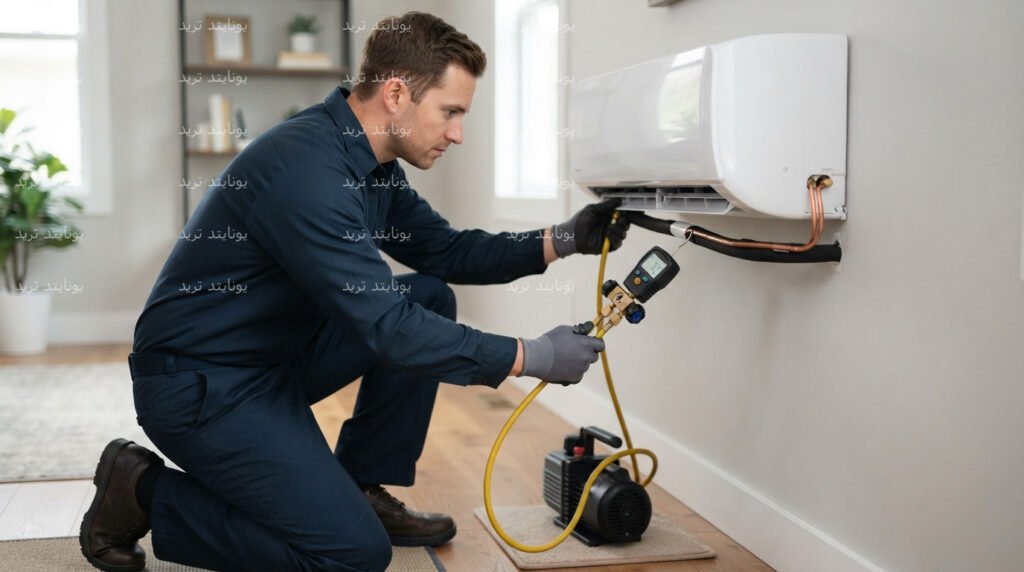
The process of emptying air using a vacuum pump and a micrometer is a technically mandatory step that does not accept random alternatives. Operating the air conditioner without emptying the air and moisture from the cooling circuit leads to damage to the compressor within a few months. This also leads to the air mixing with the refrigerant gas, which reduces the cooling efficiency significantly.
This diagram shows the correct way to ensure circuit integrity before opening the gas valves, as micron stability is the true criterion for successful work.
Comparison table between professional and random incorporation
| Technical standard | Professional establishment (🏆 Editor's choice) | Random establishment |
|---|---|---|
| Vacuum | ✓ Available (pump and gauge) | ✕ |
| Pipe slope angle | ✓ Min (3-5 degrees) | ✗ Uncontrolled |
| Copper pipe insulation | ✓ Complete thermal insulation | ✗ Partial or damaged insulation |
| Overall evaluation | ★ 9.8/10 | ★ 4.2/10 |
Improve energy efficiency after installation
Setting the thermostat at 25°C achieves the perfect balance between comfort and energy saving in hot climates. Studies indicate that lowering the temperature by one additional degree may raise energy consumption by up to 10%, directly affecting your monthly electricity bill.
- Replacing air filters regularly improves cooling efficiency by 5% to 15%.
- Avoid placing the outdoor unit in direct sunlight to reduce compressor voltage.
- Ensure that ventilation openings and doors are closed to ensure that cooled air does not leak out.
The importance of updating old devices
Air conditioners that are more than 10 years old consume 40% more electrical energy than modern models. So, when you think about Air conditioning installation New, it is recommended to choose devices with inverter technology that provides stable power consumption and prevents annoying thermal fluctuations.
❓ Advantages and disadvantages
Features:
- Achieve fast and stable room cooling.
- Reducing electricity bills in the long term.
- Extend the service life of the motor and compressor.
Disadvantages:
The actual success of the system begins with taking care of one step Establishing copper pipes Designed for the passage of the cooling medium, as choosing the appropriate diameters and insulating them tightly ensures that any possible leakage is prevented. Professionally extending these paths also allows avoiding sharp bends that may impede the flow of Freon, thus maintaining the ideal operating pressure within the refrigeration cycle.
The importance does not stop only at the installation stage, but extends to periodic follow-up of the device, as it ensures Air conditioning maintenance Air protect internal components from damage and dust accumulation. Sticking to a regular inspection schedule is the best investment in maintaining fresh, healthy airflow, while reducing the possibility of unexpected breakdowns that could cost you dearly.
The actual success of the system begins before the hardware is installed, as it represents a stage Installing air conditioning ducts The copper core is precisely used to prevent refrigerant gas leakage and ensure the smooth flow of Freon between the indoor and outdoor units. This requires choosing appropriate pipe diameters and thermally insulating them with great care to avoid moisture condensation and ensure the highest possible operating efficiency.
This context highlights the role Regular and professional air conditioning maintenance To maintain the integrity of the system and avoid sudden malfunctions resulting from operating or installation errors. This procedure includes checking the Freon gas pressure and cleaning the filters and condenser to ensure air flow at the highest possible efficiency throughout the year.
This context is not complete without realizing that the efficiency of operation after installation depends entirely on the procedure Regular air conditioning maintenance It ensures the safety of the Freon cycle and the cleanliness of the filters from impurities. This regular monitoring contributes to avoiding sudden malfunctions and maintaining clean and healthy air flow with the lowest possible energy consumption.
- The cost of professional installation may be slightly higher.
- Requires longer implementation time to ensure accuracy.
❓ Editor's judgment and final rating
Final rating is 9.5/10. This professional approach suits all those looking for lasting comfort and real savings in energy costs. Investing in quality installation saves you from frequent and expensive maintenance in the future.
In this context the importance of accuracy when Installing air conditioning ducts Copper, as its extension requires choosing the appropriate diameters and carefully insulating it thermally to avoid any gas leakage or wastage of cooling energy. Burying and directing the drainage lines at carefully considered inclination angles during this step also contributes to protecting the walls from moisture and ensuring the flow of the coolant with the highest possible efficiency.
Frequently asked questions
❓ Why must a vacuum be performed when installing a new air conditioner?
Because the presence of air and moisture inside the circuit interacts with oil and gas, which leads to corrosion of the compressor and damage to the entire system.
❓ What is the ideal distance for the height of the indoor unit?
Installing the indoor unit at a height of 2.2 to 2.5 meters ensures excellent air distribution and balanced cooling throughout the space.
❓ Does cooling pressure affect electricity consumption?
Yes, the technician’s commitment to charging the refrigerant gas according to the manufacturer’s recommended weight ensures high efficiency and ideal energy consumption.
❓ How do I maintain the efficiency of the air conditioner after completing the air conditioning installation?
Filters must be cleaned every 30 days and annual periodic maintenance must be performed to ensure the cleanliness of the outdoor unit heat exchanger.
❓ What is the difference in power consumption between old and new appliances?
Modern appliances save up to 40% of electricity consumption compared to models that are more than 10 years old thanks to advanced component technology.
Adherence to these technical standards ensures that you get powerful and sustainable cooling for many years. Start applying these steps at Air conditioning installation Your next home to ensure the best performance of your appliances.
















Community dialogue
0 comments