
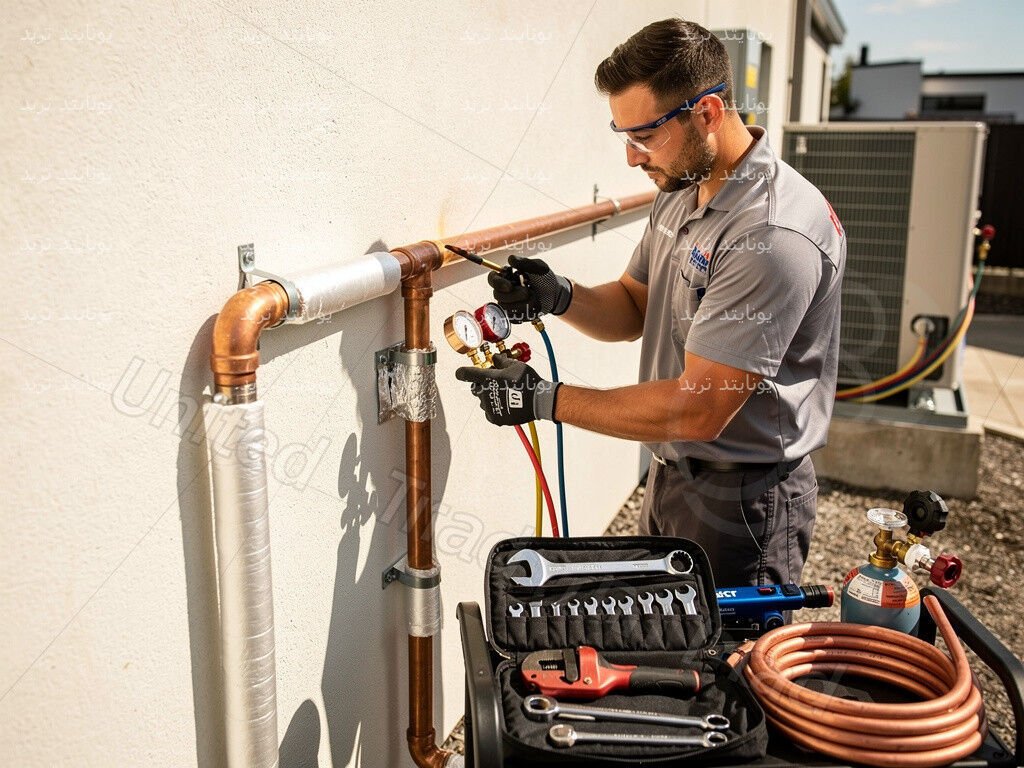
The air conditioning duct extension represents the vital artery that connects the indoor and outdoor unit of the air cooling system, as it ensures the flow of refrigerant without loss of pressure or energy efficiency. This article will explain the precise technical criteria for selecting approved copper diameters, effective thermal insulation methods, and cooling network testing techniques to ensure the sustainability of the air conditioning for many years.
Quick answer
Air conditioning ducting is a mechanical connection process that uses thermally insulated copper tubes to transfer the refrigerant between the two air conditioning units through geometrically defined paths. This procedure requires adhering to the manufacturer's recommended diameters, applying tight thermal insulation that prevents condensation, in addition to performing a nitrogen pressure test and vacuuming to ensure that there are no gas leaks and to protect the mechanical compressor from burnout.
Engineering criteria for choosing the path of the Freon network
The efficiency of the air cooling path depends on reducing the total distance between the two air conditioner units to avoid a drop in the pressure of the refrigerant. Therefore, the shortest possible path that includes the fewest sharp bends must be chosen, because sudden bends cause disturbance in the gas flow and reduce the overall cooling effectiveness.
Furthermore, running copper lines near direct heat sources or exposed main electrical installations should be avoided. As a result, the Freon remains in its desired physical state within the closed cycle without gaining unwanted parasitic heat load within the walls.
Determine the diameters and wall thickness of copper
The diameter of the copper tube depends directly on the cooling capacity of the air conditioner and the type of refrigerant used in the system. For example, 18,000 BTU air conditioners often need a half-inch diameter intake line and a quarter-inch diameter exhaust line to ensure efficient return of the lubricating oil to the compressor.
In contrast, larger capacity air conditioners, such as 24,000 and 30,000 BTU, require an intake line five-eighths of an inch in diameter. It should be noted that using a wall thickness of less than 0.8 mm may lead to cracking of the tube during bending or microscopic leakage under high Freon pressure.
Calculating extension distances and height differences
Manufacturers specify a maximum horizontal and vertical distance allowed between the two units to maintain balanced oil and gas flow. If the vertical height exceeds five meters, an oil trap should be installed every three meters to secure the rise of the refrigerant oil with the refrigerant and protect the compressor motor from dry damage.
Steps for preparing and installing cooling lines
The stages of preparing the cooling lines begin by preparing the appropriate structural openings in the walls at a slight angle of inclination outward to facilitate water drainage. Therefore, early planning helps avoid random cracking that may harm the integrity of the building’s concrete structure.
- Cut copper tubing using a dedicated tubing cutter to ensure precisely flat edges and prevent distortion of the tube circumference.
- Remove the internal metal strips very carefully with the tube facing downwards to prevent the metal strips from falling into the cycle.
- Pass each tube through an independent high-density foam insulation hose before making connections.
- Precisely expand the tube end using the custom flanger tool to achieve a leak-proof connection with the unit's valves.
- Wrap the refrigerant lines along with the signal cable and water drain hose with protective, UV-resistant tape.
Types of thermal insulation approved for air conditioning lines
Thermal insulation represents the first line of defense to protect the system from surface water condensation, which causes damage to ceilings and interior paints. Therefore, the cold gas line must be separated from the hot liquid line, and each line must be insulated with a completely independent foam tube without combining them inside one common insulator.
In addition, insulation materials vary in their ability to resist moisture and vapor permeability based on their chemical composition. On the other hand, choosing the appropriate material ensures energy consumption by reducing heat loss during the transfer of Freon between the two units.
| Type of insulation material | Thermal conductivity coefficient | Resistance to moisture and condensation | Estimated shelf life |
|---|---|---|---|
| Synthetic nitrile rubber | Very low (0.034 W/mK) | Excellent resistance to vapor penetration | From 10 to 15 years |
| Polyethylene foam | Average (0.040 W/m.K) | Good with proper external protection | From 5 to 8 years |
| Fiberglass protected | Low (0.036 W/mK) | Medium and requires aluminum housing | From 7 to 10 years |
| Flexible polyurethane | Very low (0.032 W/mK) | High in dry and closed environments | From 8 to 12 years |
Nitrogen pressure and air discharge testing
Dry nitrogen pressure testing is the critical procedure to ensure the integrity of Freon line connections before opening the refrigerant or operating the equipment. In other words, nitrogen gas is injected at a pressure of up to 400 psi for 24 hours to verify that the pressure is constant and that there are no microscopic leaks.
As a result, the technician discovers any defect in the welding or filler connections before charging the system with expensive Freon. It should be noted that soapy water or microbubble reagents should be used on the mechanical bonding areas to fully visually confirm the tightness of the seal.
The subsequent stage of preparing the piping network requires following a precise engineering protocol when... Air conditioning installation Air to ensure stable performance and prevent any future leaks. The process begins by installing vibration-absorbing stands and balancing the units with measuring devices, followed by treating the filler connections and completely suctioning the air through the vacuum pump.
The efficiency of this system starts from one stage Installing air conditioning ducts With extreme precision within concrete walls and ceilings, taking into account the selection of shorter paths to avoid sharp bends that impede the movement of the cooling medium. This procedure also requires the installation of sturdy supports and insulating protection ducts that prevent the copper lines from being damaged or mechanically stressed during subsequent construction stages.
It requires an operation Air conditioning installation Extreme precision in installing the holders and taking into account water drainage tendencies to ensure that the system operates at the highest operational efficiency. This also includes tightening the cooling lines and completely emptying the air from the circuit before releasing the Freon gas, to avoid any sudden mechanical failures in the compressor.
The effectiveness of these formulations is not complete without adhering to a periodic schedule that guarantees action Comprehensive air conditioning maintenance For all mechanical parts and cooling networks. Preventive follow-up contributes to early detection of any Freon gas leakage and cleaning of filters and evaporators, which increases the efficiency of energy consumption and extends the lifespan of the entire system.
It requires an operation Installing air conditioning ducts Great care is taken in adjusting the stages of thermal insulation and using moisture-resistant materials to protect the cooling path from condensation and energy loss. It is also necessary to carefully inspect the copper through approved nitrogen pressure tests to ensure the integrity of the welds and the absence of any hidden leaks inside the walls before closing them permanently.
Maintaining this performance is only complete through action Field inspection of air conditioners Regularly to ensure the integrity of the Freon gas cycle and the cleanliness of the heat exchanger, which prevents mechanical fatigue of the compressor under the stress of continuous operation. This direct inspection contributes to restoring maximum cooling efficiency and achieving a significant reduction in electricity consumption and monthly operating costs.
The effectiveness of these extensions is not complete without adherence to procedures Regular air conditioning maintenance Ensures the safety of cooling lines from leakage and sediment accumulation. Regular checks of gas pressure and cleaning of filters and condensers contribute to extending the life of the system and maintaining maximum cooling efficiency.
Extended operational efficiency requires superior phase accuracy Establishing cooling pipes Inside concrete walls and ceilings before final finishing works. This includes installing the tracks with carefully considered bending angles that prevent the suffocation of Freon gas, and providing a strong protective cover that protects the copper lines from damage or corrosion in the long term.
Maintaining the efficiency of these extensions is not complete without adhering to customized periodic programs, which play a role Air conditioning maintenance Air plays a pivotal role in checking refrigerant levels and early detection of any leakage that may occur in the network path. Regular checks also help clean the evaporator and condenser to ensure the refrigeration cycle remains at peak performance and avoid compressor fatigue.
The efficiency of the cooling system starts entirely from one stage Establishing pipes Copper inside the walls and false ceilings, as this requires carefully studied engineering paths to avoid sharp bends that impede the movement of Freon. The tight installation and protection of the lines from damage from subsequent finishing works also ensures the sustainability of the system and avoids any future leaks that may be difficult to treat.
The importance of emptying the system with a vacuum pump
The vacuum process, or the extraction of air and moisture, is imperative to protect compressor oil from acid decomposition and dangerous oxidation. When the vacuum pump is operated to a level below 500 microns, any water trapped within the copper lines evaporates and is completely drawn out of the closed network.
It requires a stage Air conditioning installation Air We follow strict engineering standards to install the two units and adjust the connection paths very precisely, preventing any operational vibrations that negatively affect the compressor efficiency. Proper application of the installation and air-evacuation steps from the circuit also ensures the highest cooling rates and extends the life of the entire system.
Furthermore, the presence of non-condensable air causes higher discharge pressure and compressor internal temperature. Therefore, deep vacuum ensures stability of the cooling cycle and protects sensitive valves from clogging and premature wear.
Serious technical errors lead to damage to the air conditioning duct extension
Some incorrect practices during the installation of the cooling network cause complex operational problems that lead to damage to the entire air conditioning system. Therefore, strict attention must be paid to fine details during field work to avoid high repair costs in the future.
- Bend copper pipes manually without using an external bending spring or a hydraulic bending tool, which causes the Freon path to be choked.
- Leaving the ends of the pipes open inside the construction site exposes them to dust, cement grains, and atmospheric moisture.
- Use copper pipes intended for water works that are not designed to withstand high refrigerant pressures such as R410A.
- Welding the connections without injecting inert nitrogen gas into the tube, which causes the accumulation of a black carbonate layer that clogs the system filters.
- Tightening the fastening nuts with excessive force, exceeding the specified torque, will lead to breakage of the copper expansion flange and cause a hidden leak.
Frequently asked questions
What is the maximum length allowed when extending air conditioning ducts?
The maximum standard length of most wall air conditioners is between 15 and 20 meters, according to the manufacturers’ recommendations. If this distance is exceeded, a precise amount of Freon must be added for each additional meter to compensate for the loss and ensure the performance of the compressor.
How do I know if the air conditioning pipes have a gas leak?
Freon leaks usually appear through oil stains on the insulation or around the copper connection valves. It is also accompanied by a gradual decline in the cold air and the appearance of a layer of white snow on the outer cloud line.
Can old air conditioning pipes be used with a new air conditioner?
They can be used provided that the diameters of the old copper match the requirements of the new conditioner and are free of damage or cracks. Pipes should also be washed with specialized cleaning fluids to remove old oil deposits that may not be compatible with modern Freon.
Why do the air conditioning pipes inside the house sweat?
Surface condensation occurs as a result of poor thermal insulation or cracks that allow warm air to contact the cold copper surface. Therefore, replacing damaged insulation and using a tight insulating tape will stop condensation immediately.
What is the difference between American HVAC copper, South African copper and Muller?
High-quality copper has a metal purity of over 99.9% and consistent wall thicknesses that withstand the highest mechanical operating stresses. Approved brands vary in the degree of pulling flexibility and their compliance with stringent international standards for high-pressure lines.
When should an oil trap be installed in the air conditioning piping network?
The oil trap must be installed when the outdoor unit is higher than the indoor unit by more than three vertical meters. This trap collects oil droplets and pushes them upward due to gas velocity to protect the engine from loss of lubrication.
HVAC ducting requires comprehensive engineering precision that combines selection of compatible diameters, careful insulation and stringent stress testing to protect your refrigeration investment. Start today by inspecting your cooling ducts and ensuring they meet standards to ensure clean airflow with the highest efficiency and lowest energy consumption.
















Community dialogue
0 comments