
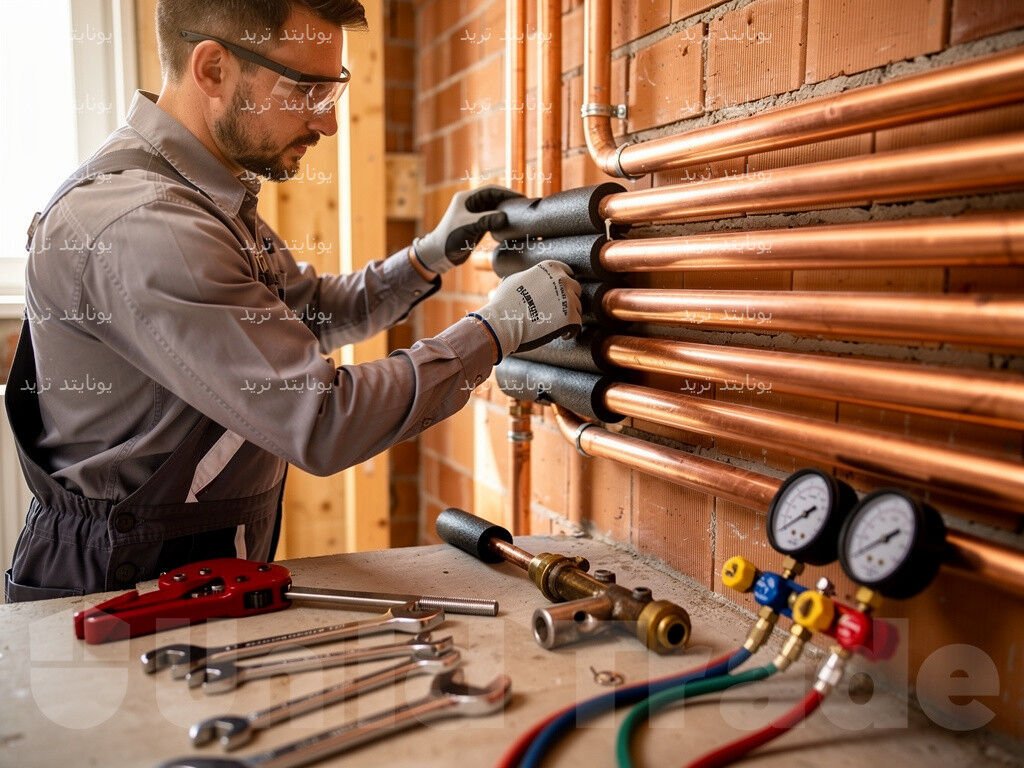
represents Establishing pipes Air conditioning is the basic mechanical pillar to ensure that the cooling units operate at the highest thermal efficiency and to avoid subsequent leakage of the refrigerant into the walls. Therefore, this guide helps you know the precise implementation steps for extending copper pipes, choosing moisture-resistant insulators, and avoiding mistakes that increase electricity consumption. Here you will learn how to evaluate the quality of tracks and stress test them with nitrogen before plastering and final finishing work.
Quick answer
Establishing pipes Conditioning is the procedure of extending insulated copper lines and water drainage within walls or false ceilings before the plastering and finishing stage. This procedure has the advantage of ensuring a safe path for Freon gas that prevents loss of cooling energy and protects the building from moisture and leaks. Therefore, correct installation requires the use of certified copper with the appropriate diameter for each unit and the network is pressurized with nitrogen gas to ensure its integrity.
Planning stages and determining mechanical paths
Pre-engineering planning begins with studying the thermal loads of each room to accurately determine the appropriate air conditioner capacity and required copper diameter. Moreover, choosing the shortest path between the indoor unit and the outdoor unit reduces the possibility of mechanical pressure loss. As a result, the compressor works stably and consumes less electrical current compared to long routes full of sharp bends.
Determine the locations of indoor and outdoor units
The location of the indoor unit must ensure that cool air is distributed evenly without directly hitting people or decorative obstructions. In addition, it is preferable to place the outdoor unit in a well-ventilated and easily accessible place for periodic maintenance purposes. It should be noted that avoiding exposing the outdoor unit to direct sunlight significantly increases the thermal performance coefficient of the compressor.
Calculating the lengths of the cooling network
Extension lengths should not exceed the maximum limits recommended in the air conditioner manufacturer's manual. For example, extending over distances exceeding 15 metres, requires the need to add a precise supplementary Freon charge to compensate for the loss within the circuit. In contrast, large vertical heights require the installation of oil traps every five meters to protect the compressor from mechanical damage.
Selection of copper ores and thermal insulation materials
The choice of copper pipes depends on the purity of the material and the thickness of the metal wall to withstand high gas pressures such as R410A or R32 gas. Therefore, technicians prefer genuine copper that is free from impurities and has good flexibility during bending without being subject to sudden dents. In addition, the surface of the pipe must be inspected to ensure that there are no longitudinal scratches that may expand with constant operating pressure.
Types of foam insulators and their characteristics
The best thermal insulator for cooling pipes is closed-cell flexible foam insulation, commercially known as Armflex insulation. This type prevents moist air from reaching the cold copper surface, thus completely eliminating the phenomenon of condensation and damage to wall paints. In addition, the thickness of the insulation used must not be less than nine millimeters in areas with high humidity to ensure complete insulation.
- Purchase approved copper pipes of the appropriate thickness for gas pressure.
- Use closed-cell rubber thermal insulation for each pipe, completely independently.
- Cover the insulation bundles with high-density white protection tape to protect it from tearing during installation.
- Preparing water drainage pipes with inclinations consistent with the law of gravity.
Steps to implement the installation of air conditioning pipes inside the walls
A process is done Establishing pipes Conditioning by drilling custom ducts inside the wall partitions using an electric missile to ensure straight edges. Therefore, the straight cut maintains the sturdiness of the wall and prevents additional areas of brick from being unnecessarily broken. In addition, the pipes are fixed with padded metal ties that prevent the extensions from moving while construction and finishing workers pass by.
How to bend copper at safe angles
Copper bending requires the use of specialized mechanical benders to avoid narrowing the inner diameter of the refrigerant flow path. A hidden dent inside the wall causes the gas flow to be choked and the electric motor of the outdoor unit to constantly overheat. Therefore, it prevents direct manual bending in tight corners without the presence of supports or flexible internal springs that maintain the roundness of the pipe.
Insulate the suction line and liquid line separately
Separating the suction line pipe and the liquid line pipe with a thermal insulator for each is the most important mechanical parameter. Direct contact between the two pipes leads to heat transfer between them, which reduces the efficiency of direct evaporation and increases electrical energy consumption. As a result, separate insulation ensures that each line maintains its design temperature until it reaches the evaporator and condenser.
Compare specifications of approved copper pipes for air conditioning systems
Copper sizes and thicknesses vary according to the size of the unit and the type of cooling medium used in the system to ensure the highest standards of mechanical safety.
| Air conditioner capacity in tons | Suction line diameter (in.) | Liquid line diameter (in.) | Minimum wall thickness | Pressure tolerance level |
|---|---|---|---|---|
| 1.5 tons (18 thousand units) | 1/2 inch | 1/4 inch | 0.71 mm | Up to 450 psi |
| 2.0 tons (24 thousand units) | 5/8 inch | 1/4 inch | 0.81 mm | Up to 500 psi |
| 2.5 tons (30 thousand units) | 5/8 inch | 3/8 inch | 0.89 mm | Up to 520 psi |
| 3.0 tons (36 thousand units) | 3/4 inch | 3/8 inch | 0.91 mm | Up to 550 psi |
Mesh pressure test with nitrogen before finishing
Dry nitrogen pressure testing is the only proven engineering method for detecting invisible mechanical leaks in copper welds. It is strictly prohibited to test the network using atmospheric air or Freon gas, as this causes the introduction of moisture that damages the expansion valves. Therefore, the network is charged with nitrogen gas to a pressure of 300 to 400 psi according to the technical inspection schedule.
Monitor the pressure gauge indicator
Monitoring the pressure gauge for enough hours detects the smallest leaking holes with extreme accuracy before concrete is poured or concreting is completed. For example, if the pressure indicator remains constant for 24 continuous hours, this confirms the integrity of the entire mechanical system. On the other hand, any unjustified drop in the indicator requires re-examination of the welding points with soap foam to determine the location of the defect and repair it.
This construction equipment is directly integrated with the stage Air conditioning installation According to engineering standards that ensure that the internal and external units are accurately balanced and securely installed. The tight connection of the Freon paths and the discharge of air from the circuit allows achieving ideal heat exchange and avoiding any mechanical vibrations that may affect the system’s efficiency in the long term.
The quality of this structural foundation is not complete without emphasizing the role Air conditioning maintenance Rotating air to check gas pressures and test the integrity of copper welds on a regular basis. Neglecting to clean the filters and monitor the efficiency of the evaporator and compressor may render the efforts of proper expansion useless, and gradually lead to a noticeable decline in cooling power and damage to sensitive mechanical parts.
The quality of the system is not complete without familiarity with periodic inspection methods and noticing defect indicators as soon as they appear, as it allows you Detecting air conditioning malfunctions and methods of maintaining them Household quickly deal with poor cooling or water loss before the damage worsens and affects the efficiency of the compressor. Early intervention to clean the filters and ensure the integrity of the connections also gives you a greater ability to maintain optimal cooling with minimal energy consumption.
Refrigeration and air conditioning networks require the application of precise principles in Installation of copper pipes According to standard thickness standards, taking care of the forming and processing stages to ensure the integrity of the connections and avoid common implementation errors. The lines must also be subjected to stringent pressure tests and final purges to ensure that the system is completely free of any hidden leaks before commissioning is completed.
After completing the extension network, there comes a stage Air conditioning installation By connecting the internal and external units and precisely adjusting the water drainage paths and tendencies. This process requires balancing Freon pressures with mechanical precision and tight electrical connections to ensure the refrigeration cycle runs smoothly and with sustained operational efficiency.
The success of a well-established establishment is not complete without adopting a periodic schedule that ensures... Air conditioning maintenance And check gas pressures regularly, to protect the compressor from premature fatigue resulting from the accumulation of impurities. This continuous technical follow-up contributes to detecting any mechanical damage early and maintaining the cooling rates designed for the building with ideal consumption efficiency.
Maintaining this sound foundation is not complete without adhering to a regular schedule that includes... Air conditioning maintenance Air and check Freon gas pressure regularly. Neglecting to clean the filters and review the integrity of the copper connections inevitably leads to a decline in air flow and fatigue of the compressor, which reduces the lifespan of the system as a whole.
Protect pipe ends from dust
Sealing the ends of the copper lines with tightly welded copper seams prevents dust and fine construction debris from leaking into the inner cavity of the pipe. Cement particles stuck inside the pipes clog the cooling filter and damage the compressor immediately after starting the air conditioner for the first time. Therefore, the nitrogen pressure remains constant until the day the units are installed to ensure that the pipes are not punctured by decorative nails.
The next stage requires executing an operation Air conditioning installation According to strict engineering standards, including balancing the internal and external units and precisely adjusting water drainage paths. A secure fit ensures that mechanical vibrations that may damage copper soldering points are avoided, maintaining refrigerant pressure and extending compressor life.
Establishing a condensation water drainage network and electrical connections
The water drainage network requires the extension of rigid plastic pipes while maintaining a positive slope of at least 1% towards the external drain. This regular tilt prevents water stagnation and the growth of fungi and bacteria that cause unpleasant odors inside the air-conditioned room. It should be noted that it is necessary to provide a water trap at the end of the line to prevent the return of unpleasant odors from the public sewage network.
- Use plastic drainpipes with a diameter of at least three-quarters of an inch to ensure a rapid flow of water.
- Insulating drainage pipes passing through suspended ceilings to avoid the formation of external drops of condensation on them.
- Extending control and signal cables inside plastic hoses separate from the main electrical supply cable.
- Choose the size of the electrical wire based on the maximum load of the compressor to ensure that the wires do not get hot during operation.
Common mistakes that lead to damage to air conditioning pipes and additional costs
The most common mistake is to use copper tubing that is too thin to save the initial setup cost at the expense of the device's lifespan. These poor-quality tubes quickly become micro-perforated due to the reaction of the refrigerant and high operating pressures, which costs huge amounts of money to treat. In addition, burying copper welds inside reinforced concrete without insulating protection causes corrosion of the pipe walls due to the chemical influence of moisture.
Neglecting to place external protective hoses around pipe insulation leaves it vulnerable to tearing by iron rods and gypsum board nails. As a result, warm air enters the intake line and condensation water is formed, which over time destroys ceilings and interior paint. Therefore, direct supervision of the installation of air conditioning ducts is considered a preventive investment that protects the building’s assets and saves complex future maintenance costs.
Frequently asked questions
What is the best type of copper to use in foundation?
The best type is copper that is free of impurities and has thicknesses that meet American Society of Engineers specifications, such as Korean, South African, or certified copper. This copper is characterized by its high ability to withstand high gas pressures and its excellent flexibility, which prevents it from cracking when making various geometric bends in construction paths.
When does the installation of air conditioning ducts begin during construction?
Foundation begins immediately after the completion of the walls and before starting the plastering work or carrying out the final plumbing and electrical installations. This timing ensures that the runs are opened without damaging other finishes, and also allows the network to be pressure tested with nitrogen for a sufficient period before concealing the conduits behind wall and ceiling layers.
Should the suction pipe and liquid pipe be insulated together in one insulator?
It is not permissible to place the two pipes inside one insulator, because this allows unwanted heat exchange between the relatively hot liquid line and the cold gas line returning to the condenser. Each pipe must be fully insulated with a thickness of at least nine millimeters to ensure the efficiency of the design refrigeration cycle is maintained and electricity consumption is reduced.
How do I make sure there is no leakage after establishment?
Verification of leakage is achieved by charging the plumbing system with dry nitrogen gas at a pressure of 350 psi with a pressure gauge installed. Leave this meter connected for 24 to 48 hours straight; If the indicator remains stable without any decrease, the system is completely free of any leakage.
What is the difference between insulated and non-insulated air conditioning drain ducts?
Insulated drainage pipes prevent the formation of dew drops on their outer surface when very cold waste water flows through them over suspended gypsum ceilings. On the other hand, uninsulated pipes in wet places cause water droplets to condense on the ceiling, mold spots to appear, and damage to paintwork and interior decoration over time.
Where should the air conditioner water drain outlet be installed?
The drain outlet must be installed at an approved water drainage point connected to the rainwater network or designated building gutters rather than randomly dumped into the street. In addition, it must be avoided connecting it directly to the manholes without installing a water siphon to prevent the reflux of gases and unpleasant odors into the refrigerated room.
Compliance with all standards for establishing air conditioning ducts ensures that your home is protected from moisture and gas leakage problems while giving the cooling devices a longer operational life. Start now by inspecting the pipe routes and request a nitrogen pressure test from the specialized technician before approving the final finish to ensure peace of mind and excellent thermal performance.
















Community dialogue
0 comments