
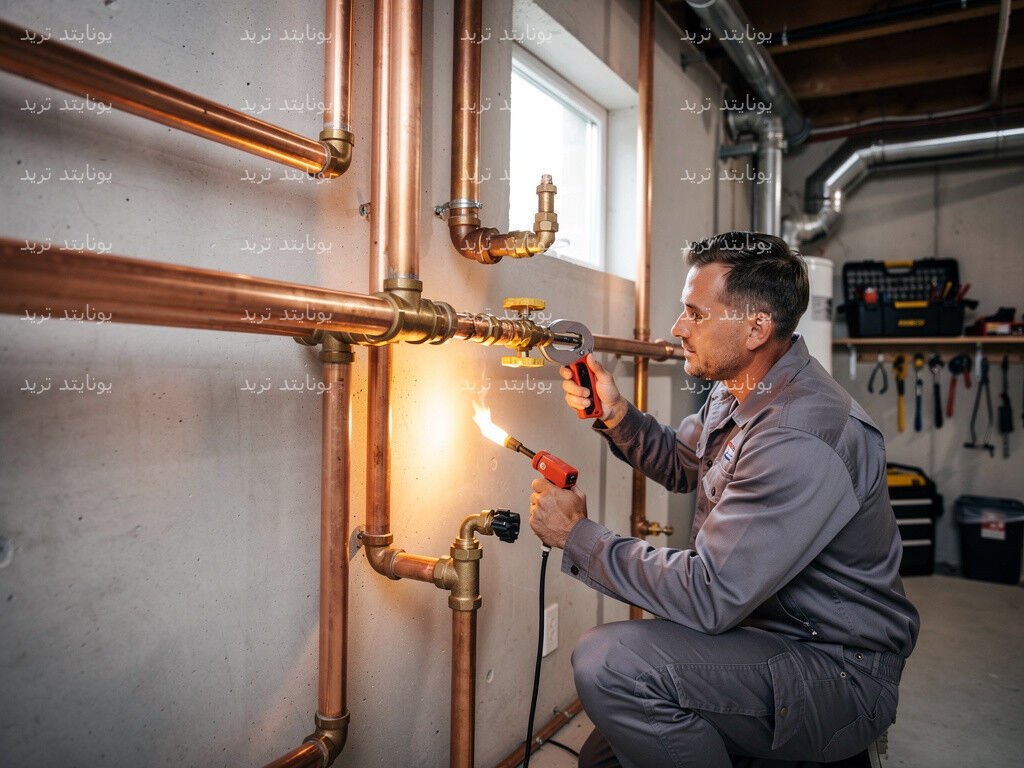
represents Installation of copper pipes The basic foundation for ensuring that cooling, air conditioning and plumbing networks operate with operational efficiency that lasts for decades without sudden malfunctions. This work requires a precise understanding of the properties of the metal and its high ability to withstand high pressures and temperatures, in addition to proficient manual skills in cutting, shaping and joining. This practical guide provides practical instructions and clear steps that enable technicians and homeowners to implement extension paths with the highest internationally followed safety standards.
Quick answer
Copper piping is an engineering process that involves cutting, shaping and welding copper alloy tubes for conveying refrigerants or water at specified operating pressures. The correct procedure is to thoroughly clean the pipe ends, apply calculated temperatures during silver soldering, followed by a mesh pressure test with dry nitrogen gas to prevent any future leaks.
What are the basic tools used in laying and preparing pipes?
Preparing the proper tools is the first step to ensuring a sound workflow free of geometric defects and metal distortions. The system requires specialized devices to cut, bend and expand the metal without affecting its internal diameter or weakening the thickness of the walls.
- Circular pipe cutter to ensure an even cut at a perfect right angle.
- Internal and external metal removal tool to facilitate fluid flow.
- Radial mechanical pipe bender to prevent kinking or kinking of the pipe.
- Copper expansion and flanging kit for preparing mechanical and soldering connection points.
- Oxy-acetylene blowtorch or map gas with soldering rods containing a suitable silver content.
Furthermore, it is recommended to rely on precise measuring tools such as a metric tape measure and an angle finder to ensure straight lines, reducing the possibility of subsequent mechanical vibrations.
How to choose the right type of copper pipe for your project?
The choice of copper pipe depends on the operating pressure, the nature of the fluid passing through it, and the environment surrounding the installation. Pipes are globally classified according to wall thickness into varying grades suitable for domestic, commercial and industrial applications.
For example, refrigeration and air conditioning lines require higher thicknesses to withstand the higher pressures of modern refrigerants than drinking water feed networks. The following table shows the fundamental differences between common categories to facilitate appropriate decision making:
| Engineering category | Metal wall thickness | Recommended field use | Operating pressure tolerance level |
|---|---|---|---|
| Type K (code green) | Extremely thick | Ground burial and very high pressure networks | Very high (up to 700 psi) |
| Type L (code blue) | Medium thickness | Air conditioning, refrigeration and internal plumbing installations | Medium to high (up to 500 psi) |
| Type M (code red) | Thin wall | Home supply and central heating networks | Low to medium (up to 300 psi) |
| Type ACR | Medium and internally processed | Refrigeration and air conditioning lines only (dehumidified) | High and compatible with cooling media standards |
Therefore, choosing the appropriate class provides proactive protection against premature corrosion or explosion due to sudden pressure surges, especially in high-load commercial applications.
Step-by-step installation and configuration stages
The executive path of the pipeline network passes through five sequential stages that ensure flow safety and no waste of thermal energy. Negligence at any stage leads to complex operational problems that are difficult to remedy after closing the walls or burying the lines.
flowchart TD A["القص الميكانيكي وإزالة الرايش"] --> B["الثني وتعديل المسارات بدقة"] B --> C["التجميع واللحام بتدفق النيتروجين"] C --> D["العزل الحراري بأكمام الإيلاستومر"] D --> E["الفحص بالضغط واختبار التسريب"]The process begins with precise cutting of the pipes and then thoroughly cleaning the edges to avoid hydraulic disturbances within the line. After that, the pipes are bent to a suitable radius that maintains the flow cross section without any lateral bending.
Technical guidance for steel welding works
Solid welding at temperatures exceeding 600°C is the true guarantee of durability of connections subject to vibration. It should be noted that using a gentle flow of dry nitrogen gas into the tube during heating prevents the formation of a black oxide layer that may later clog the expansion valves.
What are the golden rules for successfully installing copper pipes?
Achieving a solid extension system requires the application of strict preventive controls during all stages of field work. Plumbing and refrigeration experts confirm that adhering to proper installation distances prevents sagging and mechanical stress in the long term.
- Install the rubber supports and clamps at close distances not exceeding 1.5 meters to prevent the lines from oscillating.
- Complete separation of copper and other metals such as galvanized iron to avoid electrochemical galvanic corrosion.
- Leave sufficient expansion margins by creating geometric expansion arcs on long paths subject to thermal changes.
- Completely insulate the cold intake line to prevent moisture condensation and damage to adjacent buildings.
As a result, these preventive measures ensure system stability and reduce noise caused by liquids and gases flowing at high speeds inside the building.
These precision pipe fittings integrate directly with the stage Air conditioning installation Air, as the stability of the entire system depends on the tight installation of the indoor and outdoor units and the adjustment of the refrigerant flow paths. This procedure requires careful balancing to avoid any operational vibrations that could damage the connection points or reduce the overall cooling efficiency.
Methods of thermal insulation and protecting lines from condensation
Effective thermal insulation is a protective shield that conserves energy and prevents destructive moisture condensation on walls and ceilings. Insulation sleeves made of high density closed cell flexible elastomer are used to ensure tight thermal insulation.
This efficiency practically starts from one stage Establishing pipes Laying according to studied geometric paths that ensure smooth flow and reduce mechanical stress points on the network. This proper establishment requires choosing diameters that are compatible with the system’s loads, and installing the supports at calculated distances to prevent any vibrations that may lead to future leaks.
The efficiency of the cooling system does not depend only on the quality of the initial installations, but its sustainability depends on the implementation of procedures Regular air conditioning maintenance Protects copper lines from leakage and impurity buildup. This continuous check ensures that optimum refrigerant flow rates are maintained and sudden drops in compressor performance are avoided.
This mastery in extending the network is integrated with following steps Accurate air conditioning installation High engineering includes installing the internal and external units and adjusting the connections tightly to avoid sudden malfunctions. This integrated approach ensures maximum cooling efficiency and reduces energy consumption, thus preserving the lifespan of the entire air conditioning system.
This efficiency practically starts from one stage Establishing pipes Extension according to carefully studied paths that take into account the required inclinations and bends and avoid areas of thermal and mechanical stress. This advance planning ensures that lines are protected from future leaks and facilitates installation and insulation operations with the highest standards of engineering safety.
The efficiency of the cooling system does not depend only on the quality of the initial installations, but its sustainability depends on the implementation of procedures Regular air conditioning maintenance Protects copper lines from leakage and impurity buildup. This continuous check ensures that optimum refrigerant pressure ratios are maintained and mechanical stress on the compressor is avoided.
The quality of establishment is not complete without commitment to periodic programs dedicated to conducting Regular air conditioning maintenance Ensures the safety of cooling lines from leakage and accumulation of impurities. This continuous monitoring contributes to the early detection of any decline in pressures and the treatment of vibrations that may affect the copper connections over time, which maintains the efficiency of the refrigerant flow and prolongs the operational life of the system as a whole.
These precise equipments are integrated with the stage of installing the internal and external units, adjusting the water drainage paths, and connecting the power lines. Air conditioning installation According to sound technical standards, it ensures ideal air distribution and avoids refrigerant gas leakage. Adhering to the recommended distances between units also contributes to reducing the voltage on the compressor and maximizing the efficiency of energy consumption.
This efficiency practically starts from the field planning stage, as it requires one step Establishing cooling pipes Plumbing has carefully studied engineering paths to avoid sharp bends that impede the flow of liquids and gases. This procedure also includes tightly fixing the support points and thermal insulators inside the walls and floors before moving on to the welding and final operation stages, which protects the entire system from the risks of vibration and premature corrosion.
These precise equipments are integrated with the stage of installing the internal and external units, adjusting the water drainage paths, and connecting the electrical control circuits with great care. Requires steps to complete Efficient air conditioning installation Consider tight thermal insulation of the gas lines and empty the air from the circuit completely to avoid any decrease in cooling capacity or leakage of the Freon compound.
In contrast, the insulation material should not be pulled or stretched forcefully during insertion because this reduces its effective thickness and creates weak thermal bridges. Furthermore, all joints and joints must be sealed with specialized glue and UV-resistant adhesive on exterior parts exposed to the sun.
Inspection and verification procedures for delivery quality
Compression testing is the critical measure that confirms the success of the laying process and the integrity of all welding and assembly points. The network is pressurized with moisture-free nitrogen gas to a pressure equivalent to 1.5 times the design operating pressure for a period of not less than 24 continuous hours.
In addition, leak detection foam is used on all bonding areas immediately after gas is introduced to ensure there are no micropores. The stability of the pressure gauge reading throughout the test period, taking into account the slight changes resulting from the air temperature, gives the green light to start discharging the air and charging the system.
Frequently asked questions
What is the best way to connect copper pipes without using solder?
Hydraulic piston joints and flier bonding technology are considered the best alternatives to traditional welding. These methods provide superior mechanical sealing without the need to use open flames in sensitive or flammable locations.
Can copper pipes be mixed with iron pipes in one network?
Yes, but on the condition that dielectric insulating connections are used to separate the two metals to prevent electrochemical corrosion. Direct contact between copper and iron in the presence of moisture leads to rapid corrosion of the iron and damage to the mesh.
How do I avoid clogging of pipes during the bending process?
Mechanical pipe benders with rollers that exactly match the outer diameter of the pipe should be used, avoiding random manual bending. The use of internal bending springs for thin tubes ensures that the circularity of the entire internal section is maintained.
What is the appropriate gas for copper mesh leakage testing?
Dry nitrogen is the standard and only technically recommended gas for pressure testing and purging of copper networks. Nitrogen prevents moisture or oxygen from entering the pipes, unlike regular compressed air, which causes oxidation and damage to the oils.
Why does a black layer appear inside copper pipes after welding?
This layer is formed due to the oxidation of copper due to the interaction of the heated metal with oxygen present in the surrounding atmospheric air. To avoid this problem, inert nitrogen gas must be pumped at a low flow rate into the tube throughout the heating period.
How many years do copper pipes last after being properly installed?
The lifespan of professionally installed copper pipes ranges from 50 to 70 years under normal conditions. The quality of the installation, the neutral environment for water, and the system’s freedom from mechanical stress contribute to achieving the maximum possible operational life.
Mastering the installation of copper pipes is a real investment that increases the efficiency of the infrastructure and prevents costly operational risks. Begin carefully applying these technical steps in your next project to ensure stable, long-lasting performance.
















Community dialogue
0 comments