
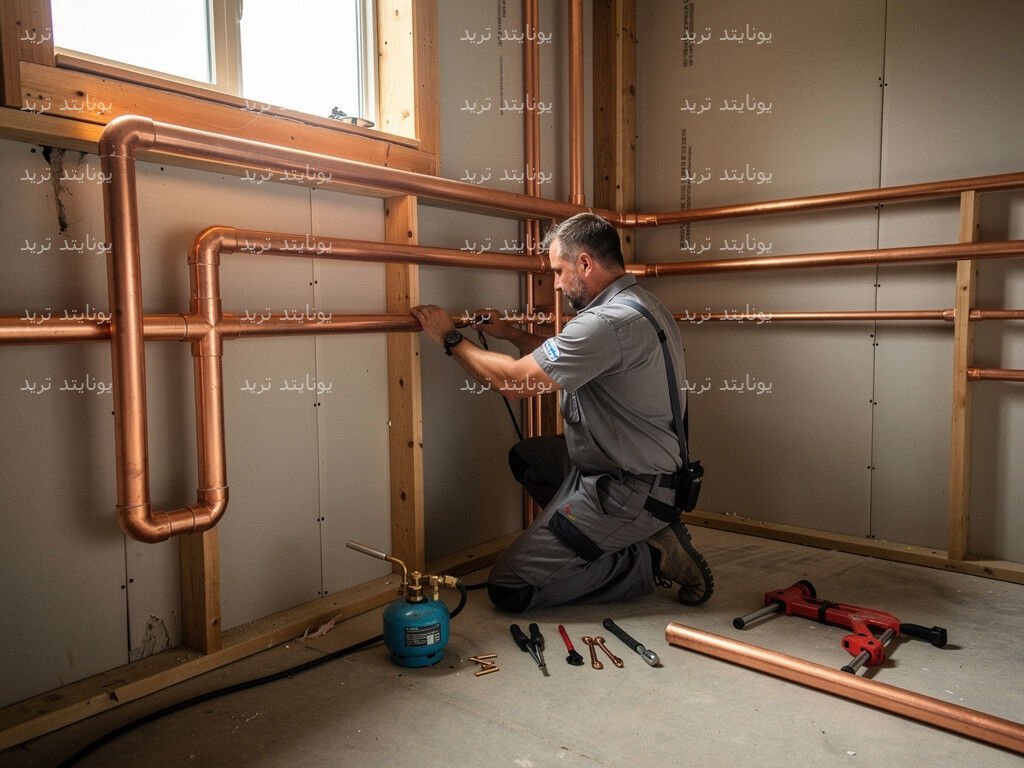
represents Installation of copper pipes An essential foundation for ensuring the efficiency of modern refrigeration, air conditioning and plumbing systems for many years without malfunctions. This guide provides detailed application steps that help technicians and project owners understand the criteria for correct extension and avoid dangerous leaks. Here you will learn about the approved tools, mechanical connection methods, and safety procedures necessary to achieve the highest levels of operational performance.
Quick answer: What are the basic rules for carrying out the work?
Copper piping installation is an engineering process that requires cutting the pipe at a right angle, carefully removing excess metal, and then connecting via silver soldering or mechanical joining under a flow of nitrogen gas. These procedures ensure preventing the formation of internal copper oxide and protecting the system from gas or liquid leakage, followed by a pressure test and air discharge phase to ensure insulation efficiency and flow stability.
The basic tools needed to start installing copper pipes
The process of installing copper pipes requires specialized tools that ensure accuracy and prevent deformation of thin metal walls. Conventional cutting tools are unreliable because they crush the edges of the pipes and impede fluid flow.
Field cutting and cleaning equipment
Rotary pipe cutter: A mechanical tool that provides a flat, 90-degree cut without creating rough edges. In addition, an internal and external deburring tool is used to smooth out the pipe mouth and prevent any internal hydraulic vortices. Non-metallic sanding tape is necessary to clean the outside of the copper to a complete shine before attaching.
Bending and shaping devices
Manual or hydraulic pipe benders are used to make smooth bends at specified angles without breaking the pipe or reducing its internal diameter. Furthermore, reaming tools make it possible to precisely prepare pipe dovetail connections, eliminating the need for additional connecting pieces on long runs.
flowchart TD A["قطع الأنبوب بزاوية 90 درجة"] --> B["تنظيف الحواف وإزالة الرايش"] B --> C["تشكيل الانحناءات وثني المسار"] C --> D["ضخ النيتروجين وتطبيق اللحام"] D --> E["اختبار الضغط والعزل الحراري"]Technical comparison between common copper pipe types
Copper pipes vary in wall thickness and capacity to withstand operating pressures according to international standards. Choosing the right type helps reduce the project cost and ensure the safety of the network against explosion or premature corrosion.
| Standard type | Wall thickness | Maximum operating pressure | Main area of use |
|---|---|---|---|
| Type K (green) | Very thick | Extra high (above 700 psi) | Underground burial and heavy duty industrial applications |
| Type L(Blue) | Medium thickness | Medium to high | Air conditioning and refrigeration networks and hot water lines |
| Type M (red) | Relatively thin | Low to medium | Light indoor domestic water installations |
| Type ACR | Uneven (clean and dry) | High and suitable for Freon | Commercial refrigeration systems and split air conditioning |
Steps to carry out the installation of copper pipes via solid welding
The success of thermal bonding depends on applying balanced temperatures and avoiding internal oxidation of the copper tubes. Therefore, a strict technical sequence must be followed that protects the internal components of devices connected to the network.
- Clean the ends of copper pipes using steel wool to remove layers of oxidation and oily impurities.
- Insert the pipe end into the connection to a depth of no less than the nominal diameter to ensure a solid mechanical bond.
- Passing inert nitrogen gas at low pressure into the pipe during the heating process to prevent the formation of black soot.
- Heat the contact with an oxy-acetylene torch until the brass reaches a soft cherry glow.
- Filling the capillary void with silver soldering alloy without directing the flame towards the soldering wire itself.
- Leave the connection to cool naturally in the air without using sudden water to avoid microscopic cracks.
Mechanical connection techniques without thermal welding
Mechanical compression joints and flame joints are an ideal alternative in locations where the use of open flames is prohibited. These methods provide extremely rapid completion speed while maintaining very high safety standards against leakage.
Flare joint: A technique based on forming a conical flange at a 45 degree angle at the end of the pipe using a special device. Tightening is done by a brass nut that tightly presses the flange onto the corresponding connecting thread. As a result, technicians prefer this option in attaching the internal units of air conditioners for ease of dismantling them later during maintenance work.
In contrast, modern snap links rely on embedded rubber O-rings that are compressed by a special hydraulic piston. The connection adheres to the metal strongly, preventing mechanical movement, and withstands pressures that exceed daily operating requirements with high efficiency.
Installation and insulation requirements to protect copper tracks
Proper pipe routing requires a secure fit that prevents vibrations caused by fluid flow and pressure pumps. It should be noted that neglecting installation causes mechanical stress on the welding points, which leads to the appearance of micro-cracks over time.
Requires implementation of Efficient air conditioning installation High consideration of the precise compatibility between the copper paths and the capacity of the internal and external units to avoid loss of refrigerant pressure. Correct calibration of installation angles and the use of appropriate thermal insulators also contribute to reducing energy consumption and extending the life of the entire device.
- Use rubber-lined mounting jumpers to prevent galvanic corrosion caused by contact of copper with other metals.
- Leave support distances not exceeding 1.5 meters for horizontal paths to avoid bending of pipes under the influence of their own weight.
- Insulate cold intake lines with closed-cell elastomer foam to prevent moisture condensation and building damage.
- Seal the insulation joints with high-quality insulating tape to prevent air leakage to the outer surface of the pipe.
- Providing U-shaped thermal expansion and contraction paths in long lines exposed to wide thermal fluctuations.
Pressure and air discharge testing procedures from the network
Pressure and vacuum testing represents the last line of defense to verify the integrity of the system before actual operation. This procedure helps detect even the smallest manufacturing defects or delivery errors before shipping refrigerants or expensive liquids.
The implementation phase begins with a crucial step that requires planning the paths and choosing the appropriate diameters before the final installation, as the success of the entire extension network depends on the mastery of Establishing pipes Refrigeration and plumbing with high engineering precision. This ensures that the lines are protected from sudden bends and facilitates future maintenance without damaging the building's structural structure.
No elaborate piping installation is complete without a plan that includes... Air conditioning maintenance Air to ensure stable gas pressures and the safety of cooling lines from blockage. Early detection of the slightest vibration or filtration protects the entire system from sudden malfunctions and maintains maximum cooling efficiency.
Implementing plumbing and cooling installations requires extreme skill based on mastery Professional installation of copper pipes According to precise engineering standards to control high pressures. Adherence to proper welding techniques and tight connections helps protect the network from future damage while ensuring that no sudden leaks occur that may threaten the integrity of the system.
These procedures begin with a phase Establishing pipes Cooling and plumbing are carried out with utmost precision, taking into account the ideal paths within the walls and securing the fixing points tightly to avoid any future vibrations. This also requires protecting the extension lines with appropriate thermal insulators before plastering and final sealing operations are completed.
The efficiency of cooling does not depend only on the quality of the initial installation, but its sustainability also depends on the implementation of procedures Regular air conditioning maintenance It maintains stable refrigerant pressure and clean heat exchange paths. This regular inspection helps in the early detection of even the smallest cracks or mechanical leaks, ensuring maximum operational performance and reduced energy consumption.
The success of perfect extensions is not complete without following a regular schedule of services Air conditioning maintenance Air, as regular checks contribute to detecting any early leakage of Freon gas and treating blockages in filters and condenser. This preventive measure maintains the efficiency of the compressor and extends the life of the entire cooling system without wasting energy consumption.
The quality of copper extensions is not complete without implementing several steps Professional air conditioning installation Care must be taken to adjust the air paths and insulate the connections tightly. This ensures that the compressor is protected from overstress and that the cooling efficiency in the targeted spaces is maximized with the highest possible operating performance.
The accuracy of the work begins with the implementation of a stage Establishing cooling pipes According to approved engineering plans to ensure smooth paths that reduce resistance to the flow of the refrigerant. This procedure requires selecting appropriate mounting points and using diameters that match the capacity of the devices to avoid future pressure drops. Proper construction also contributes to protecting the lines from mechanical stresses and facilitating subsequent maintenance operations.
Requires implementation of Efficient air conditioning installation High consideration of the precise compatibility between the pipe paths and the capacity of the internal and external units to ensure the smooth flow of the refrigerant. Adhering to the weight of the pressures and insulating the connections perfectly leads to avoiding energy loss and preserving the lifespan of the entire system.
The network is gradually pressurized with dry nitrogen gas until it reaches the design test pressure, then the system is left for 24 hours to monitor the pressure gauge indicator. Furthermore, each connection is inspected using specialized soap suds to ensure there are no micro-leak bubbles.
After successful pressure testing, a vacuum pump is connected to extract air and moisture from within the lines to a level of 500 microns or less. In other words, this step ensures the purity of the internal circuit and protects synthetic oils from chemical degradation and premature wear.
Frequently asked questions about copper extensions and networks
What is the difference between rigid and flexible copper pipes?
Rigid pipes come in straight lengths, withstand higher pressures and are used in long structured runs. In contrast, flexible tubing is available in coils that are easy to form by hand without many joints, making them ideal for tight spaces and direct feeding.
How to avoid oxidation of pipes during the welding process?
Oxidation can be avoided by pumping inert nitrogen gas at very low pressure through the pipelines during welding. Nitrogen completely expels oxygen from the cavity, preventing the formation of harmful black carbon scales on valves and engines.
Can copper pipes be installed for natural gas lines?
Yes, it is permitted to use copper pipes to transport natural gas provided that the locally approved types K or L are used. High-temperature silver soldering or specialized mechanical connections must also be used to prevent any possibility of gas leakage through the joints.
Why should copper air conditioning ducts be insulated separately?
Separate insulation for each line prevents heat transfer between the warm liquid line and the cold gas line, increasing the efficiency of the overall refrigeration cycle. The insulation also protects the external surroundings from the accumulation of dew drops that lead to corrosion of the walls and the appearance of mold.
What are the reasons for poor refrigerant flow after installation?
Poor flow is often caused by the pipe becoming choked due to it being bent without a suitable bending tool, or solder build-up within the inside diameter. In addition, failure to remove the bits after cutting may result in the deposit of impurities that impede the fluid movement of the fluid.
When should the copper pipe be replaced instead of repaired?
The pipe must be replaced when extensive external chemical corrosion is observed, or there are longitudinal cracks resulting from freezing of liquids, or when the pipe wall is dented by more than 20% of its original diameter.
Mastering the installation of copper pipes represents a real investment that increases the reliability of engineering facilities and saves emergency maintenance costs resulting from recurring leaks. Always make sure to apply professional safety standards and use the appropriate tools for each stage to ensure a durable network that will last for decades.
















Community dialogue
0 comments