
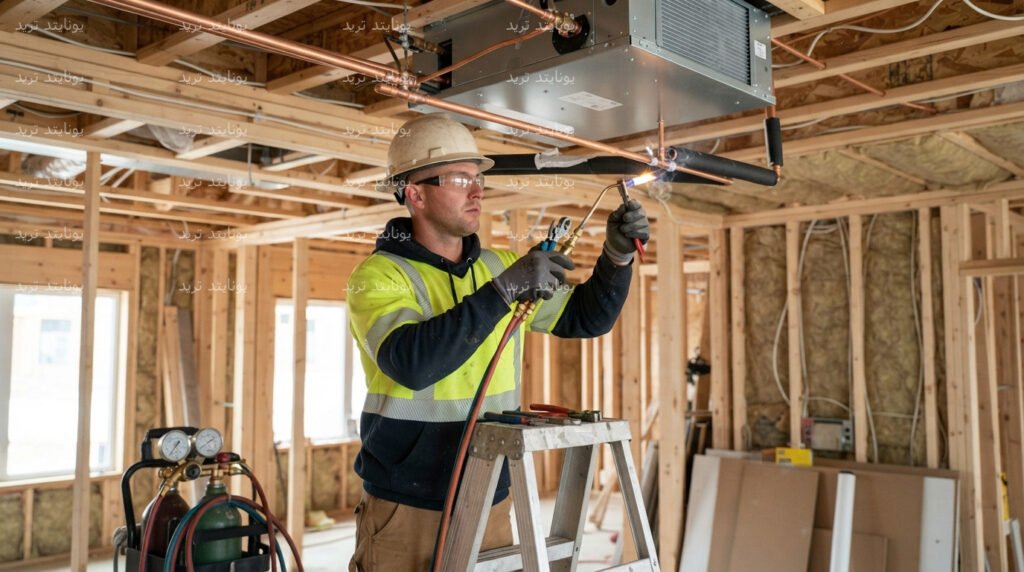
practical Air conditioning duct extension It is the most important step in establishing cooling systems, as the performance of the device directly depends on the quality of installation of copper tracks. Choosing the appropriate diameters and properly insulating the pipes prevents condensation and ensures the smooth flow of Freon gas into the unit. This article covers the precise engineering standards that ensure your home's cooling is sustainable and avoid common malfunctions associated with faulty foundation.
Technical specifications for choosing the diameters of cooling pipes
The diameter of the copper pipes must be chosen based on the cooling capacity of the air conditioner in BTU; The higher the compressor capacity, the larger diameters are required to ensure optimal operating pressure. The use of incompatible diameters inevitably leads to a decline in cooling efficiency and an increase in the temperature of the compressor.
❓ The effect of air conditioner power on the size of pipes
1.5 HP air conditioners typically require 1/4 inch diameter copper tubing for the liquid line and 3/8 inch diameter copper pipe for the gas line. In contrast, high power air conditioners such as 3 HP need diameters of 3/8 inch for liquid and 5/8 inch for gas to ensure gas flow without thermal obstructions.
Safe distances and their effect on compressor life
The length of the copper tracks must adhere to a geometric range between 3 and 15 meters to achieve an optimal balance between compression and cooling. Exceeding or reducing these limits excessively places an additional load on the device's motor parts, reducing their service life over time.
- Short tracks (less than 3 metres): It causes high back pressure, which leads to damage to the valves inside the compressor.
- Long tracks (more than 20 metres): It leads to a significant decrease in cooling capacity and additional energy consumption.
Insulation and protection techniques inside walls
establishment Air conditioning duct extension It is required to use a thermal insulator with a thickness of no less than 9 mm, such as the “Armoflex” type, to prevent the phenomenon of water condensation. Protecting these pipes inside 2-inch diameter plastic pipes inside the walls prevents them from being damaged by concrete loads or structural cracks later.
| Technical standard | Required specifications | Technical evaluation |
|---|---|---|
| Thermal insulation (Armoflex) | 9mm minimum | ★ 10/10 |
| Path protection | 2 inch plastic pipe | 9.5/10 – Editor's Choice |
| Leak test | Nitrogen pressure | ★ 10/10 |
| Air discharge | Vacuum pump | ★ 10/10 |
The diagram above shows the correct path to carrying out installations, where the work begins with planning and ends with pressure tests to ensure there are no leaks.
Technical errors reduce performance efficiency
Unprofessional practices such as sharp bending of copper pipes lead to suffocation of the flow of refrigerant, which reduces the cooling capacity of the air conditioner. Loose welding is a major cause of Freon gas leakage, forcing the user to repeatedly recharge and unjustifiably increasing electricity consumption.
❓ Advantages and disadvantages
Features:
- Achieving fast and stable cooling inside rooms.
- Saving electricity consumption when properly installed.
- Extending the life of the compressor.
Disadvantages:
The next stage requires initiation Air conditioning installation According to precise technical principles, which include fixing the internal and external units tightly and taking into account the recommended ventilation distances. Controlling water drainage tendencies and tightening the cooling lines also contribute to avoiding any leakage, which increases the cooling efficiency and extends the operational life of the system.
requires Installing air conditioning ducts Extreme precision in choosing the paths and securing them inside the walls to ensure their protection from external factors and construction pressures. Adherence to technical standards at this stage ensures the sustainability of cooling efficiency and prevents any future leaks that may affect the integrity of the building’s structural structure.
The next stage requires implementation Air conditioning installation According to strict technical standards, including installing the internal and external units with extreme precision and adjusting their balances. It is also necessary to tighten the refrigerant lines and completely evacuate the air from the circuit before operation, to avoid refrigerant leakage and protect the compressor from premature damage.
Maintaining the efficiency of these extensions is not complete without adhering to a periodic schedule that includes: Air conditioning maintenance Air and check cooling levels carefully. Early detection of any clogged filters or leaks in connections prevents compressor fatigue and extends the life of the entire system.
In order to ensure that the system continues to operate at the highest efficiency after the establishment is complete, the importance of conducting this procedure is highlighted Regular air conditioning maintenance For early detection of any possible leakage in cooling circuits or blockages in filters and drains. This preventive step not only maintains the purity of the air inside the rooms, but also extends the life of the air compressor and significantly reduces electrical energy consumption.
It requires a stage Installing air conditioning ducts Careful planning of the paths inside the walls and ceilings, taking into account the inclination of the pipes to ensure water drainage and prevent future leaks. Adherence to technical standards in extending and installing this network gives the system high operational efficiency and protects the place’s infrastructure from any damage resulting from condensation.
The efficiency of the cooling system does not stop at the installation stage only, but it remains a procedure Regular air conditioning maintenance The decisive factor in maintaining the integrity of copper pipes and avoiding sudden Freon leaks. Continuous inspection of unit components, cleaning of filters, and checking of gas pressure contribute to extending the life of the device and reducing energy consumption to a minimum.
It requires a stage Installing air conditioning ducts Careful planning of the paths inside the walls and ceilings before finishing work, taking into account engineering tendencies that ensure efficient drainage of condensation water. The use of copper materials that conform to international specifications and their complete thermal insulation also ensures that the systems are protected from leakage and ensure long-term cooling efficiency.
- Higher cost when using high-quality materials.
- Difficulty in maintenance if the foundation is built inside unprotected concrete.
❓ Editor's judgment and final rating
We give Professional Incorporation a rating of 9.4/10. This option is well suited for modern buildings seeking sustainable performance; The end result is a cooling system that operates at peak efficiency for many years without the need for frequent maintenance.
It requires an operation Professional air conditioning installation Extreme precision in installing the holders and directing the extension paths to avoid any sharp bends that may hinder the cooling cycle. Periodic checking of gas pressure after final connection is a crucial step to ensure cooling efficiency and sustain the unit’s operational life.
Frequently asked questions
❓ What is the effect of short runs on conditioning?
Paths less than 3 meters cause high, direct pressure on the compressor, damaging internal valves and reducing the life of the device.
❓ Should copper pipes be insulated?
Yes, 9 mm thick thermal insulation is very necessary to prevent water condensation and keep the gas passing through the pipes cool.
❓ Why is it recommended to use a vacuum pump?
Vacuuming the cycle of air and moisture using a vacuum pump is an essential technical procedure to prevent moisture from mixing with the oil, which protects the compressor from damage.
❓ How do I choose the appropriate pipe diameters?
The diameter depends on the capacity of the air conditioner; 1.5 HP air conditioners require 1/4 and 3/8 inches, while 3 HP air conditioners require larger diameters such as 3/8 and 5/8 inches.
❓ Do extensions inside walls affect performance?
Extensions inside walls are completely safe provided that they are placed inside protective plastic pipes (2 inches) and that sharp bends are avoided during installation.
Always ensure the quality of implementation Air conditioning duct extension Before sealing walls or pouring concrete to ensure there are no leaks. Using specialized technicians avoids costly future repairs and ensures high and sustainable cooling efficiency.
















Community dialogue
0 comments