
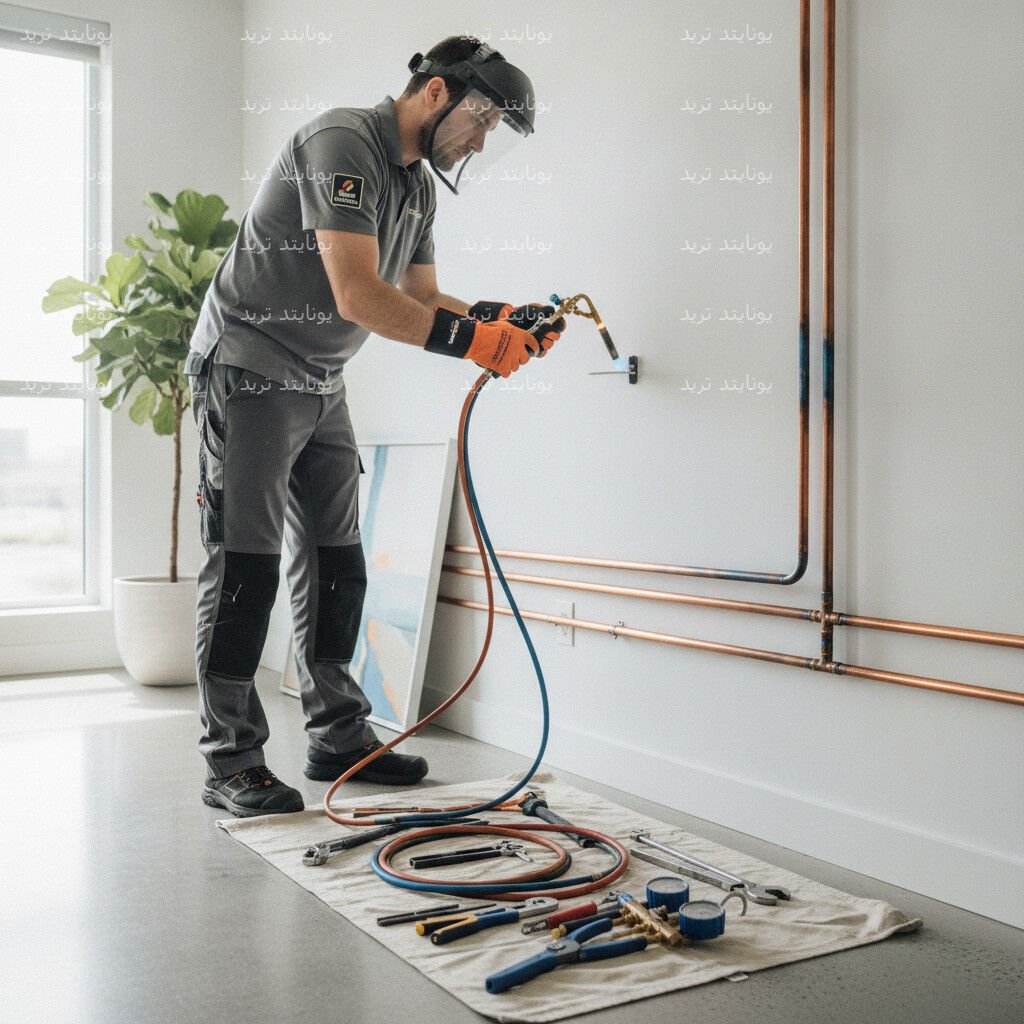
practical Air conditioning duct extension It is the cornerstone of ensuring that the cooling system operates at high efficiency and preventing costly future breakdowns. Many people forget that the accuracy of the installation in copper piping directly affects the life of the compressor and the distribution of refrigerant within the unit. In this article, we reveal the true technical standards for extensions and how to avoid common mistakes made by non-professional technicians to ensure the best performance for your home.
Why is the quality of copper pipes a technical necessity?
The safety of the cooling system depends entirely on its quality and durability Air conditioning duct extension used on the site. The use of copper tubing less than 0.7 mm thick in domestic systems often results in dents during bending, which reduces gas flow and puts undue stress on the compressor.
❓ The importance of thermal insulation of pipes
Each pipe must be individually insulated with a material Armaflex High quality to prevent thermal condensation. Untreated condensation leads to moisture accumulating and seeping into the walls, causing stains and structural damage to the building’s interior design in the long term.
Approved standards for safe extension paths
International standards require that the length of the horizontal extensions between the indoor and outdoor unit not exceed 20 metres. Exceeding this distance results in a loss of pressure, which requires careful calculations to add Additional cooling charge (Refrigerant Charge) to ensure system balance.
❓ Avoid sharp bends in the paths
It is always recommended to use pipe benders instead of manual bending to avoid any narrowing of the pipe diameter. Errors in bending angles increase resistance to coolant flow, which negatively affects the overall cooling efficiency of the device.
Secrets of professional welding of copper pipes
The career secret in 2024 is to pass Nitrogen gas Inside pipes during the brazing process. This technology prevents the formation of internal oxidation resulting from the combustion of oxygen, which is the oxidation that often causes blockage of the expansion valve and leads to damage to the compressor.
The above diagram shows the correct technical sequence to ensure professional pipe installation, as nitrogen testing is an insurmountable step.
Comparison table: safety and performance standards
| Technical standard | Commercial incorporation (🏆 Editor's choice) | Traditional incorporation |
|---|---|---|
| Copper thickness (0.7mm+) | ✓ | ✕ |
| Use of nitrogen gas | ✓ 9.8/10 | ✗ 4.5/10 |
| Double Armflex insulation | ✓ | ✓ |
| Pressure test (400 PSI) | ✓ | ✕ |
The table shows the differences between professional performance and random establishment. Certified commercial establishment gives you high reliability and savings on air conditioning maintenance later.
Pressure tests and leak detection
Before operating the system, the piping must be pressure tested using nitrogen gas at a pressure of 400 to 500 PSI for a full 24 hours. This procedure is the only way to ensure the integrity of the welds and that there are no microscopic leaks that may appear after filling with gas.
❓ Advantages and disadvantages
Features:
These technical standards are not complete without completion Professional air conditioning installation Ensures that the indoor and outdoor units are installed in precise geometric alignment that protects the compressor from vibrations and prevents Freon leakage. Taking into account the recommended distances and ventilation of the outdoor unit contributes directly to increasing cooling efficiency and reducing energy consumption for many years.
- Significantly extend the life of your air conditioner.
- Preventing financially costly refrigerant gas leaks.
- Maintaining the efficiency of the device’s electricity consumption.
Disadvantages:
The first stages of the project require extreme precision in determining paths and isolating lines in a correct engineering manner, as... Establishing pipes High-quality cooling ensures the safety of the Freon cycle and prevents any gas leakage or suffocation in the long term. This elaborate procedure also facilitates subsequent maintenance work and protects the walls from the accumulation of moisture or harmful condensation.
come Air conditioning maintenance As a necessary preventive step to maintain optimal performance of devices and avoid deterioration of their efficiency over time due to dust accumulation or gas leakage. Adhering to a regular inspection schedule ensures the integrity of internal components and extends the life of the system, significantly reducing the possibility of sudden and costly failures.
Process dependent Installing air conditioning ducts Choose smooth paths that avoid sharp bends that may impede the flow of Freon gas and cause additional pressure on the system. The tight thermal insulation of the pipes also ensures that the required temperatures are maintained and prevents moisture condensation that may lead to damage to the walls or a decrease in cooling efficiency in the long term.
Once the proper establishment phase is completed, responsibility shifts towards... Air conditioning maintenance Periodically and regularly to maintain that efficiency and ensure continuity of performance. Adhering to a careful technical inspection schedule will help detect any leaks or dust accumulations in their infancy, which will avoid sudden system downtime and significantly extend its lifespan.
Once the foundation phase is completed, it becomes important Air conditioning maintenance Periodically to maintain the integrity of the connections and ensure that Freon gas does not leak. Continuous preventive inspection of mechanical and electrical parts prevents the accumulation of dust inside the pipes, which extends the life of the device and ensures stable performance throughout seasons of use.
These foundational preparations are not complete without following the principles Air conditioning installation Correct, as this stage requires installing the internal and external units in precise alignment and connecting the circuits tightly to prevent any leakage. This engineering integration ensures the system runs as quietly as possible and saves energy consumption in the long run.
Phase dependent Installing air conditioning ducts Choosing precise diameters that match the cooling capacity of the device, while fully adhering to thermally insulating the paths to prevent condensation and maintain stable gas pressure. Performing this step skillfully ensures avoiding Freon leaks that may exhaust the compressor and lead to poor overall system performance.
The quality of these extensions is not complete unless careful engineering steps are followed Air conditioning installation With its various parts, to ensure that loads are balanced and that the units are securely fixed. The tight connection between the copper network and the internal and external units prevents Freon leakage and ensures air flow with the highest possible operational efficiency.
- High initial cost of materials and skilled labor.
- The need for technicians with specialized measuring devices.
❓ Editor's judgment and final rating
Overall rating is 9.6/10. We strongly recommend investing in high-quality foundation materials and experienced labor, because the cost of subsequent repair exceeds many times the immediate savings in materials. Air conditioning duct extension
Frequently asked questions
❓ What is the maximum distance for extending air conditioning ducts?
The safe distance ranges between 15 to 20 metres, and any increase requires careful calculations to add an additional refrigerant charge to ensure the compressor works efficiently.
❓ Why should nitrogen gas be used during welding?
Nitrogen is used to prevent internal oxidation caused by heat, which causes blockage of the expansion valve and subsequently causes damage to the entire refrigeration cycle.
❓ Does Armoflex insulation affect cooling quality?
Of course, insulation prevents condensation that causes water to leak into the walls, and it also keeps the gas cool inside the pipes until it reaches the indoor unit.
❓ How can we ensure that there are no leaks in the pipes?
This is done by performing a pressure test with nitrogen at a pressure of 400-500 PSI for 24 hours and monitoring the pressure indicator to ensure it is completely stable.
❓ What is the best type of copper pipes for air conditioning extension?
Copper pipes with a thickness of no less than 0.7 mm must be chosen, manufactured according to international standards to withstand high gas pressures without cracks.
❓ Can pipes be extended in a curved way?
This is possible, but specialized bending tools must be used to avoid reducing the pipe diameter, as narrowing the diameter will stress the compressor and reduce system efficiency.
Always remember that a good foundation is a long-term investment that will avoid annoying breakdowns and expensive maintenance costs. Make sure to hire technicians who adhere to the mentioned pressure and welding standards to ensure sustainable performance for your home.
















Community dialogue
0 comments