
Criteria for classifying pipe thicknesses according to standard specifications
The process of installing copper pipes is subject to precise engineering classifications that determine the internal wall’s ability to withstand mechanical pressures. These classes are distributed globally according to standard codes that explain the optimal use of each building or industrial style.
| Standard category | Inner wall thickness | Identification color | Recommended range of use |
|---|---|---|---|
| Type K | Highest wall thickness | Green | Direct underground burial, main feed lines, and heavy services exposed to high pressures |
| L type | Medium wall thickness | Blue | Internal hot and cold water installations and domestic and commercial air conditioning networks |
| Type M | Thin wall thickening | Red | Central heating with low pressure systems and light residential works free from operational stress |
| Type DWV | Very low thickness | Yellow | Drainage and ventilation networks that are completely free of high hydraulic pressures |
Procedures for preparing and forming pipelines before connecting
Technical success in installing copper pipes requires extreme precision in the preparatory stages that precede assembly and welding, as proper mechanical treatment contributes to avoiding disturbances in the flow path or internal deposits that hinder the system’s operation.
Cutting and metal removal techniques
- Use a rotary pipe cutter with steel wheels to ensure a ninety degree right cutting angle that prevents tilting of assembly points.
- Avoid excessive pressure while turning to avoid narrowing the inner diameter of the pipe at the cutting end.
- Apply an internal and external deburring scraper to remove fine burrs that cause hydraulic noise and local wear due to swirling fluid.
Mechanical bending and track adjustment practices
- Rely on spring or hydraulic pipe bends to determine the proper bend radius and prevent buckling of the copper wall.
- Take care that the bending angle does not exceed the permissible limit to prevent thinning of the outer wall of the bending point.
- Preferring bending of soft pipes in long paths to reduce the number of intersecting joints and limit the possibility of future mechanical leakage.
Common mistakes during implementation and ways to avoid them
The efficiency of the installations is negatively affected by some lapses that occur during installation, which shortens the life of the pipes and leads to premature damage to the networks.
- Excessive use of fusing aid, causing acidic residue to accumulate inside the pipes leading to internal chemical corrosion; This is avoided by applying a thin layer and wiping off the external excess immediately after the installation process is completed.
- Fixing pipes with uninsulated iron or steel clamps, resulting in galvanic corrosion due to the contact of two dissimilar metals; The solution is to use cleats lined with rubber or copper to protect the outer surface.
- Ignoring the natural thermal expansion of copper metal in hot water and air conditioning lines, which causes twisting of the connections; This requires the creation of U-stretch rings at geometrically defined distances.
- Sudden cooling of welded joints using cold water, which weakens the microstructure of the alloy; The joint must be left to cool itself in the open air to maintain the strength of the bond.
Hydraulic testing and final purge protocol
Verifying the integrity of the system represents a crucial stage before the actual operation of the water and refrigerant gas networks to ensure that the path is free of mechanical gaps and deposited impurities.
Steps for positive pressure testing
- Isolate network sections and close all exits with heavy-duty valves.
- Gradually fill the system with test fluid or dry nitrogen gas, evacuating trapped air from the highest point of the path.
- Raise the pressure to one and a half times the design operating pressure and leave it for a specific period of time during which the pressure gauge indicators are monitored.
- Use foam detection solutions on the connection points to monitor the slightest gas leakage and ensure that the readings remain stable throughout the test period.
Chemical washing and sterilization
- Deposit-free water flows at high speeds to push metal residues and combustion particles resulting from welding out of the mesh.
- Injecting a sterile solution with specific concentrations into drinking water networks to disinfect the internal walls of biological contaminants.
- Rinse and empty the lines completely, then check the quality of the outgoing water to ensure it complies with health standards for human consumption.
Installing copper pipes represents the basic foundation for ensuring the safety of water supply networks and modern cooling systems, due to their thermal efficiency and high resistance to internal corrosion. This article aims to provide you with the approved professional path for preparing extension lines, choosing geometric diameters accurately, and avoiding mechanical bottlenecks that may cause damage to the equipment in the long term.
Quick answer
Copper pipe installation is an engineering process designed to connect networks of liquids and gases by precisely cutting and installing pipes using heat welding or mechanical tightening connections. This procedure is characterized by providing a safe path that is highly resistant to high pressures and severe thermal changes, with a lifespan exceeding fifty years.
What grades and thicknesses of copper pipe are most commonly used?
Copper pipes in engineering markets vary according to the thickness of the metal wall and its ability to withstand mechanical stresses. Therefore, the correct choice of project depends on the type of fluid transported and the design pressure adopted.
Type K solid and evacuated copper tubes
Type K Pipes: These are ultra-thick wall copper pipes intended for underground construction works and high-pressure mains. In addition, this category provides excellent structural protection against corrosion caused by soil moisture or chemical reactions in concrete.
L type mild copper tubes
Type L pipes: They are the most common pipes in internal water supply networks and cooling extensions for residential and commercial buildings. Moreover, this category combines balanced cost and high ability to withstand water pressures reaching record levels inside facilities.
M type light copper tubes
Type M pipes: These are pipes characterized by a thin wall and used exclusively in domestic supply networks with low pressures and liquid drainage. As a result, they are not ergonomically permitted to be used in natural gas networks or Freon gas lines subject to constant vibration.
Technical comparison between approved copper pipe grades
Technical comparison between categories helps determine the most appropriate option for the nature of your network and avoid financial waste or operational failures. The following table shows the most important fundamental differences between the three types:
| Tube type | Wall thickness | Operating pressure level | Ideal area of use | Mechanical flexibility |
|---|---|---|---|---|
| Type K | Very thick | Too high | Underground burial lines and industrial applications | Solid and requires heating to bend |
| L type | Average thickness | high | Central air conditioning and internal water extensions | Available in rigid and flexible wrap versions |
| Type M | Low thickness | Moderate to low | Sub-feeder networks and light gutters | Solid, difficult to bend manually |
The basic tools that must be prepared before starting field work
Preparing the extension network requires a specific set of professional equipment to ensure accurate measurements and clean cuts. It should be noted that neglecting to use the appropriate tool causes deformation of the pipe section and fluctuation of the fluid flow.
- Rotary pipe cutter to ensure even geometric cuts at a ninety degree angle without crushing the metal.
- Deburring tool for smoothing inner edges and preventing vortex turbulence.
- Hydraulic or mechanical copper bending blade to obtain smooth bending angles without damaging the diameter.
- High temperature gas flame blowtorch with silver or phosphor wire.
- Mechanical flanging tool for expanding pipe ends and preparing tightening connections in compression units.
Steps for installing copper pipes by welding and mechanical charging
The actual work steps begin with strict mechanical cleanliness and precise sizing before final installation. On the other hand, adherence to the geometric sequence ensures consistent lines that are completely free of hidden leaks.
Requires technical procedures to be followed when Air conditioning installation The air is in perfect harmony between the diameter and thickness of the pipe to avoid loss of pressure and leakage of the refrigerant during continuous operation. This adherence to engineering standards ensures stable cooling efficiency and protects the compressor from thermal stress in the long term.
Proper application of these classifications requires implementation of a phase Establishing extension pipes With utmost precision, it takes into account the paths of the walls and floors and the required drainage tendencies. This construction step ensures that supply lines are protected from physical stresses and premature damage under varying operational pressures.
The technical procedures adopted to ensure cooling efficiency require proper engineering dimensions, which is where business success is based Air conditioning installation Ensures complete compatibility between the diameters of the pipes and the size of the external unit. Fixing the thermal insulation tightly and avoiding sharp bends in the pipes also protects the system from refrigerant leakage and prolongs the operational life of the compressor.
After installation, copper networks require periodic follow-up to ensure that leaks do not occur in the cooling medium as a result of vibrations or high operational pressures within the system. So it represents operations Building air conditioning maintenance An essential preventive step to maintain stable heat exchange efficiency and extend the service life of suction and exhaust lines.
requires Air conditioning duct extension A precise understanding of the specific paths of the cooling network to ensure efficient flow of the refrigerant without a drop in pressure. This process requires applying engineering standards to choose the appropriate copper diameters and thicknesses for each cooling capacity, followed by proper mechanical installation stages to avoid future vibrations and leaks.
Requires implementation of Air conditioning installation Following precise engineering standards ensures the stability of the unit and carefully isolates the cooling paths to prevent any possible leakage of Freon gas. This tight mechanical adjustment contributes to protecting cooling efficiency and reducing operating energy consumption in the long term, preventing the compressor from premature wear.
After its installation, the piping network requires periodic follow-up to ensure that there are no refrigerant gas leaks or blockages in the high and low pressure ducts. Hence the importance of taking action Regular air conditioning maintenance To maintain the efficiency of the compressor and extend the life of the cooling system as a whole.
The first construction stages require extreme precision to ensure the safety of the installations, as the quality of the supply and drainage networks depends entirely on the efficiency Establishing pipes The building and determining its paths according to the correct geometric slopes. This step contributes to avoiding problems of leakage and blockage of lines in the future, which maintains the sustainability of the facility’s infrastructure.
After its installation, the piping network requires periodic technical follow-up to ensure the integrity of the cooling paths and that they are free of any leaks that may affect the efficiency of the compressor. It constitutes adherence to procedures Regular air conditioning maintenance An essential step to maintain the stability of mechanical pressures inside the pipes and extend the life of the entire system.
Modern extension networks require extreme precision when... Establishing pipes Distribution to ensure its structural integrity with expected pressure loads and to avoid premature corrosion. This includes identifying proper engineering paths and using standard installation techniques that prevent any future leaks within walls or floors.
- Cut the pipe to the desired length precisely while avoiding excessive pressure on the rotary cutter handle.
- Clean the outer end of the pipe and the inner end of the fitting using steel wool to remove the oxide layer.
- Applying the designated magma material to metal surfaces to facilitate the melting and flow of the soldering alloy.
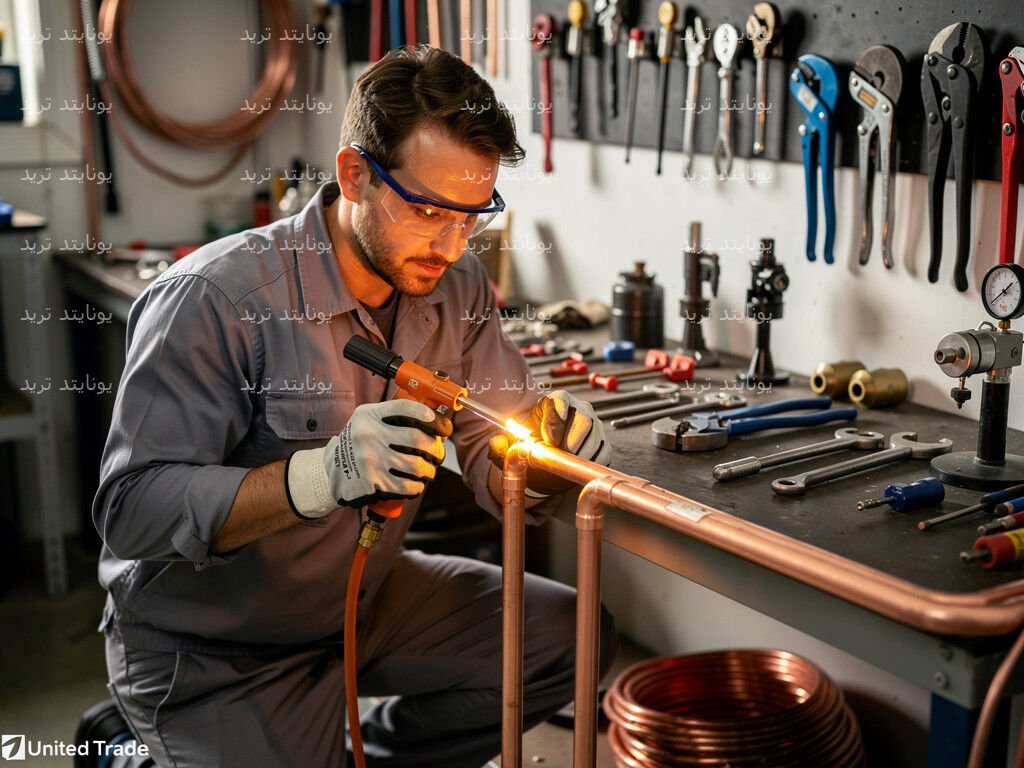
- Direct the burner flame evenly around the copper joint until it reaches the required melting temperature.
- Touching the welding wire to the edge of the joint and allowing it to flow through capillary action without directing flame to the wire.
- Allow the joint to self-cool in the open air without pouring cold water to avoid thermal cracking of the alloy.
Preventive engineering measures to install tracks and thermal insulation
The stability of the network after the connections are completed depends on the quality of the supports and the quality of the sheathing materials surrounding the pipes. Therefore, tracks should be secured with flexible supports that take into account the natural thermal expansion and contraction of the copper metal.
Implementing any successful refrigeration project requires taking into account the engineering standards for refrigerant flow paths, which include steps Air conditioning installation In order to avoid any gas leakage and maintain the efficiency of the compressor for as long as possible. Precise piping installation and thermal insulation also helps reduce energy consumption and eliminate annoying operational vibrations.
Installing mechanical load-bearing cleats
Installing insulating rubber-lined cleats protects the pipe body from scratches and frictional wear caused by flow vibrations. Furthermore, suspension points must be distributed at intervals not exceeding one and a half meters to avoid bending of long tracks under the influence of their own weight and internal content.
Application of high-density foam insulation
Insulating copper lines using closed-cell elastomer foam prevents atmospheric moisture condensation on cold surfaces. In addition, this packaging limits ambient heat gain in the cooling lines, which directly contributes to reducing the energy consumption of the system.
Field errors that weaken the efficiency of metal installations and how to avoid them
Some technicians make common mistakes while making connections that reduce the lifespan of the copper system. For example, excessive heating of the metal during welding causes the magma to burn and weaken the molecular cohesion of the joints, raising the possibility of cracking under operational stresses.
Galvanic corrosion is another dangerous phenomenon that occurs when copper metal comes into direct contact with galvanized iron without an electrical insulator separating them. Therefore, special plastic or bronze electrical insulation connectors must be used to completely separate the two metals and avoid rapid chemical necrosis in the network.
Frequently asked questions
What is the correct way to bend copper pipes without breaking them?
An external bending spring or mechanical bending tool with rollers matching the outside diameter of the pipe must be used. Furthermore, it is necessary to soften the rigid tubes by heating them with a gentle flame until faint redness and letting them cool gradually before beginning the bending process.
How do you ensure that the copper mesh is free of leaks after welding?
The network is tested by injecting it with dry nitrogen gas under a pressure equivalent to one and a half times the usual operating pressure for twenty-four hours. In contrast, welded joints are inspected using specialized soap suds and precise strain gauges to detect any slight mechanical deterioration.
Can copper pipes for gas and plumbing lines be installed together?
Yes, copper can be used for both applications, but on the condition that the appropriate type of pipe is chosen for each network in accordance with the approved engineering code. For example, thick, silver-welded Type K or L pipe is used for gas lines, while Type L or M pipe is sufficient for drinking water applications.
Why is copper preferred over plastic pipes in air conditioning?
Copper can withstand very high refrigerant pressures and extreme heat levels that plastic pipes fail to keep up without structural deformation. In addition, copper has zero permeability that prevents the leakage of fine gas particles through the walls of the pipe throughout the period of operation.
What is the difference between soft welding and hard welding of copper pipes?
Soft soldering is based on tin alloys that melt at temperatures below four hundred and fifty degrees Celsius and is suitable for water installations. In contrast, steel welding requires silver and phosphorus alloys and temperatures exceeding six hundred degrees Celsius to withstand the vibrations and pressures of cooling and gas systems.
conclusion
Installing copper pipes represents a long-term investment that ensures the efficiency of mechanical systems and protects them from premature damage when adhering to the correct technical standards. We always recommend choosing the appropriate thickness and using specialized welding tools under qualified engineering supervision to achieve the best operational performance for your facility.
















Community dialogue
0 comments