
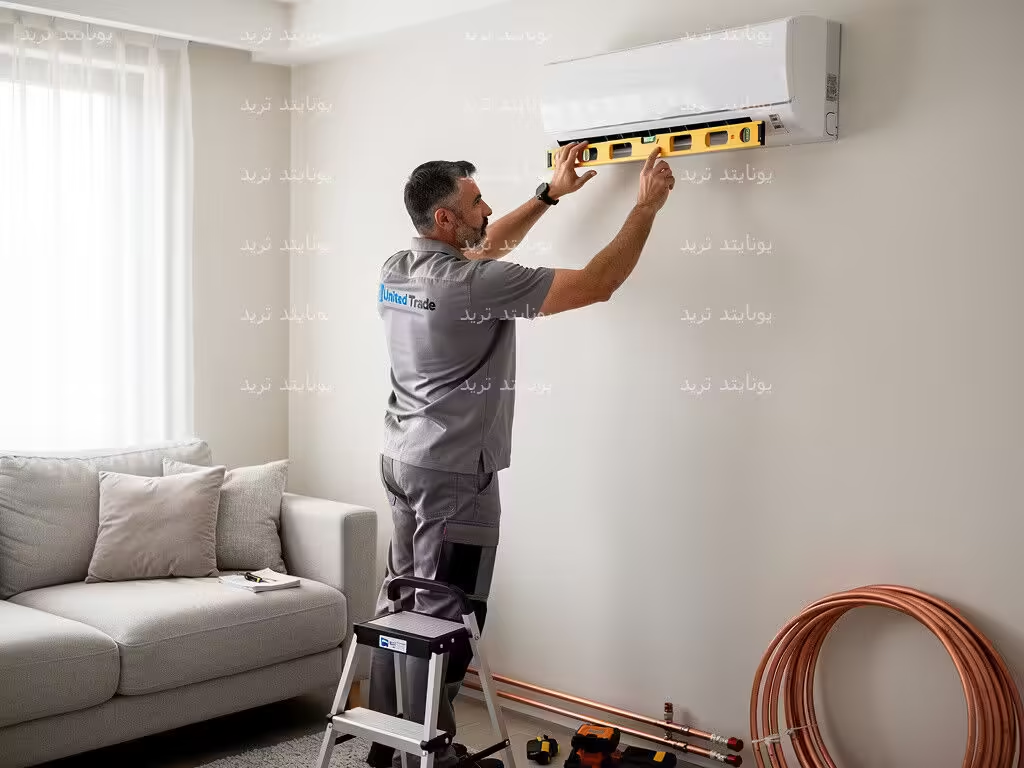
Technical criteria for choosing the location of the indoor and outdoor units
Determining the appropriate location for each part of the cooling system requires a careful engineering study of the space and the nature of air movement inside and outside the room. Incorrect location selection will cause compressor fatigue and reduce the efficiency of distributing fresh air throughout the space.
Indoor unit placement conditions
- Stay away from direct heat sources such as cooking ovens or sunlight shining through uninsulated windows.
- Leave a vertical distance of at least 15 cm between the top of the unit and the ceiling of the room to facilitate the extraction of return air.
- Install the device on a strong concrete wall capable of bearing the weight and reducing sound vibrations resulting from the movement of the fan.
- Direct the air flow away from places of permanent sitting or sleeping to avoid health damage resulting from direct exposure to cold air.
Outdoor unit locators
The outdoor unit needs a well-ventilated environment that allows the condenser to dispose of the absorbed heat very smoothly. It is always preferable to place it in a shaded place away from dust-laden winds, while providing a free space of no less than half a meter behind the device and a full meter in front of it to ensure easy regular maintenance and the flow of air current without mechanical obstructions.
Compare the technical specifications for the requirements of power cables and circuit breakers
The stability of the air conditioner's operation depends on matching the electrical connections to the actual load of the device. Choosing the correct circuit breaker and wires helps avoid overheating of the network and short circuit accidents.
| Air conditioning capacity in horsepower | Cooling capacity in thermal units | Cross-sectional area of copper wire in millimeters | Automatic cutter capacity in amps |
|---|---|---|---|
| 1.5 hp | 12000 units | 4 mm | 16 amps |
| 2.25 hp | 18000 units | 4 mm | 20 amps |
| 3.0 hp | 24,000 units | 6 mm | 26 amps |
| 5.0 hp | 36,000 units | 10 mm | 40 amps |
Common mistakes while laying copper pipe networks
The copper network is the lifeline of the cooling system, and any defect during its laying leads to material losses and continuous malfunctions in the gas compressor.
- Manually bending the pipes at sharp angles, which leads to suffocation of the coolant path and increased load on the engine.
- Neglecting to insulate each copper line separately, as collecting the intake and exhaust lines in one insulator leads to heat transfer that hinders the Freon cycle.
- Do not use a fine pipe cutting machine and rely on hand saws that leave metal filings inside the network.
- Failure to clean the pipe ends with a deburring reamer before the flanging operation will prevent complete tightening of the nuts and cause an invisible gas leak.
represents Air conditioning installation Properly airing is the mainstay to ensure effective cooling and a long operational life of the device without sudden breakdowns. This expert guide helps you understand the precise stages of the installation process, from site selection to commissioning. You will also learn about the most important technical differences between types and how to avoid mistakes that raise your electricity bill.
Quick answer: How is the installation process done professionally?
Air conditioning installation Airing is a technical process that requires the indoor unit to be installed on a solid, flat wall, and connected to the outdoor unit via tightly insulated copper pipes. The process involves vacuuming air and moisture from the circuit using a vacuum pump to ensure refrigerant efficiency. Therefore, correct installation ensures smooth air flow without water leaks or additional stress on the compressor.
Criteria for choosing the appropriate location for the indoor and outdoor units
Determining the location of installation requires careful study of air distribution and movement of people within the room. The indoor unit must be installed at a height of at least 2 meters from the floor to distribute coolness evenly. Furthermore, you should avoid placing the unit directly above electronic devices to avoid any damage in the event of sudden water condensation.
Requirements for installing the outdoor unit
The outdoor unit needs a well-ventilated and shaded place as much as possible to reduce energy consumption. Therefore, a distance of at least thirty centimeters must be left behind the unit and a full meter in front of the exhaust fan. It should be noted that the use of rubber feet significantly reduces vibrations and noise transmitted through the walls.
Factors for the success of placing the indoor unit
It is recommended to leave a distance of at least fifteen centimeters between the indoor unit and the ceiling to ensure free air intake. In addition, it is preferable to direct the cooling vents towards open space rather than wide walls. This geometric distribution reduces heat loss and achieves the required temperatures in the shortest possible time.
Stages of mechanical connection and insulation of the copper network
Mechanical connections are considered the vital artery of any closed refrigeration cycle in modern systems. The technician begins by laying the copper pipelines for gas extraction and extraction, while covering each line with a separate thermal insulator. As a result, this independent insulation prevents thermal condensation and cold loss along the external path.
Fastening pipes with flange nuts requires extreme precision to avoid micro-cracks. For example, excessive tightening can damage the pipe flange and cause invisible gas leakage over time. On the other hand, the loose connection causes the Freon charge to gradually escape, which completely disables cooling within a few months.
Steps to empty the circuit and test the system pressure
Vacuuming the circuit: A mandatory step in which a vacuum pump is used to extract moisture and air from the copper mesh before opening the valves. This procedure ensures the purity of the refrigeration cycle from microscopic water droplets that may turn into acid that damages the compressor oil. Therefore, abandoning the use of the pump is a serious mistake that reduces the life of the device by half.
The efficiency of the system depends fundamentally on the accuracy followed during... Establishing copper pipes extending between the two units, avoiding sharp bends that impede the flow of the refrigerant. This procedure also requires insulating the intake and exhaust lines with great care to prevent moisture condensation and ensure that the gas reaches the ideal pressure and temperature.
- Carefully connect the two-track pressure gauge to the service valve on the outdoor unit.
- Run the vacuum pump for a minimum of twenty minutes to reach full negative pressure.
- Close the measuring valve and monitor the indicator for ten minutes to ensure that the pressure is completely stable.
- Open the gas valves slowly using the designated key to allow Freon to flow into the circuit.
Engineering differences between common types of air conditioners
Requirements vary Air conditioning installation Air depending on the model chosen and the nature of the place to be cooled. The following table helps you compare the most important home options available to determine the best fit for your budget and space needs.
A cell that ensures smooth airflow and avoids dust accumulation on the inner fins, reducing the need for constant cleaning Regular air conditioning maintenance Caused by blockage. Balanced installation helps reduce power consumption and significantly extends the life of the device.
To ensure continued efficiency of the cooling system during periods of high temperature, careful periodic inspection of mechanical and electrical parts must be performed and preventive maintenance procedures must be implemented. FProactive seasonal preparation It reduces the possibility of any sudden downtime and significantly extends the life of the device.
It counts Air conditioning duct extension An essential step in the architectural preparation and interior finishing stage of any building, as the life of the compressor and the efficiency of electricity consumption depend directly on the integrity of these connections and the consistency of their diameters. Therefore, careful adherence to correct establishment standards ensures sustainable operational performance of the system and avoids leakage failures resulting from poor laying.
Cell in a place that allows easy access, as the procedure Regular air conditioning maintenance Cleaning the filters regularly ensures that the airflow remains pure and free of obstructions. Avoiding installing it above direct heat sources also helps protect the internal sensors from false readings and extend the life of the device.
This choice is closely related to the route of the copper wiring connecting the two units, as it requires a phase Installing air conditioning ducts Taking into account the shortest possible path and the least number of bends to ensure the refrigerant flows with high efficiency. The tight thermal insulation of these extensions also ensures that water leaks into the walls are avoided and the system is protected from losing cooling energy during operation.
A cell in the free air flow path, with the need to facilitate access to it later for any Regular air conditioning maintenance And clean the filters without hindrance. Careful installation that takes into account standard spacing ensures cooling stability and extends the life of the device.
The efficiency of the entire system depends on the quality of work execution Establishing copper pipes And water drainage paths before installing the devices, to ensure that there is no leakage of the cooling medium or blockage in the drainage lines. At this stage, care should be taken to choose pipe diameters appropriate to the device’s capacity, while carefully insulating them thermally to avoid condensation and loss of cooling energy along the path.
| Air conditioning type | Ease of installation | Noise level | Cooling efficiency | Perfect use |
|---|---|---|---|---|
| Wall split | Medium (requires wall hole) | Very low | Very high | Residential rooms and medium offices |
| Window air conditioner | Simple (requires dedicated slot) | Medium to high | Good | Old buildings and guard rooms |
| Central (Concealed) | Complex (requires ductwork) | Almost non-existent | Ultra efficient | Villas and large commercial spaces |
| Al-Qaim (wheel) | Easy to medium | middle | Powerful for large spaces | Large halls and mosques |
Electrical connection and water drainage requirements
The safety of the entire system depends on the electrical loads matching the device manufacturer's specifications. An independent circuit breaker must be allocated in the main panel that matches the horsepower of the air conditioner. Furthermore, it is forbidden to connect the device to common household sockets to avoid overheating and wire burnout.
- Use approved copper cables with a diameter of no less than four millimeters to avoid voltage drops.
- Install the water drainage hose with a slope of no less than two centimeters per meter to ensure normal flow.
- Insulate the internal drainage hose route to avoid moisture dripping onto the false ceilings.
- Connecting the grounding line to ensure users are protected from any sudden electrical short circuit.
Common technical errors that affect cooling efficiency
Many non-specialists make fundamental mistakes during air conditioning installation that quickly damage the system. The most prominent of these disadvantages is making sharp bends in copper pipes without using a special bending spring, which stifles the flow of Freon. As a result, the load on the compressor increases and the engine sounds louder without getting the required cooling.
In addition, neglecting the water scale when installing the indoor unit panel will result in a defect in the drain path. It should be noted that accidentally tilting the unit towards the opposite side of the hose outlet will inevitably lead to water flooding into the room. In other words, accuracy in simple engineering details is what protects the decorations and saves the costs of repairs later.
Frequently asked questions
How long does it take to install a new split air conditioner?
The process usually takes between two to three hours if the piping paths and electrical source are ready. The time may extend longer if additional concrete holes or longer lines are required.
Can the outdoor unit be installed in a closed place?
This cannot be done, because the outdoor unit needs to expel hot air freely and constantly draw in fresh air. Placing it in a confined space will cause the compressor to overheat and self-separate to protect its internal parts.
What is the ideal length of copper piping between the two units?
The recommended standard length often ranges from three to seven meters to ensure the compressor operates flexibly. A pipe shorter than two meters causes an increase in vibration transmission, while an excessive length requires an additional charge of Freon.
How do I know that the air conditioning was installed without gas leaking?
A skilled technician makes sure of this by checking the connections with a custom foam solution after applying pressure or using an electronic leak detector. The stability of the pressure gauge clock indicator after the unloading phase also demonstrates the integrity of the entire circuit.
Why does water come out of the indoor unit after operation?
This is often due to a clogged drain or the hose incline was not adjusted accurately during installation. In addition, this malfunction may be caused by a lack of gas charge and ice formation on the internal evaporator fins.
Does the new air conditioner need to charge Freon during installation?
The new units come pre-injected with enough Freon for pipe lengths that usually reach up to five metres. The device does not require additional charges unless the actual piping route exceeds the lengths specified in the operating manual.
Completing the air conditioning installation process requires the use of qualified technicians who possess precise equipment to ensure the highest levels of efficiency. Always make sure to review the warranty certificate and monitor the operating pressures to ensure the integrity of the connections before regular use. Invest in precision installation today for a comfortable environment and stable cooling for years to come.
















TQTAG76 Community dialogue
0 comments