
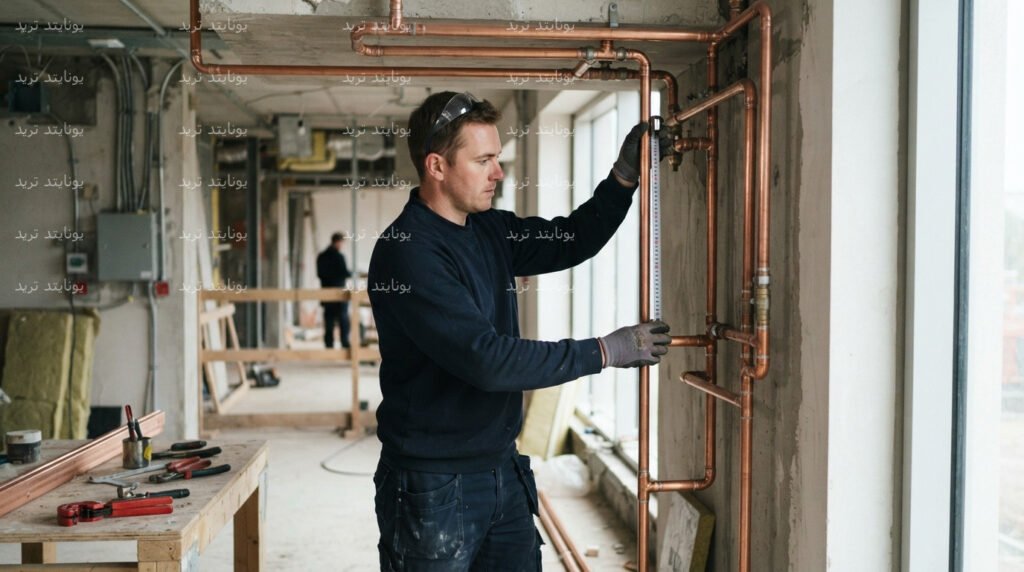
Sustained, energy-efficient cooling performance depends on quality Establishing pipes Air conditioning Inside the building walls before final finishing. This stage is the cornerstone of any split air conditioning system, as proper planning of paths and preparation of copper connections ensures future failures such as Freon leakage or moisture condensation are avoided. Professional technicians realize that precision in implementing this installation saves the owner expensive maintenance costs and ensures that the device operates at its full cooling capacity throughout the seasons of the year.
Technical assets for extending copper pipes inside the walls
A process must be done Establishing pipes Air conditioning Using high-quality copper tubes conforming to international specifications, avoiding any connections or welds hidden inside the walls. The welds inside the wall are a weak point that may cause Freon gas to leak over time, requiring the walls to be broken down later for repair.
❓ Choosing appropriate pipe diameters for cooling capacity
The diameter of the copper pipe is closely related to the specific capacity of the device in tons of refrigeration, and using an inappropriate diameter will lead to additional pressure on the compressor. Professional technicians adopt standard sizes such as 1/4 inch for liquid line and 3/8, 1/2, or 5/8 inch for gas line according to the manufacturer's catalog.
The importance of thermal insulation for copper pipes
The essential role of thermal insulation is to prevent water condensation around cold pipes, thus protecting walls and ceilings from moisture damage. Rubber or foam insulation with a thickness of at least 3/8 to 1/2 inch must be used to ensure efficient insulation under various external temperature conditions.
❓ Securing the drainage path with geometric flow
Condensation water needs a plastic type drainage system UPVC With a suitable diameter, it is installed with a precise geometric slope of at least 1% to ensure smoothness. Any error in the slope or weak connections will lead to water backing up or leaking into the rooms, so it is advisable to test the slope of the drain before closing the paths completely.
Quality testing protocol before final closing
The testing phase using nitrogen gas ensures that all connections are intact and that there are no pinholes that may cause a loss of pressure. Pipes are pressurized to 400 psi with the pressure indicator monitored for 24 hours, and if the reading holds, capping and finishing procedures can begin.
These steps show the logical sequence to ensure accuracy of work, as nitrogen testing is a critical stage that cannot be skipped to ensure efficiency Establishing pipes Air conditioning In the long term.
Comparison of available foundation materials
| Standard | High quality brass 🏆 Editor's choice | Cheap commercial copper | Plastic (UPVC) |
|---|---|---|---|
| Durability | ✓ 9.8/10 | ✗ 5/10 | ✓ 9/10 |
| Pressure resistance | ✓ 10/10 | ✗ 6/10 | – |
| Thermal insulation | ✓ | ✓ | ✕ |
| Overall evaluation | ★ 9.7/10 | ★ 5.5/10 | ★ 8.8/10 |
Frequently asked questions
❓ What is the ideal distance between the indoor and outdoor unit?
It is preferable that the distance not exceed 15 meters to ensure that the cooling efficiency does not decrease, bearing in mind that every additional meter may require an additional charge of Freon gas.
❓ Is it possible to install air conditioning pipes after completing the painting?
This is not recommended, because the process Installing air conditioning ducts It requires breaking walls and extending paths, which will necessarily lead to damage to paintwork and interior decoration.
It requires an operation Air conditioning installation Split type with extreme precision in installing the indoor and outdoor units to ensure perfect air flow and efficient cold distribution throughout the place. The correct balance between the level of the unit and the integrity of the electrical connections prevents annoying vibrations and extends the operational life of the device, providing a comfortable environment free of noise and sudden technical malfunctions.
❓ Why should nitrogen be used in leak testing?
Nitrogen is an inert, dry gas that helps detect the smallest holes in welds. It also prevents the formation of oxidation inside the pipes that may harm the air conditioning compressor in the future.
The specialized technician realizes that good foundation alone is not enough without continuity of provision Regular air conditioning maintenance It maintains the efficiency of the compressor and the cleanliness of the internal filters. These regular checks contribute to early detection of any defect in refrigerant gas levels and avoid sudden damage to the cooling system as a whole.
requires Professional installation of air conditioning piping Precision engineering in selecting paths and ensuring complete thermal insulation for each extension, which prevents loss of cooling energy and protects the structural structure from moisture damage. This attention to technical detail not only ensures that the system operates at maximum efficiency, but also represents a long-term investment in the safety of the property and the sustainability of the performance of the air conditioners for many years.
It requires commitment to all Principles of establishing air conditioning piping Great care was taken to choose the appropriate pipe diameters and thermally insulate them with complete accuracy, to prevent energy loss and ensure smooth flow of coolant. This elaborate technical procedure contributes to extending the life of the air compressor and reducing electricity consumption, which reflects positively on the cooling power and its stability in different seasons.
The specialized technician realizes that a perfect foundation is only effective by following a regular plan that includes: Air conditioning maintenance Rotating air for early detection of any blockage in the filters or a decline in coolant pressure. This continuous inspection of the internal and external units helps maintain the efficiency of heat exchange and extend the life of the cooling system as a whole.
The specialist technician understands that the completion of foundation work leads directly to the... Air conditioning installation Air is supplied according to precise standards that ensure the balance of the internal and external units and the tightness of the mechanical and electrical connections. This procedure requires a secure fit to the bases and careful insulation of the connections to ensure maximum efficient airflow without annoying vibrations.
The specialized technician realizes that good establishment is not complete without periodic procedures that include: Air conditioning maintenance The building is regularly inspected to check gas pressure and clean filters and water drains. This continuous monitoring helps maintain the efficiency of the compressor and reduce electricity consumption for the longest possible operational period.
The specialist technician understands that the completion of foundation work leads directly to the... Accurate air conditioning installation Highly engineered to ensure tight installation of the internal and external units. This step requires carefully adjusting the mounting balances and connections of the electrical circuits and cooling lines to prevent vibrations and achieve the highest airflow efficiency in the room.
❓ How to determine the correct copper pipe diameter?
The diameter is determined based on the technical specifications contained in the installation manual for each air conditioner, as requirements vary depending on the cooling capacity and the type of refrigerant gas used.
❓ Does the inclination of the drain pipe affect the efficiency of the device?
Yes, the absence of the correct tilt leads to water accumulating inside the basin of the indoor unit, causing unpleasant odors or water dripping into the room, which spoils the walls.
❓ When should you start installing air conditioning ducts?
It must be started immediately after the completion of the brickwork and before the plastering work, to ensure that the paths are integrated hidden and safe within the concrete walls and ceilings.
❓ Advantages and disadvantages
Features:
- Complete protection of pipes from external factors and humidity.
- Clean aesthetic appearance with no visible connections.
- Extending the lifespan of copper pipes thanks to thermal insulation.
Disadvantages:
- Difficulty accessing pipes in the event of a drain blockage.
- Higher initial implementation cost compared to external extensions.
- It requires high engineering precision to avoid any error in the water path.
❓ Editor's judgment and final rating
It counts Installing air conditioning ducts Professionally, it is a long-term investment that protects the property from moisture damage and ensures the efficient performance of the cooling system. The final rating is 9.5/10, and it is a must-have choice for every owner looking for lasting quality and comfort in their home.
Adherence to these technical standards guarantees you an ideal user experience and tangible savings in energy consumption. Always make sure to choose specialized technicians to ensure that all required tests are carried out before the final closure of the tracks.
















Community dialogue
0 comments