
Guide to selecting pipe thicknesses and diameters according to application
The success of a copper piping installation depends on the exact fit between the type of pipe and the operating pressure required for the system. Copper wall classifications vary to suit the areas of heating, cooling, and various liquid and gas supply networks, which imposes the necessity of knowing the engineering specifications for each category before starting implementation.
| Tube type (grade) | Inner wall thickness | Recommended field use | Stress tolerance level |
|---|---|---|---|
| Type K (green) | Extremely thick | Underground extensions and main lines | Very high |
| Type L(Blue) | Medium thickness | Refrigeration and air conditioning networks and internal hot water lines | High to medium |
| Type M (red) | Low thickness | Low-pressure domestic water installations and central heating | Medium to low |
| Type DWV (yellow) | Very thin | Water, waste and condensate drainage lines only | No pressure (gravity drainage) |
Preventive maintenance procedures for existing copper networks
The sustainability of copper fittings ensures that buildings are protected from sudden failures, limescale build-up and galvanic corrosion caused by contact with incompatible metals. Monitoring these systems requires specific measures to prevent performance deterioration over the years:
- Inspect mechanical fastening points regularly and ensure that there are rubber insulators separating the copper from the steel clamps to prevent friction and the generation of oxidative charges.
- Monitor the stability of the outer insulation layer around copper pipes to prevent moisture condensation on the outer surfaces and avoid temperature loss in fluid lines.
- Perform periodic washing using pH-balanced cleaning solutions to remove mineral scales accumulated inside the inner walls of pipes without harming the original metal texture.
- Inspection of relief valves and water hammer traps to ensure absorption of hydraulic shocks that may lead to deformed bends and weak welded connections.
The installation of copper pipes represents an essential pillar in the construction of modern plumbing and air conditioning systems due to their high resistance to corrosion and their ability to withstand extreme pressures. This article gives you a detailed field guide that explains the correct connection mechanisms and effective insulation standards to ensure operational efficiency that will last for decades. You will also learn about engineering fastening tools to avoid costly failures and protect your construction networks.
Quick answer
Copper pipe fitting is a mechanical and engineering process for connecting copper pipes in cooling and water networks using silver soldering techniques or mechanical compression joints. Successful installation requires careful cleaning of the ends, thermal insulation of the tracks, and securing them with rubber supports every 1.5 meters to absorb vibrations and prevent leakage.
What are the tools used to prepare copper lines?
The preparation phase requires the use of specialized equipment to ensure the integrity of the pipes and avoid deformation of their internal diameters during preparation. Use of non-designated equipment can cause fluid pressure drops or invisible blockages that affect flow efficiency.
Rotary pipe cutter: A hand-held cutting tool equipped with a sharp steel wheel that ensures an even, even cut at a ninety-degree angle without creating metal shavings. Furthermore, this tool provides clean cuts that protect copper flanges from future mechanical cracking.
Internal deburring tool: A conical scraper used immediately after cutting to smooth the edges of the pipe and remove rough edges that may cause turbulence in the flow of liquids and gases. In addition, cleaning the inner cavity prevents the accumulation of limescale or the formation of swirling corrosion foci inside the mesh.
Standards for classifying engineering copper thicknesses
The bearing capacity of pipes varies depending on the pipe wall thickness and its ASTM color code. Choosing the right type helps you balance the financial cost with the operational stress requirements of your mechanical system.
| Code type | Identification color | Wall thickness | Common field use |
|---|---|---|---|
| Type K | Green | Extremely thick | Ground burial, high pressure lines and gas networks |
| L type | Blue | Medium thickness | Internal water extensions, cooling and air conditioning systems |
| Type M | Red | Low thickness | Home heating systems and low pressure water lines |
| Type DWV | Yellow | Very thin | Sewerage drains and non-pressurized drains |
As a result, HVAC and plumbing engineers recommend blue and green types within critical commercial and residential projects. It should be noted that the red type is limited to closed circuits with relatively limited pressures.
Stages of installing copper pipes with annealed welding system
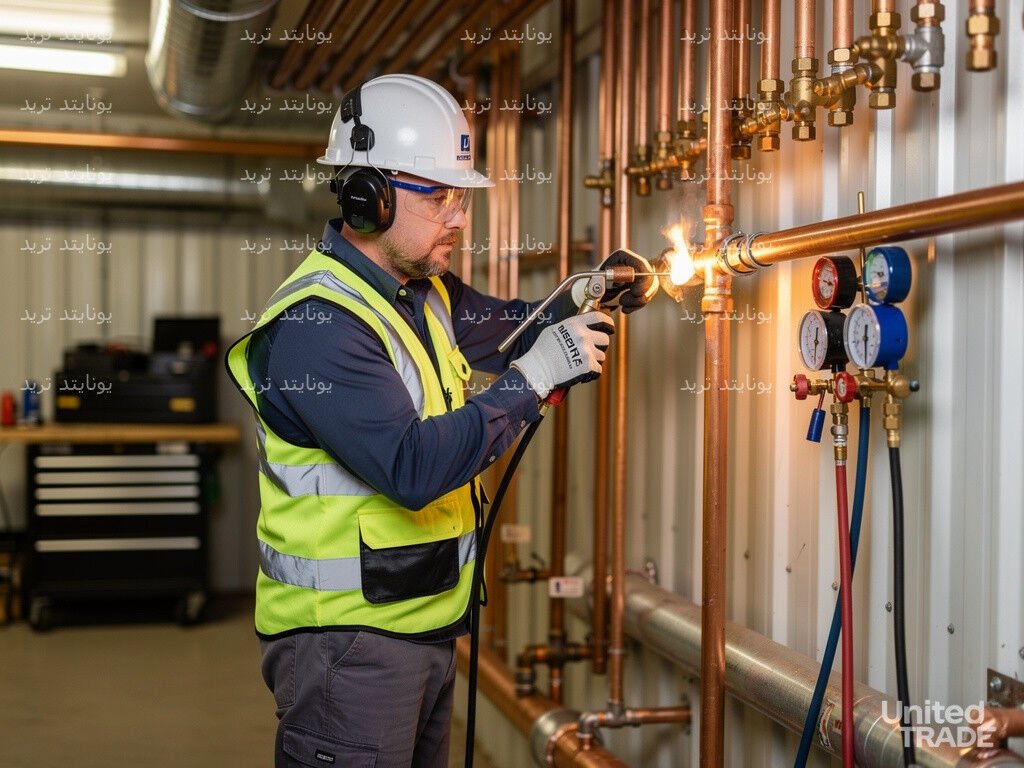
High-temperature welding requires applied skill to form a strong and tight molecular bond that completely prevents the leakage of Freon or hot water. The following steps ensure safe implementation that complies with occupational safety requirements:
- Clean and prepare the outer surface of the copper using a non-metallic sanding cloth until the metal shines and oxidation is gone.
- Apply the flex chemical regularly to the overlap area only to facilitate the spread of the soldering alloy and prevent the formation of oxides.
- Heat the bonding area with an oxy-acetylene torch until the metal reaches a soft cherry glow suitable for melting.
- Passing the soldering wire containing silver until it melts automatically by capillary action and completely fills the interstitial space without gaps.
- Cool the contact point naturally with air, then wipe off the remaining flex with a damp cloth to prevent local corrosion.
How to carry out thermal insulation to protect pipes
Effective thermal insulation protects pipe runs from thermal energy loss and prevents condensation of moist water vapor on cold external surfaces. On the other hand, neglecting insulation leads to corrosion of walls and the growth of fungi and bacteria as a result of constant moisture around construction lines.
Closed-cell elastomer: A specialized insulating material that is extremely resistant to moisture absorption and maintains flexibility over a wide temperature range. For example, technicians prefer to use elastomer insulators with a thickness of no less than nineteen millimeters for intake lines in cooling systems.
Implementing any successful cooling project requires taking into account technical standards Air conditioning installation Air to ensure efficient flow of refrigerant without loss of pressure. This step includes adjusting the paths of the copper lines and thermally insulating them with complete accuracy to avoid the formation of condensation and achieve the highest levels of performance.
Therefore, all connections and bends must be covered with aluminum adhesive to prevent atmospheric air from entering under the layers of insulation. Moreover, protecting the insulating material from ultraviolet rays contributes to maintaining its rubber structure for the longest possible period in open places.
The initial phase of the supply and cooling networks requires strict engineering standards to be followed Establishing copper pipes To ensure flow efficiency and the safety of the system from future leaks. This procedure is based on installing tracks with appropriate diameters and using strong supports that protect the extensions from vibrations resulting from pressure differences.
Maintaining the efficiency of these extensions requires periodic intervention to ensure that the cooling media does not leak or the connection points do not corrode under the influence of varying pressures. Hence the importance of taking action Regular air conditioning maintenance It includes all mechanical parts and piping networks, as continuous inspection contributes to prolonging the lifespan of the cooling system as a whole.
Maintaining the safety of facilities requires careful routing Extension of copper pipes according to specifications Engineering to ensure efficient construction flow. These standards include conducting tight pressure and leakage tests for the network, choosing the category of pipe appropriate to the nature of use, and applying insulation and thermal expansion absorption measures to protect the system from damage in the long term.
requires Air conditioning duct extension High engineering precision to adjust the paths and ensure the movement of the refrigerant between the internal and external units with the highest operational efficiency. Properly planning and installing these paths helps protect the compressor from mechanical stress, reducing the possibility of Freon leaking or wasting energy over time.
The initial stage of the supply and air conditioning networks requires great care to ensure flow efficiency, as it is based on a step Establishing extension pipes To determine safe paths and choose diameters that suit the actual volume of consumption. This preventive measure contributes to avoiding pressure drops in the future, and also protects copper lines from the dangers of friction and mechanical corrosion in the long term.
Ensuring efficient cooling is not only limited to safe connections, but also requires adherence to a regular schedule that includes: Air conditioning maintenance Check the levels of Freon gas and the cleanliness of the internal filters. This preventive measure helps avoid high-pressure leaks that strain the copper lines, extending the life of the cooling system as a whole.
Maintaining the efficiency of these copper networks is closely related to procedures Regular air conditioning maintenance Ensures the safety of cooling lines from leakage and accumulation of impurities. Regularly checking pressure levels and cleaning the coils helps prevent the system from piping fatigue and extends its life, keeping temperatures within the facility as stable as possible.
Implementing any successful cooling project requires taking into account technical standards Air conditioning installation Air to ensure efficient flow of refrigerant without loss of pressure. This stage includes installing the indoor and outdoor units and tightly connecting the copper intake and exhaust lines to prevent any possible leaks. Adhering to these precise steps will extend the life of the device and achieve the highest levels of energy efficiency.
The first construction stage requires extreme precision during construction Establishing pipes Extensions to ensure smooth paths that reduce pressure loss and protect the network from mechanical stresses. Proper planning of penetration locations and anchor points helps maintain structural integrity and avoid any future conflicts with other systems.
Requires a step Air conditioning installation Air is extremely precise in determining the pipe paths and installing the internal and external units according to standards that ensure the smooth flow of the refrigerant. Adhering to the recommended diameters and insulating the copper lines well contributes to protecting the compressor from stress and increasing energy efficiency in the long term.
Procedures for installing copper lines and mounting supports
The stability of the mechanical network depends on the balanced distribution of metal cleats and supports along the horizontal and vertical paths of the building. Proper fasteners prevent bending of pipes caused by their own weight or natural thermal expansion during repeated working cycles.
- Installing suspension collars lined with rubber every one hundred and fifty centimeters to absorb vibrations resulting from the flow of compressors.
- Install U-shaped expansion joints in long lines to absorb metal elongation resulting from weather changes.
- Isolate pipes from concrete structures using protective plastic bushings to prevent harmful chemical reaction with cement.
- Completely avoid fixing copper with non-insulated galvanized iron fasteners to avoid the occurrence of galvanic and electrochemical corrosion.
In other words, the mechanical separation between different metals ensures the sustainability of the pipes and protects them from microscopic holes caused by electrical differences. Therefore, professional companies are keen to apply the latest insulation and engineering installation codes.
Pressure testing and leak detection protocol
Mechanical stress testing is the critical step to verify the integrity of welds and quality of connections before the system is finally commissioned. This procedure is done by filling the network with dry, inert nitrogen gas because it is safe and does not contain any impurities or moisture that are destructive to the compressor.
The technician gradually raises the circuit pressure to one hundred and fifty percent of the designed operating pressure, and the network is left under observation for a full twenty-four hours. In addition, specialized soap sudsers or tiny electronic sensors are used to monitor any emergency air bubbles around sensitive connections.
Frequently asked questions
What is the appropriate distance between pipe supports?
The typical distance between pipe supports is between one and a half meters in horizontal runs to avoid bending. It should be noted that the vertical lines need a stabilizer every two and a half meters to support the weight of the net quite efficiently.
Can copper pipes be installed without welding?
Yes, they can be installed using modern hydraulic piston connectors or flanged brass flange nuts. Compression joints provide superior speed of execution and eliminate the risks associated with using open flames in enclosed spaces.
How do I protect copper pipes from corrosion inside the walls?
Pipes are protected by completely encasing them in insulating plastic sleeves that prevent direct contact with concrete or cement mortar. In addition, this insulation prevents chemical corrosion and provides free space for thermal expansion and contraction of the pipes.
Why is nitrogen gas preferred in checking line pressure?
Nitrogen gas is completely inert and dry, free of moisture and oxygen molecules that damage internal components. Moreover, nitrogen prevents internal rust formation and withstands high pressures safely during field tests.
What is the difference between silver soldering and tin soldering?
Silver soldering is characterized by superior mechanical strength and can withstand very high temperatures and pressures, and is approved for refrigerant and gas lines. In contrast, tin solder melts at low temperatures and its uses are limited to low-pressure domestic water systems.
conclusion
Mastering the installation of copper pipes requires careful adherence to engineering standards and the correct selection of tools and insulating materials to protect the building from the dangers of leakage. Always pressure test with nitrogen before closing tracks to ensure peace of mind and the quality of your facility. Start inspecting your mechanical tracks now and hire certified technicians to ensure a professional and sustainable implementation.
















Community dialogue
0 comments