
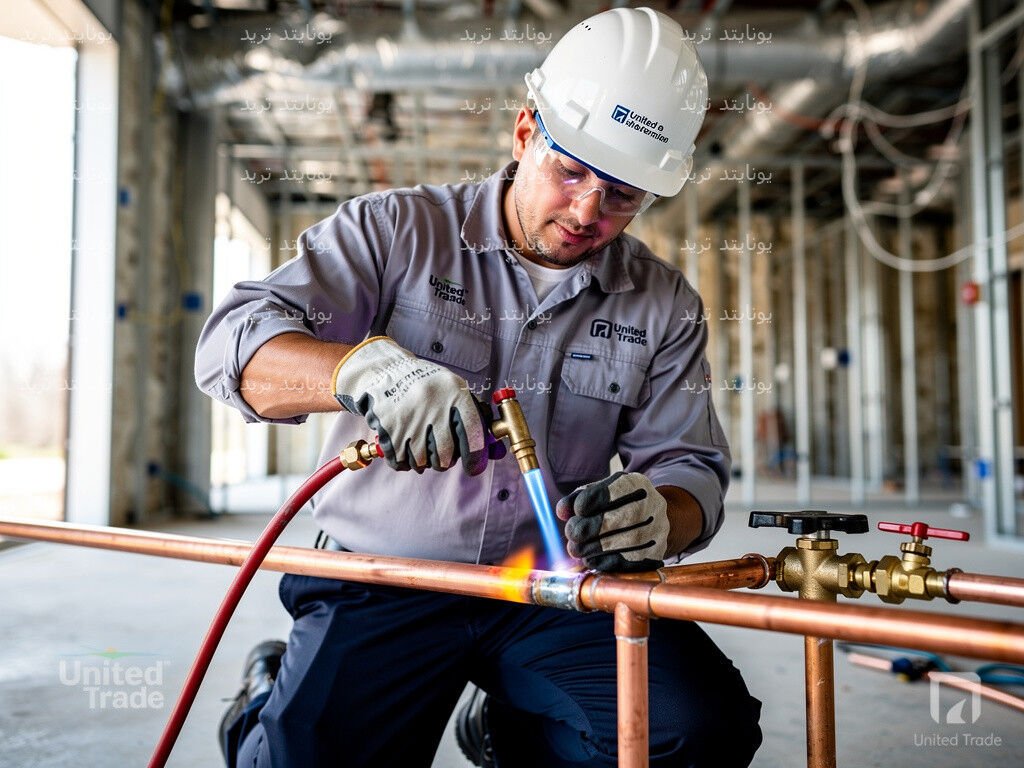
Steps for pressure and leakage testing of copper networks
Verifying the integrity of the installations after the completion of mechanical operations requires the application of a strict hydrostatic testing protocol before final covering or commissioning of the actual system. This procedure helps detect any defects in connection points whether welded or welded, preventing future structural damage caused by leakage of fluids or pressurized gases inside the building.
Stages of implementing the field hydraulic test
- Close all end valves and plug the open ends using specialized, airtight seals to withstand high pressures.
- Gradually fill the grate with clean water from the lowest point of the path to expel trapped air pockets through the upper vent holes.
- Use a manual or electric test pump to raise the pressure inside the pipes to one and a half times the design operating pressure approved for the project.
- Monitor the calibrated pressure gauge indicator for a period of not less than two hours to ensure that the reading is completely stable and that there is no slight decrease.
- Inspect all connections visually and by touch to ensure that there are no leaching or fine water droplets around the connection areas.
Compare categories of copper tubing and their specific uses
Commercially available copper pipes vary in internal wall thickness and their ability to withstand different pressures and environmental conditions, which requires selecting the appropriate type for each application to ensure efficiency and safety.
| Tube class | Approved color code | Inner wall thickness | The most prominent areas of use and application |
|---|---|---|---|
| Type K | Green | The thickest and most durable | Underground installations, main water distribution networks, and buried fuel and gas lines. |
| L type | Blue | Average thickness | Internal extensions for hot and cold water inside buildings and central heating networks. |
| Type M | Red | Thinest and lightest | Low-pressure home supply networks and internal air conditioner drainage. |
| Type DWV | Yellow | Very thin and not intended for pressure | Sanitation, ventilation and rainwater drainage systems without operating pressure. |
Preventive measures to protect copper lines from vibration and thermal expansion
Metals are generally exposed to expansion and contraction phenomena resulting from varying temperatures of the fluids transported within them, and addressing these engineering effects requires precise solutions that maintain the integrity of the structural structure.
- Installing pods and fasteners lined with insulating rubber to absorb mechanical vibrations and prevent direct contact with other metals to avoid galvanic corrosion.
- Making U-shaped expansion joints in long straight paths whose distances exceed the permissible limits for freedom of longitudinal movement.
- Determine installation distances between supports based on the outside diameter of the pipe to avoid any unwanted loosening or bending over time.
- Leave sufficient spaces around pipes when penetrating walls and ceilings, while placing flexible bushings to facilitate thermal movement without stressing the welding points.
The installation of copper pipes represents the basic foundation for ensuring the efficiency of networks for transporting fluids and gases under high pressures and varying temperatures. This specialized guide helps you understand the correct engineering methods for preparing lines, and know the technical standards that protect you from microscopic leaks and reduce financial waste during implementation.
Quick answer: How to install copper pipes correctly?
Installing copper pipes is a mechanical and thermal process that requires cutting the pipe at exactly right angles, removing the inner feather to prevent swirling fluid turbulence, then forming the connections either by silver welding or mechanical joining, with the necessity of applying tight thermal insulation and testing the line under dry nitrogen pressure to ensure that there are no leaks before actual operation.
Choosing pipe diameters and thicknesses according to practical application
The successful operation of any network depends on the accurate determination of the pipe wall thickness and its ability to withstand the operating internal pressure. The technical requirements for cooling and air conditioning networks differ radically from the requirements for drinking water extensions or domestic natural gas networks.
Engineering differences between commercial copper pipe classifications
Copper lines are globally classified into three main types including Type K, Type L and Type M. For example, Type K has the thickest wall and is therefore preferred for industrial and underground applications where it is exposed to external stresses and operating pressures exceeding 700 psi. In contrast, Type L is used in internal cooling and heating installations, while Type M is limited to low-pressure water installations due to its thin internal wall.
Tools and equipment needed to complete the installation without errors
Professional work requires specialized measuring, cutting and shaping tools that ensure the integrity of the pipe's metal structure during mechanical processing. The use of crude or inappropriate tools distorts the roundness of the pipes, creating structural weaknesses that cause premature cracking when the refrigerant media flows.
- Rotary pipe cutter equipped with a sharp steel blade to ensure smooth cutting at a straight ninety degree angle.
- A tool for scraping and emptying the internal and external feathers to avoid friction of the fluid with the sides of the pipe and subsequent corrosion of the metal.
- Hydraulic or manual pipe benders of identical sizes to prevent blockage of the flow channel or choke of the path.
- Mechanical encoder device for making conical flanges for high-tightness threaded connections.
- Oxy-acetylene or advanced MAB gas welding torch to reach the required melting temperatures.
Steps for installing copper pipes in the approved engineering sequence
Proper operational procedures require following a strict linear sequence to ensure consistency of connections and quality of the route. Compliance with these steps reduces the need for subsequent adjustments, in addition to maintaining the purity of the pipe from impurities and oxidation resulting from high temperature.
- Clean opposing pipe ends with oil-free steel wool until a pure metallic shine appears.
- Insert tightening or expanding accessories taking into account the appropriate engagement depth of no less than the outer pipe diameter.
- Passing low-pressure nitrogen gas into the line during the welding process to prevent the formation of black copper oxide scales.
- Heating the junction area with a homogeneous flame and directing the silver alloy wire to be drawn into the void by capillary action.
- Allow the joint to cool naturally in the air without rapid water pouring, which causes thermal shock and capillary fractures.
Technical comparison table between common copper pipe types
The following table shows the mechanical properties and recommended uses for each class of copper, which helps the technician and engineer make the right decision at the design and implementation stage.
| Engineering category | Wall thickness | Pressure tolerance level | Main areas of use | Flexibility of formation |
|---|---|---|---|---|
| Type K (green) | Very thick | Extra high (up to 750 lbs) | Buried lines, oxygen networks and heavy-duty cooling | Solid / requires heating for large bending |
| Type L(Blue) | Average thickness | High (up to 500 lbs) | Home and commercial air conditioning systems and water installations | Flexible and easy to hand shape |
| Type M (red) | Slightly thick | Low to medium (up to 300 lbs) | Domestic water distribution and light drainage systems | Relatively solid and does not like to be bent strongly |
Insulation and installation methods to protect the network from thermal stresses
Copper metal has a significant coefficient of thermal expansion, which requires the installation of flexible supports that absorb the longitudinal movement of the pipe during the change of seasons. As a result, it is necessary to avoid installing pipes with solid iron clamps that directly touch the copper surface, in order to avoid galvanic corrosion resulting from the interaction of different metals in the presence of atmospheric humidity.
When reaching the stage of installing the internal and external units, it is important to follow precise engineering standards to ensure the stability of the equipment and avoid operational vibrations. Requires action Air conditioning installation With high efficiency, it balances electrical loads and adjusts the flow of refrigerant in the equipped paths to ensure the highest performance of the system.
The accuracy and success of these tests depends on the quality of the stage Establishing pipes Feeding from the beginning, as the lines must be installed with strong clamps and appropriate engineering tendencies must be taken into account to reduce mechanical stresses. This proper preparation of the tracks contributes to enhancing the durability of the network and its ability to withstand high operating pressures without the occurrence of future cracks.
When reaching the stage of installing the indoor and outdoor units, it is important to follow precise engineering standards to ensure the stability of the equipment and efficient air distribution. Include procedures Air conditioning installation Air: Take into account the recommended distances around the unit to facilitate maintenance and avoid the return of thermal currents. Proper installation on sturdy stands also ensures that vibration and operating noise are kept to a minimum.
To ensure the sustainability of the efficiency of the cooling system in the long term, the importance of adopting a periodic work schedule is highlighted Air conditioning maintenance Air, as regular inspection contributes to maintaining stable gas pressures and avoiding sudden malfunctions. These operations include checking the integrity of circuits and isolation valves to avoid any hidden leaks that may negatively affect the life of the compressor.
The efficiency of the cooling system does not depend on the quality of the copper fittings alone, but rather the financial and operational performance is completed by implementing procedures Air conditioning maintenance Regular ensures smooth air flow and reduces stress on the compressor. This includes checking refrigerant levels and cleaning internal parts periodically to keep energy consumption within its lowest operating rates.
Connecting the indoor and outdoor units requires extreme precision Air conditioning duct extension To ensure the circulation of the refrigerant without loss of operational efficiency. Proper adjustment and installation of the paths also prevents the compressor from premature fatigue, and completely reduces the risk of gas leakage in the long term.
Regular adherence to procedures Air conditioning maintenance An essential pillar for maintaining the efficiency of cooling lines and ensuring that their performance does not deteriorate over time. This inspection includes cleaning the filters and monitoring the pressure levels of the refrigerant to ensure the stability of the system and avoid sudden malfunctions that may drain energy and raise operating costs.
The accuracy and success of these examinations depend on the quality of the stage Establishing feeding pipes Taking into account the geometric dimensions and slope tendencies carefully from the beginning. The tight fit of the tracks and the use of appropriate supports ensure that mechanical stresses are avoided that may cause sudden cracks during fluid flow under high operating pressures.
These precise tests are considered the basic foundation for ensuring cooling efficiency and avoiding the waste of Freon gas in the long term, as they are closely linked to programs Regular air conditioning maintenance It protects the entire system from sudden malfunctions and extends the life of the compressor. Therefore, tightness of connections at the foundation stage facilitates periodic inspection tasks and ensures stability of operational pressures within the recommended standard rates.
The accuracy and success of these tests depends primarily on the quality of implementation of a stage Establishing feeding pipes And taking into account their geometric inclinations and diameters approved from the beginning. The tight installation of the tracks and the use of appropriate supports ensure that the network can withstand high operating pressures without vibration or separation of the connections.
The importance of closed thermal insulation for cold and hot lines
Closed-cell elastomer foam insulation prevents water vapor condensation around cold lines, protecting suspended ceilings and walls from moisture and mold. Moreover, good thermal insulation reduces heat losses in hot water pipes by up to eighty percent, thus improving the overall performance of the system and reducing electrical energy consumption significantly in the long term.
The next stage requires installing the internal and external units and adjusting the refrigerant flow paths with extreme engineering precision. The completion of stages Air conditioning installation Air according to factory standards ensures the highest efficiency in energy consumption and a balanced distribution of temperatures within the required spaces.
Procedures for examining and verifying the integrity of the installation against leakage
The installation of copper pipes is not considered complete and successful unless it passes the static pressure stage and comprehensive mechanical testing of the network. It should be noted that normal atmospheric air is prohibited from being used in testing cooling lines, as it contains moisture and oxygen, which harm the compressor oils and cause their rapid deterioration.
The test begins with the injection of moisture-free nitrogen to a pressure equivalent to one and a half times the system's design operating pressure. Next, fine leak detection foam is sprayed over all welding areas and mechanical connections, and the line is then left under digital pressure gauge monitoring for twenty-four hours to ensure that the indicator is 100 percent stable and that there is no drop in readings.
Frequently asked questions
What is the expected lifespan of copper pipes after installation?
Copper pipes last over fifty years under normal operating conditions when corrosion protection standards are adhered to. The correct choice of diameter and thickness ensures continued conduction efficiency and avoids internal blockages over such a long period.
How do I prevent blackening of copper from the inside during the welding process?
You can prevent black oxide formation by passing dry nitrogen gas at a very low flow into the tube during heating. This technology expels oxygen molecules from inside the duct, leaving the inner surface clean and shiny and preventing clogging of the filters later.
Why is copper preferred over plastic in cooling networks?
Copper is characterized by its superior ability to withstand very high operating pressures and its resistance to the penetration of gas molecules under extreme temperatures. In addition, copper possesses excellent thermal conductivity and structural flexibility that make it the standard engineering choice for industrial gas systems.
Can copper pipes be installed directly inside concrete walls?
Do not bury copper conduits directly into wet concrete without the use of an insulating jacket or external protective sleeve. Alkaline cement reacts with the metal, causing rapid chemical corrosion that leads to holes in the copper wall and the occurrence of hidden leaks that are devastating to the building.
What is the correct way to bend a copper pipe without breaking it?
The ideal method relies on the use of automatic benders with rollers that exactly match the outer diameter of the pipe to be formed. Bending should be performed in one smooth motion and sharp corners less than the allowable design bending radius of the metal should be avoided.
Adherence to technical standards during copper piping installation provides maximum safety and operational efficiency for your network in the long term. Start now by inspecting the extension paths and choosing the appropriate diameters for your project to ensure smooth flow and uninterrupted operation completely free of sudden malfunctions.
















Community dialogue
0 comments