
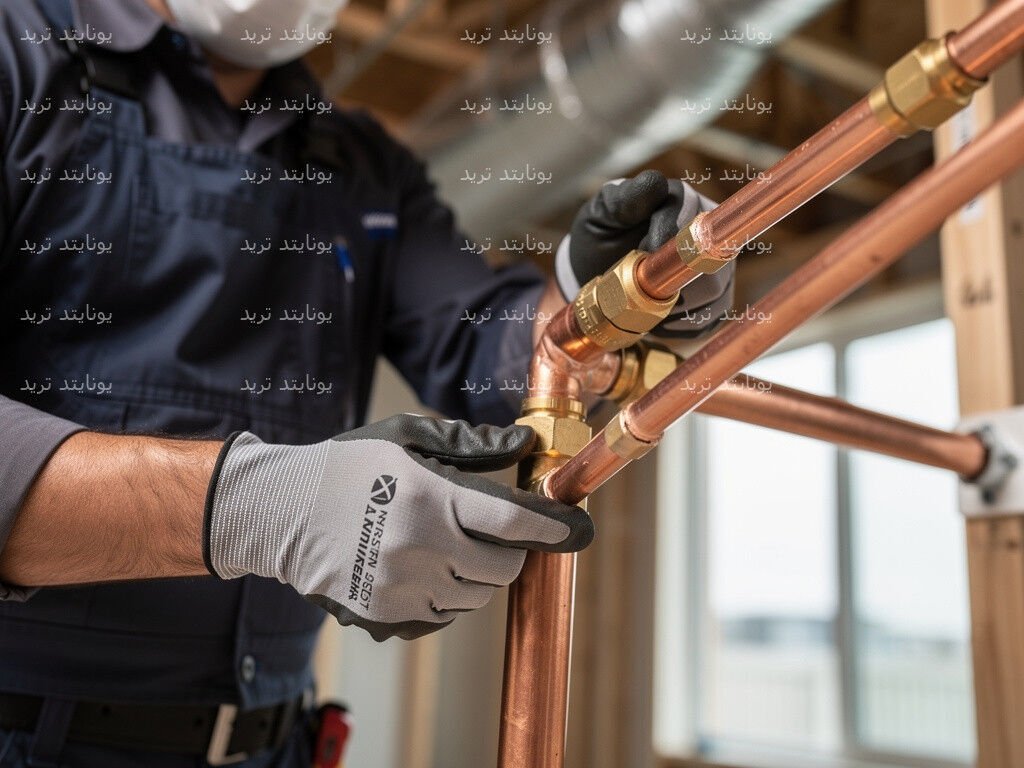
The extension of the air conditioning ducts represents the vital artery that connects the internal and external cooling units to ensure the flow of the refrigerant with extreme efficiency. This process, when implemented with the correct technical standards, gives you the highest heat exchange rate and significantly saves energy consumption. Here we will review the precise field work steps and choosing the appropriate diameters to protect the compressor from premature damage.
Quick answer
Extending air conditioning piping is the installation and connection of insulated copper lines to transport refrigerant gas between parts of the separate air conditioner. This process requires choosing diameters that match the manufacturer's specifications and applying double thermal insulation to avoid condensation and decreased efficiency. Successful work is completed by performing a dry nitrogen pressure check and vacuum discharge using a vacuum pump to completely prevent gas leakage.
Why is air conditioning duct extension a crucial component of cooling?
The extension of air conditioning ducts directly determines the efficiency of withdrawing and pumping the refrigerant within the closed compression cycle. Any irregularities in pipe diameters or bending angles obstruct the return of lubricating oil to the mechanical compressor. As a result, the operating load on the electric motor increases and the current consumption increases significantly.
Furthermore, even a slight blockage or internal warping reduces the actual cooling capacity of the device by more than 25 percent. For example, sharp angles cause a sudden drop in pressure, causing the evaporator to freeze. Therefore, the smooth path ensures a longer operational life and integrated protection for the entire air conditioning system.
Engineering criteria for selecting copper mesh path
A geometrically straight and shorter path is the rule of thumb to avoid dynamic pressure loss during the refrigeration cycle. The chosen path should stay away from direct heat sources and main power lines to avoid thermal interference and electromagnetic influence. Accordingly, wall passages are precisely defined before drilling and architectural finishing work begins.
In addition, specialized oil traps are required in ascending vertical lines if the height exceeds 3 continuous metres. These traps help the coolant pick up trapped oil droplets and return them smoothly toward the crankcase. On the other hand, neglecting these traps causes the compressor's mechanical parts to dry out and its electrical coils to burn out quickly.
Types of copper pipes and the most important technical differences
Modern air conditioning systems rely on seamless copper tubes with a high purity of 99.9 percent to ensure they can withstand high pressures. Wall thicknesses vary according to international copper classifications, and Class L and Class K are the most commonly used in professional quality applications. It should be noted that modern refrigerant gas requires additional thicknesses to withstand the increased operating pressure.
Type L copper pipe
L-type copper pipes have a medium wall thickness that makes them the most common and economical choice in residential and office facilities. These pipes can withstand operating pressures that reach standard levels that are ideal for Freon type R410A. Therefore, refrigeration engineers recommend adopting this type in standard vertical and horizontal paths.
Type K copper pipe
Type K copper tubing has the thickest metal wall of all commercial types available in specialty markets. This category is often used in cooling lines buried under concrete or exposed to harsh environmental conditions and constant humidity. As a result, the system provides maximum protection against mechanical wear and sudden gas leaks in the long term.
| Tube type | Wall thickness | Maximum operating pressure | Ideal area of use |
|---|---|---|---|
| Type K copper | Very thick | Exceeds 700 psi | Structural burial and harsh conditions |
| Type L copper | Medium thickness | Up to 550 psi | Standard residential and commercial projects |
| Type M copper | Low thickness | Less than 350 psi | Not recommended for modern cooling systems |
Steps to carry out the extension of air conditioning ducts professionally
Proper work begins with preparing the installation environment and measuring field distances with extreme accuracy to reduce material waste and avoid repetitive welds. Extending air conditioning ducts requires the application of successive steps that prevent dirt or atmospheric moisture residues from entering the circuit. The recommended technical order for completing the withdrawal and rollover process is as follows:
- Cutting pipes at exactly right angles using a specialized cutting tool that prevents distortion of the circular diameter of the gas duct.
- Clean the inner edges carefully with a deburring scraper to avoid metal fragments being transferred towards the thermal expansion valve.
- Dress closed-cell foam insulation with a minimum thickness of 19 mm around each cooling line independently.
- Bend pipes using guided mechanical benders to prevent internal congestion or reduce cross-flow area.
- Seal both ends of the pipes with tight caps throughout the pulling period to protect the lines from dust and rainwater.
Thermal insulation procedures and prevention of water condensation
Integrated thermal insulation prevents warm room air from coming into contact with cold metal surfaces carrying liquefied refrigerant. Contact of humid air with uninsulated pipes leads to water condensation, which causes damage to false ceilings and wall paint. Furthermore, effective insulation keeps the gas cool, ensuring efficient heat absorption within the space to be cooled.
The efficiency of the entire system depends on the phase Air conditioning installation According to sound engineering principles, the tight installation of the units ensures the avoidance of vibrations and gas leakage in the future. Adjusting the drainage angles and precise alignment also contributes to extending the life of the compressor and increasing the quality of cooling within the required space.
The success of this entire system requires a very precise initial stage that precedes operation, as it ensures... Establishing copper pipes Suitable diameters and tight thermal insulation protect the lines from damage or Freon leakage in the future. Burying these extensions in the walls according to the correct engineering paths gives the system a longer lifespan and preserves the aesthetics of the place.
The next stage requires initiation Air conditioning installation With extreme precision, by installing the holders and connecting the cooling lines tightly to ensure that no leakage occurs. Adhering to engineering specifications during this step helps maintain ideal gas pressure and extend the life of the device. This also ensures that the system operates at the highest levels of quietness and the best possible cooling performance in various weather conditions.
Cooling efficiency does not depend only on the quality of installation, it requires action Regular air conditioning maintenance To detect any potential leakage in the copper network and ensure stable gas pressure. This continuous inspection helps maintain the integrity of the compressor and extend the life of the entire HVAC system.
Maintaining infrastructure integrity and aesthetic appearance requires mastery Extending cooling networks to the walls According to strict engineering principles before completing the final finishing stages. This early action helps protect walls from random cracking and architectural damage, while ensuring that the copper lines are safely installed within the concrete partitions. Adherence to pre-insulation controls also contributes to preventing any internal condensation that may harm paints and decorations in the future.
Incorporation integrity is not complete without implementing procedures Regular air conditioning maintenance It maintains the readiness of the system and detects early any leakage that may occur in the refrigerant cycle. Commitment to regular inspection helps detect warning signs before they become worse, ensuring superior performance and extending the operational life of device components in the peak summer heat.
The efficiency of the cooling system does not depend only on the quality of the initial installation, but its operational sustainability depends on a procedure Regular air conditioning maintenance To detect any possible leaks in the cooling lines and treat filter blockages. This continuous check ensures that ideal gas pressure is maintained and protects the compressor from premature wear in the long term.
The first stage requires carrying out work Installing air conditioning ducts Very carefully inside the walls and ceilings before finishing them, to ensure smooth paths free of sharp bends that may hinder the movement of Freon. This early action helps protect the cooling network from mechanical damage and facilitates future maintenance without the need for breakage or structural modification.
The efficiency of the cooling cycle does not depend only on the quality of the installation, it requires a procedure Regular air conditioning maintenance To detect any possible leakage of Freon gas or blockage in the drain lines. This continuous check protects the compressor from thermal stress and ensures that the air inside the enclosed spaces is kept pure for as long as possible.
It is considered a stage Establishing cooling pipes Inside the walls and ceilings are the basic foundation for ensuring the safety of the air conditioning system for many years without leaks. This procedure requires very carefully insulating the copper pipes and installing them with carefully considered bending angles that prevent suffocation of the Freon gas and facilitate its free flow. The tight fit also ensures that vibrations caused by operating pressure are avoided and that the installations are protected from damage during subsequent finishing works.
In addition, combining the suction and ejection lines within a single insulating housing should be avoided under any circumstances. Improper combination causes harmful heat exchange between the warm fluid and the cold gas returning to the engine. Therefore, each refrigerant line is insulated with separate, UV-resistant foam insulation and then wrapped together with protective plastic packing tape.
The final stage of these procedures requires extreme precision in installing the units and connecting the electrical circuits to ensure that the system operates completely safely. All of these steps are integrated into procedures Air conditioning installation According to sound engineering standards to avoid any future vibrations or leakage of Freon gas. This fine-tuning helps extend the life of the device and reach the maximum cooling power possible.
Pressure and vacuum tests to ensure quality
Dry nitrogen gas pressure testing is the only proven engineering method for verifying the integrity of welds and mechanical connection points. Nitrogen is injected into the tubes at a pressure of up to 400 psi and left for at least 24 hours. This technical procedure helps detect even the smallest microscopic holes before covering the tracks or operating the device.
- Check the drop in the pressure gauge indicator after the specified period has elapsed, taking into account the effect of changing ambient air temperatures.
- Use specialized soap suds to remove bubbles around copper connectors and threaded connections.
- Connect a vacuum pump to reach a negative pressure of 500 microns as a minimum.
- Break the vacuum and fill the refrigerant according to the exact weight specified in grams on the device’s external data plate.
Frequently asked questions
What is the maximum allowable extension length for air conditioning ducts?
The maximum depends on the capacity of the air conditioner and the manufacturer’s catalogue, and usually ranges between 15 and 25 meters in split home units. Exceeding this distance without adding measured amounts of Freon will lead to a noticeable decline in performance and damage to the compressor.
How does twisting of air conditioning pipes affect the operation of the device?
Internal twisting reduces the flow rate of the coolant, generating hydraulic resistance that raises the temperature of the electric motor windings. This results in the air conditioner stopping frequently via the thermal cut-off sensor due to high internal pressure.
Can the suction line and liquid line be combined within one thermal insulator?
It is never permissible to combine the two lines within one insulator; Because this causes unwanted heat transfer between the liquid and gas. This faulty exchange results in a lower coefficient of performance and increased voltage from the outdoor condensing unit.
Why is nitrogen gas specifically used to test air conditioning pipes?
Nitrogen is used because it is an inert and dry gas that absorbs moisture molecules from inside the lines and does not react with oil residues. In contrast, the use of regular air causes contamination of the cycle with oxygen and moisture, which leads to serious internal oxidation.
When should an additional amount of Freon gas be added to the system?
Additional gas charging is required when the piping path length exceeds the pre-calibrated factory length of 5 or 7.5 metres. Manufacturers specify the addition of about 20 to 30 grams of Freon for every additional linear meter of track.
Where is the importance of emptying air with a vacuum pump?
The importance is to remove moisture and non-condensable gases that may react with the cooling oil to form corrosive acids. Deep vacuum prevents clogging of the diffusion valve with particles formed by the solidification of the remains of fine water droplets.
Final tips for long-lasting operation
Entrusting the task of extending air conditioning ducts to certified technicians represents a real investment that guarantees your peace of mind and the safety of your property for many years. Proficient installation, supported by effective insulation and stringent stress tests, protects the motor and significantly saves electricity consumption. Check your cooling ducts periodically to ensure continuity of fresh air and optimal operational performance inside your home.
















Community dialogue
0 comments