
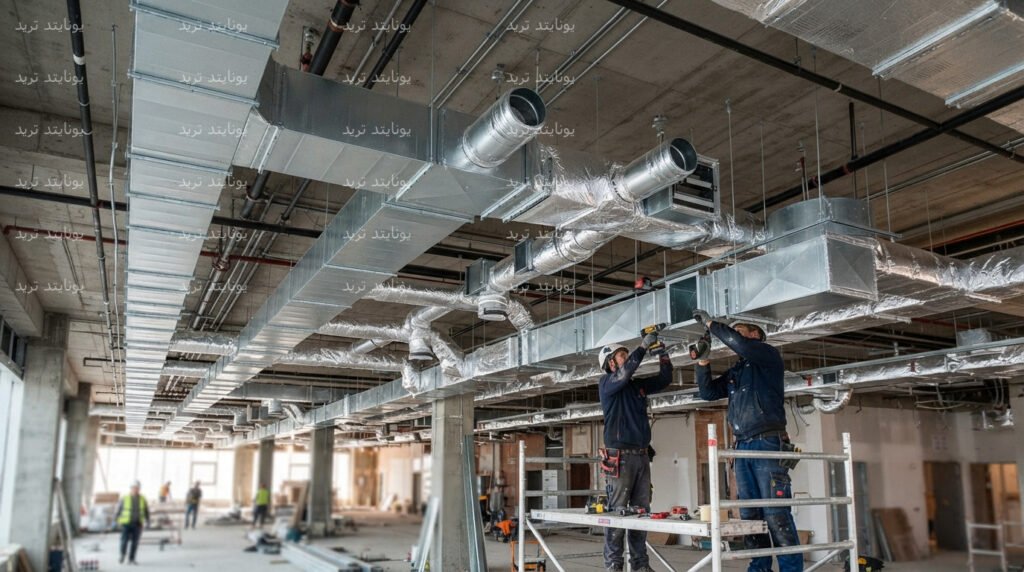
It is a process Air conditioning duct extension The step that most affects the efficiency of the entire cooling system inside your home or office. The precise engineering layout of the copper paths and their connections prevents the loss of Freon gas pressure, ensuring strong performance of the air conditioner throughout its years of operation. In this content, you will discover the technical standards adopted to ensure a professional installation that avoids common faults and significantly reduces electricity consumption.
Planning piping paths to ensure optimal flow
A path must be specified Air conditioning duct extension Very carefully to avoid sharp bends that impede the movement of Freon. The direct and least long path is always the best option to reduce heat loss within the ducts.
❓ Engineering criteria for choosing the appropriate path
It is always advisable to choose a path that avoids concrete columns or hidden electrical wires to facilitate future maintenance. Pipes must be completely thermally insulated using “Armaflex” material to prevent condensation or energy loss.
❓ Avoid sharp bends in copper
Using a specialized pipe bender prevents bottlenecks in the pipe's internal diameter. Bottlenecks lead to high compressor pressure, which significantly shortens its life.
Selection of copper ores and insulation materials
Quality of materials used in Air conditioning duct extension It directly determines the sustainability of the system and avoids Freon leaks. Copper intended for air conditioning must be of a thickness that can withstand high gas pressures without corrosion.
| Standard | High quality brass 🏆 Editor's choice | Commercial copper |
|---|---|---|
| Withstand Freon pressure | ✓ Excellent | ✗ Average |
| Flexibility and ease of formation | ✓ High | ✗ Low |
| Wall thickness | ✓ Conforms to specifications | ✗ Thin |
| Shelf life | ★ 9.5/10 | ★ 6.0/10 |
Investing in original copper materials with approved thickness saves you periodic maintenance costs resulting from gas leaks. Always make sure to use a thermal insulator with a thickness of at least 9 mm to ensure effective thermal insulation.
Steps for technical implementation of the cooling network
We begin by carefully planning the route, then cutting the pipes and preparing them for connection. After that, welding operations are performed by a specialized technician using oxygen and acetylene gas to ensure strong bonding. Finally, the network must be tested with nitrogen pressure to ensure that there are no leaks before the final covering process is completed.
The importance of pressure and vacuum testing
Pressure testing with nitrogen gas is the difference between a successful system and a failure-prone system. The goal of this process is to ensure that all connections are tight Air conditioning duct extension Before charging the device with refrigerant.
❓ Vacuum is an indispensable necessity
Using a vacuum pump to remove moisture and air from the cycle prevents acidity from forming inside the compressor. The presence of moisture leads to corrosion of internal components and damage to the oil, causing serious malfunctions in the refrigeration cycle.
Advantages and disadvantages
Features:
requires Air conditioning installation It is effective to choose copper pipes with standard thickness and specifications that match the device’s capacity, to ensure an ideal flow of refrigerant gas without any leaks. Experts also stress the need to carefully insulate these pipes thermally to prevent condensation and maintain the cooling temperature, which extends the lifespan of the internal and external units.
Implementation of air conditioning work requires special care at one stage Establishing pipes Cooling inside walls and ceilings before starting final finishes. This procedure is based on choosing the appropriate copper diameters and insulating them with extreme precision to avoid Freon leakage or moisture condensation, which creates a solid infrastructure that guarantees the safety of the system and the stability of its operational efficiency.
Requires implementation of Efficient air conditioning installation High consideration for the tight installation of the indoor and outdoor units and precise adjustment of the airflow balances to prevent vibrations and noise. Insulating the electrical connections and testing the circuit pressure before operation also contributes to enhancing safety and avoiding any sudden malfunctions.
The effectiveness of these extensions is not complete without adherence to procedures Regular air conditioning maintenance Checks the integrity of the refrigerant lines and prevents any possible leakage of Freon over time. This periodic inspection helps clean filters and detect malfunctions early, which maintains air flow stability and extends the life of air conditioning units.
Maintaining cooling efficiency requires applying specific steps Secrets of extending air conditioning ducts Carefully, starting by choosing the shortest, least curved paths to reduce resistance to the flow of Freon gas. Precise selection of pipe diameters and thermal insulation also helps reduce compressor overload and prevent energy waste, ensuring a longer operational life of the device and stable performance in the long term.
The expansion process requires selecting precise copper diameters that match the cooling capacity, as any error in calculations may lead to throttling of the gas flow and dangerously raise the pressure on the compressor. Therefore, adopting smooth paths and avoiding sharp bends is the best way to ensure... Safety of air conditioning extensions Avoiding Freon leaks that deplete cooling efficiency over time.
The importance of the system does not stop only at the quality of establishment, but extends to include periodic follow-up through a procedure Air conditioning maintenance Preventive measures that ensure the safety of internal components from damage. Regular technical inspection contributes to early detection of gas leaks or dust accumulation, which maintains the continuity of cooling with high efficiency and extends the life of the device.
The success of this system requires strict engineering principles to be followed Establishing pipes Air conditioning in walls and ceilings during the first stages of construction. Proper burying of the pipes and the use of copper diameters matching specifications ensures that the network is protected from blockages and leaks, providing an ideal operating environment for the devices in the long term.
Once the proper foundation is in place, the priority shifts to programs Air conditioning maintenance Periodic to ensure the sustainability of this efficiency and avoid sudden breakdowns. Preventive inspection of system components and treatment of build-up in external units extends the life of the device and keeps power consumption within optimal levels.
The success of this system requires careful attention at some stage Installing air conditioning ducts In the structural structure of the building and before the final finishing works. Choosing appropriate diameters and using copper materials with durable thermal insulation protects the network from future damage and facilitates maintenance operations later.
- Increase cooling efficiency and save electricity consumption.
- Extend the life of compressor and mechanical components.
- Prevent Freon leakage and protect the environment.
- Ease of maintenance if the establishment is organized.
Disadvantages:
The success of these connections requires the implementation of steps Air conditioning installation With extreme precision, starting with installing the indoor and outdoor units in locations that ensure smooth airflow, all the way to tightening the mechanical and electrical connections. This compatibility between the quality of the tracks and the accuracy of the installation is what gives the system its maximum operational efficiency and protects it from premature malfunctions.
- The initial establishment cost is higher when using original materials.
- It requires high precision in implementation and technical specialization.
- Difficulty in treatment in the event of an error after burying the pipes.
Based on technical criteria, we give Professional Copper Network Setups a rating of 9.4/10. It is strongly advised not to compromise on the quality of the brass or the skill of the technician; This decision saves you huge amounts of subsequent repair costs and ensures optimal performance for your device.
Frequently asked questions
❓ What is the maximum distance allowed to extend air conditioning ducts?
The maximum distance varies depending on the capacity and type of the air conditioner, but often ranges between 15 to 25 meters to ensure efficient cooling without the need to supply gas.
❓ How can I be sure of the quality of the copper used in the extension?
Ensure that the copper bears the standard conformity stamp, is of a heavy weight and has a wall thickness of at least 0.8 mm for common diameters.
❓ Can copper pipes be soldered using glue?
No, it is strictly prohibited to use glue or materials other than brazing. The high Freon pressure requires strong soldering connections to prevent any future leaks.
❓ Why does ice appear on air conditioning pipes?
The appearance of ice is often the result of a lack of Freon charge, a blockage in the path, or a sharp bend in the... Air conditioning duct extension It hinders the cooling movement.
❓ How long does a nitrogen pressure test take?
The test usually takes from 30 minutes to an hour to ensure that the indicator is holding the desired pressure, ensuring that there are no pinholes.
conclusion
The care of Air conditioning duct extension From the start, you are guaranteed peace of mind and unrivaled cooling efficiency. Always make sure to cooperate with specialized technicians and rely on approved materials to protect your investment in air conditioning devices.
















Community dialogue
0 comments