
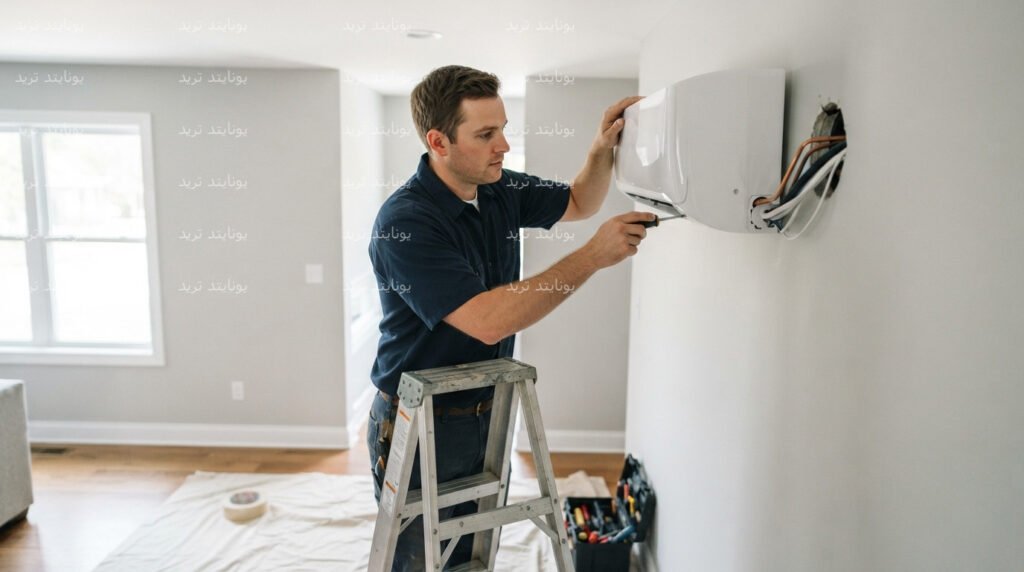
The efficiency of cooling devices depends mainly on the accuracy Air conditioning installation According to strict engineering standards; Technical data indicate that the quality of field installation affects the overall performance of the device by more than 80% [1]. When installed correctly, it ensures sustained cooling, reduces electricity consumption, and avoids premature breakdowns that could stress the compressor. In this article, we will review the basic technical steps and international standards to ensure that your device operates at the highest possible efficiency.
The basics of choosing the ideal location for the indoor and outdoor unit
requires Air conditioning installation It is successful to choose strategic locations that ensure effective air distribution and protect sensitive parts from weather factors. The indoor unit must be installed in a central area away from direct heat sources, making sure there is enough space to clean the filters periodically.
❓ Outdoor unit installation standards to ensure sustainable cooling
The outdoor unit must be placed in a completely shaded place, away from direct sunlight and sources of heavy dust. Technical standards require leaving a distance of no less than 30 cm between the unit and any back wall to ensure smooth air flow [5], which prevents the compressor from suddenly rising in temperature.
Fine tuning of wall openings and drainage extensions
A process is done Air conditioning installation Professional by adjusting the inclination of the wall opening and the angle of the indoor unit to ensure water drains naturally. The wall hole must be drilled at an angle of 5 to 10 degrees outward to prevent condensation water from refluxing into the room.
❓ Adjust the water balance of the indoor unit
The indoor unit must be adjusted using a precise water level with a slight inclination of no more than 2 mm towards the drain pan [2]. This simple adjustment prevents water accumulation inside the plastic body, and protects the device from corrosion or water leaks that may damage the chamber walls.
The importance of the vacuum and air vacuum process
The vacuum process (emptying air and moisture) is the most sensitive stage Air conditioning installation New to ensure refrigerant efficiency. Neglecting this step leads to a sharp drop in cooling capacity of up to 40%, with double electricity consumption due to the presence of impurities within the cooling cycle [1].
❓ Technical challenges of modern refrigerants
Advanced devices use refrigerant gases such as (R-32), which operate at 3% to 10% higher operating pressures compared to (R410a) [4]. These high pressures require extreme precision in tightening the copper connections (flare nuts) and using nitrogen in leak tests to ensure that no amount of refrigerant is lost.
| Technical standard | Usual installation | Professional installation (🏆 Editor's choice) |
|---|---|---|
| Vacuum process | ✕ | ✓ 9.8/10 |
| Adjust the water balance | ✗ Not accurate | ✓ 10/10 |
| Wall inclination angle | ✗ Not well thought out | ✓ 9.5/10 |
| Nitrogen test | ✕ | ✓ 9.9/10 |
Advantages and disadvantages of installation procedures
Features:
- Compliance with vacuum standards extends the life of the compressor by up to 50%.
- Adjusting the correct inclination prevents wall damage caused by water leakage.
- Using precise measurements increases the cooling efficiency of the device.
Disadvantages:
It is a stage Establishing copper pipes The basic foundation upon which the success of the cooling system is based, as it requires extreme precision in choosing paths and providing thermal insulation to prevent gas leakage or loss of cold. Careful implementation of this installation in accordance with technical principles ensures the flow of the refrigerant with high efficiency, which prolongs the life of the device and protects the compressor from excessive operational pressures.
- Professional installation requires more time compared to traditional methods.
- These procedures require expensive measuring tools that not everyone has.
❓ Editor's judgment and final rating
Our rating for this trail is 9.7/10. Commitment to steps Air conditioning installation The aforementioned represents a long-term investment that protects your device from malfunctions. This approach suits homeowners looking for stable cooling performance and significantly reduced monthly bills.
This operational efficiency is not complete without adherence to steps Regular air conditioning maintenance It includes checking refrigerant levels and cleaning filters and condensers periodically. This technical audit contributes to maintaining the device’s original capacity and avoiding sudden breakdowns during peak summer use, which extends the life of the compressor and reduces operating costs.
Reaching this level requires progress in applying standards Professional air conditioning installation With extreme precision, starting from balancing the units and avoiding refrigerant leakage, all the way to tight thermal insulation of the pipelines. This strict engineering commitment ensures airflow at the highest operating efficiency and protects internal components from constant thermal stress.
Reaching this level requires following principles Professional air conditioning installation It included applying engineering standards at every step in the field, from carefully calculating distances and air distribution, all the way to tightening the insulation of the cooling pipes and installing the units in perfect alignment. This strict adherence prevents refrigerant leakage and reduces mechanical vibrations, providing an ideal operating environment that delivers maximum cooling power with the lowest possible energy consumption.
This ideal performance is not complete with precise installation alone, but rather requires periodic follow-up to ensure continued efficiency and prevent mechanical corrosion of the internal parts. Therefore, the implementation of specialized programs in Air conditioning maintenance Regularly protects the compressor from thermal stress and maintains fresh air flow with minimal energy consumption.
A stage comes Establishing cooling pipes As a cornerstone of the process, extending copper paths requires extreme precision in insulation and bending to avoid any leaks or loss of Freon pressure. This proper establishment ensures optimal refrigerant flow, protecting the compressor from operational stress and extending the life of the entire system.
This ideal performance of the compressor and the cooling system as a whole is not complete without adhering to the steps Regular air conditioning maintenance Maintains heat exchange efficiency and filter purity. This preventive follow-up contributes to early detection of Freon gas leaks and avoiding sudden malfunctions, ensuring the longest possible lifespan of the device with the lowest energy consumption.
Achieving this efficiency begins early in the stage Installing air conditioning ducts Brass with geometric precision that takes into account direct paths and avoids sharp bends. Choosing appropriate pipe diameters and tightly insulating them ensures smooth flow of the refrigerant compound and prevents Freon leakage or moisture formation inside the walls.
This diagram shows the professional sequence that must be followed to ensure a successful installation and obtain the best possible cooling performance.
Frequently asked questions
❓ Why is vacuum necessary when installing a new air conditioner?
The vacuum process removes air and moisture from the copper tubes, preventing ice from forming inside the device and ensuring fully efficient refrigerant circulation.
❓ Does the location of the outdoor unit affect your electricity bill?
Yes, placing the outdoor unit in a dark and ventilated area reduces the compressor voltage, which results in a significant reduction in electricity consumption.
❓ What is the appropriate capacity for large spaces?
In hot regions, it is recommended to estimate 500–600 BTU per square meter, while temperate regions need about 333 BTU per square meter [3].
❓ Can the device be installed without a slight tilt of the drain hole?
Strictly prohibited; The tilt is necessary to ensure that water flows outward and prevent it from accumulating inside the indoor unit, causing stains on the walls.
❓ How do I ensure the safety of copper connections from leaking?
A nitrogen pressure test must be performed after tightening the Flare Nuts to ensure that there are no gas leaks before actual operation begins.
By following these technical steps, you are guaranteed to get the highest possible performance from your device while reducing power consumption. Do not hesitate to request a specialized technician who adheres to these standards to ensure the comfort of your home throughout the summer.
















Community dialogue
0 comments