
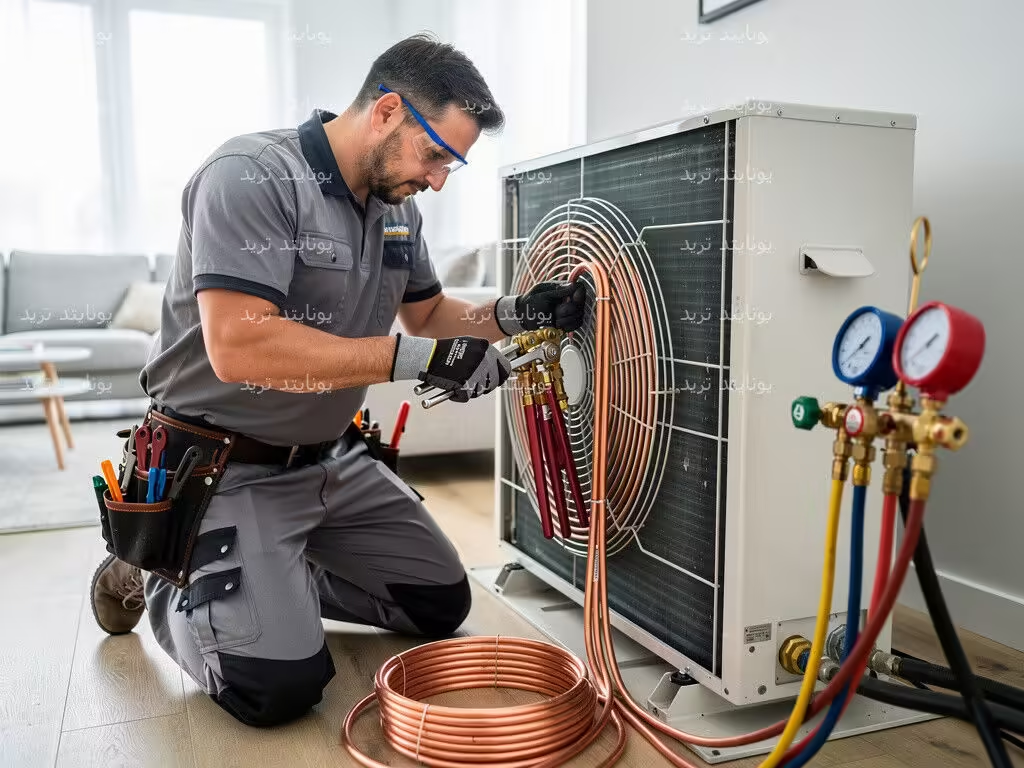
Extending the air conditioning ducts represents the basic foundation for ensuring that the cooling system operates with high operational efficiency and economical energy consumption for many years. This comprehensive guide helps you identify the correct field stages of installing a copper network, starting from choosing the appropriate thickness all the way to pressure and vacuum testing, thus avoiding compressor damage and costly refrigerant leakage inside the building.
Quick Answer: What are the basic rules for a successful extension?
Extending air conditioning ducts is the process of installing and securing refrigerant gas intake and exhaust lines made of copper between the indoor and outdoor units according to precisely specified diameters. The success of this process depends on using certified original copper, covering it with thermal insulation at least nine millimeters thick, and performing a pressure test with dry nitrogen gas under two hundred and fifty pounds per square inch for twenty-four hours to ensure that there are no leaks completely.
How to choose suitable copper pipe for extension?
The choice of refrigerant piping depends on the capacity of the air conditioner and the type of refrigerant gas used in the engineering cycle. Modern refrigeration units that rely on R gas require four hundred and ten tubes with a wall thickness of no less than eight-tenths of a millimeter, in order to withstand higher operating pressures compared to older systems. In addition, technicians prefer to use Korean or American L-type copper coils, as these types are characterized by superior flexibility that reduces the possibility of microscopic cracks during bending operations inside the walls.
Technical differences between copper thickness grades
Wall thickness determines how well the pipe can resist internal corrosion caused by the reaction of oil and refrigerant. For example, thin-walled pipes are completely unsuitable for installation inside cement plaster. As a result, selecting pipes conforming to ASTM P280 guarantees a lifespan exceeding fifteen years without corrosion.
Indispensable engineering tools in extending air conditioning ducts
Copper network extension operations require specialized tools to prevent bottlenecks that impede the flow of the refrigerant in the path. These tools include mechanical pipe benders, nozzle expanders, vacuum cleaners, and sharp circular copper cutters to ensure smooth, burr-free edges.
- Manual pipe bender: allows corners to be formed without bending the inner pipe, keeping the gas flow rate constant.
- Pipe End Expander: Facilitates overlapping of pipe ends before welding to ensure a strong, tight mechanical bond.
- Vacuum pump: removes moisture and impurities stuck inside the network before completely opening the refrigerant valves.
- Nitrogen Gas Regulator: Allows gas to be injected at a calculated pressure to test the durability of welds and connection points without causing damage to internal valves.
Professional installation and thermal insulation steps
The correct installation step begins with passing each cooling line through an independent thermal insulator made of closed-cell rubber foam. This separation prevents heat exchange between the cold intake line and the warm liquid line, which maintains heat exchange efficiency when the gas reaches the evaporator. In addition, the external insulation must be wrapped with UV-resistant PVC protection tape if the installations run in paths exposed to the sun.
Standards for protecting lines inside walls and ceilings
The pipes are installed inside flexible plastic channels or custom ducts to protect them from decorative nails and future plaster work. It should be noted that it is necessary to leave a safe distance between copper pipes and high-voltage wires to avoid any effect of the electromagnetic field on the signal cables and sensors. On the other hand, sharp bends at ninety degrees should be avoided, and replaced with wide, smooth bends to reduce the effort exerted by the mechanical compressor.
Comparison between buried and exposed extension paths
The type of building and the nature of the architectural design determine the appropriate cooling network path method for each interior space. The following table shows a precise comparison between extension inside walls and extension through exposed surface ducts to help you make the best decision for your project.
| Comparison standard | Extension buried in the wall | Exposed virtual extension |
|---|---|---|
| Aesthetic appearance | Completely hidden and preserves the beauty of the interior decoration | It is visible and requires plastic runners to beautify the path |
| Initial installation cost | Higher due to crushing and structural stabilization works | Low and fast without cracking in buildings |
| Easy maintenance and inspection | Requires electronic detectors and may require breaking in emergency | Easy and direct, and the tubes can be visually inspected |
| Level of mechanical protection | Completely protected from external shocks and the sun | Vulnerable to direct friction or mechanical damage |
| The life span of the insulator | Lasts longer due to not being exposed to wind and external heat | It needs to be renewed every few years because it is affected by weather factors |
Catastrophic errors destroy the refrigerant path
Some technicians make common mistakes that ultimately lead to the compressor motor burning before the end of its life. The most prominent of these errors is combining the intake and exhaust tubes together inside one insulating tube, which leads to a noticeable loss of cooling and an increase in the temperature of the compressor. Therefore, separating the suction line from the liquid line with independent insulators is an uncompromising golden rule in residential and commercial applications.
The process of installing the internal and external units requires extreme precision to ensure smooth air distribution, as the success of the cooling system depends entirely on implementing Proper air conditioning installation It takes into account appropriate water drainage tendencies and safe ventilation distances. This mechanical integration ensures the compressor is protected from premature fatigue and gives you the highest energy efficiency ratings in your target space.
- Neglecting to pump nitrogen during welding: This leads to the formation of black oxide scales inside the pipes that later clog the expansion valve.
- Exceeding the permissible lengths without adding oil: This causes a lack of compressor lubrication due to oil being trapped inside the remote paths.
- Bending pipes with the bare hand: causes invisible internal bottlenecks that raise the exhaust pressure and consume additional electrical current.
- Failure to vacuum the air: leaves moisture that combines with the refrigerant gas to form hydrochloric acids that corrode the internal copper coils.
How to test the cooling network and ensure its safety
Pressure and vacuum testing is the critical separator between an amateur installation and a reliable, well-done engineering job. The technician gradually pumps dry nitrogen gas into the pipes until it reaches a pressure of two hundred and fifty pounds per square inch while monitoring the pressure gauge indicator. It should be noted that the stability of this indicator for an entire day gives you conclusive confirmation that there are no leaks at the connection points or copper welds.
Completing this system requires advance planning starting from one stage Installing air conditioning ducts Inside the walls and ceilings with thoughtful diameters and streamlined paths that reduce sharp bends. This step ensures that the cooling lines are protected from leakage or suffocation in the future, and facilitates the periodic maintenance process without the need for subsequent breakage or structural modification.
Early system damage, especially if services are neglected Regular air conditioning maintenance It may aggravate undetected leaks and degrade compressor capacity. Continuous preventive inspection of pipes and their connections contributes to addressing blockages and controlling refrigerant levels before they turn into costly malfunctions that affect the air quality inside the space.
The success of this establishment is not complete without implementation Preventive air conditioning maintenance Regular maintenance includes cleaning mechanical parts and carefully calibrating the thermostat. These scheduled procedures contribute to reducing electricity consumption, and prevent sudden malfunctions that may put pressure on the piping network and weaken its efficiency over time.
The process of establishing air conditioning ducts requires careful engineering care to determine safe paths within walls and floors away from structural stress points. The success of this step also depends on the application Burial standards and copper selection The thickness and diameters conform to standard codes to ensure resistance to high pressures and avoid leakage of refrigerant gas in the future.
Requires work to be carried out Installing air conditioning ducts Careful planning of the paths inside the concrete walls and ceilings before the finishing stage to ensure smooth flow of the refrigerant. This procedure also requires insulating the pipes with advanced materials and installing them with a studied slope that prevents the accumulation of moisture or vibration of the network during continuous operation.
require Air conditioning maintenance Homes should be carefully checked periodically, including checking the copper connections and ensuring the integrity of the thermal insulation, as any minor leakage of refrigerant gas as a result of corrosion of the pipes may lead to a sharp decrease in cooling efficiency and increased pressure on the engine. Therefore, conducting a comprehensive preventive examination ensures the continued optimal performance of the device and significantly extends its lifespan.
require Air conditioning maintenance Homes and establishments should periodically inspect the cooling paths, as any minor leak in the copper connections leads to the loss of Freon gas and a decline in the device’s ability to cool. Therefore, performing preventive maintenance and checking the integrity of the pipes ensures continued optimal performance and protects the compressor from premature damage due to abnormal pressures.
The process of completing the technical preparations requires following precise and deliberate steps during Air conditioning installation Air, as this stage ensures that the internal and external units are installed in perfect alignment, preventing vibrations and refrigerant leakage. Precisely adjusting the drainage angles and securing the electrical connections also contribute to enhancing cooling efficiency and extending the lifespan of the entire system.
Requires work to be carried out Installing air conditioning ducts Accurate engineering planning determines the extension paths away from sources of heat and excessive structural pressure. This includes precisely installing copper circuits and drainage pipes and completely thermally insulating them inside the walls before the finishing stage to ensure smooth flow of the refrigerant medium and prevent moisture condensation.
The culmination of these delicate extensions requires a step Air conditioning installation Air Installing the indoor and outdoor units in geometric parallel to prevent any future vibrations. The tight connection between the copper connections and the cooling devices ensures that the refrigerant flows smoothly and without the slightest leakage, which increases the quality of the system’s final performance.
The stage of emptying and withdrawing moisture from the system
This stage begins after ensuring that the path is free of leaks and that the nitrogen gas has been completely emptied out of the network. Connect a vacuum pump to draw air until the pressure reaches five hundred microns on a digital vacuum gauge. As a result, suspended moisture evaporates into steam that exits the circuit, protecting expansion valves from freezing during intense field operation.
Frequently asked questions
What is the maximum length of HVAC duct extension?
The recommended maximum range for most household appliances is between fifteen and twenty-five meters according to the manufacturer's brochure. If the distance exceeds this, a calculated amount of refrigerant and lubricating oil must be added to compensate for the loss in the long path.
Can old air conditioning pipes be used with a new device?
Yes, it can be used provided the inner track is washed with designated cleaning fluids and a careful pressure test is performed. But if the old pipes are damaged or have a smaller diameter than the requirements of the new device, they must be replaced immediately to avoid damaging the compressor.
How do I know if there is a leak in the air conditioning duct extension?
You can notice the leakage by decreased cooling efficiency, and a layer of ice on the thin intake pipe at the outdoor unit. You can also use specialized soap foam on welding points or use precision electronic gas detectors.
Why should copper pipes be insulated separately?
Each pipe must be individually insulated to prevent heat transfer between the cold gas line and the high temperature liquid line. This separation increases the efficiency of the cooling cycle and prevents water droplets from condensing on the walls and interiors of the building.
What is the difference between American, Korean and Chinese air conditioning copper?
American and Korean brass has high metal purity, consistent wall thickness, and excellent resistance to corrosion and bending without cracking. In contrast, Chinese commercial copper may come with lower wall thicknesses that may not withstand the high pressures of modern refrigerants.
Extending air conditioning ducts requires following strict engineering standards and selecting original components to ensure stable home cooling for many years. Always make sure to assign certified technicians to conduct pressure and vacuum tests before operating the system, and invest in periodic inspection of the paths to avoid sudden malfunctions and maintain the efficiency of your device.
















TQTAG76 Community dialogue
0 comments