
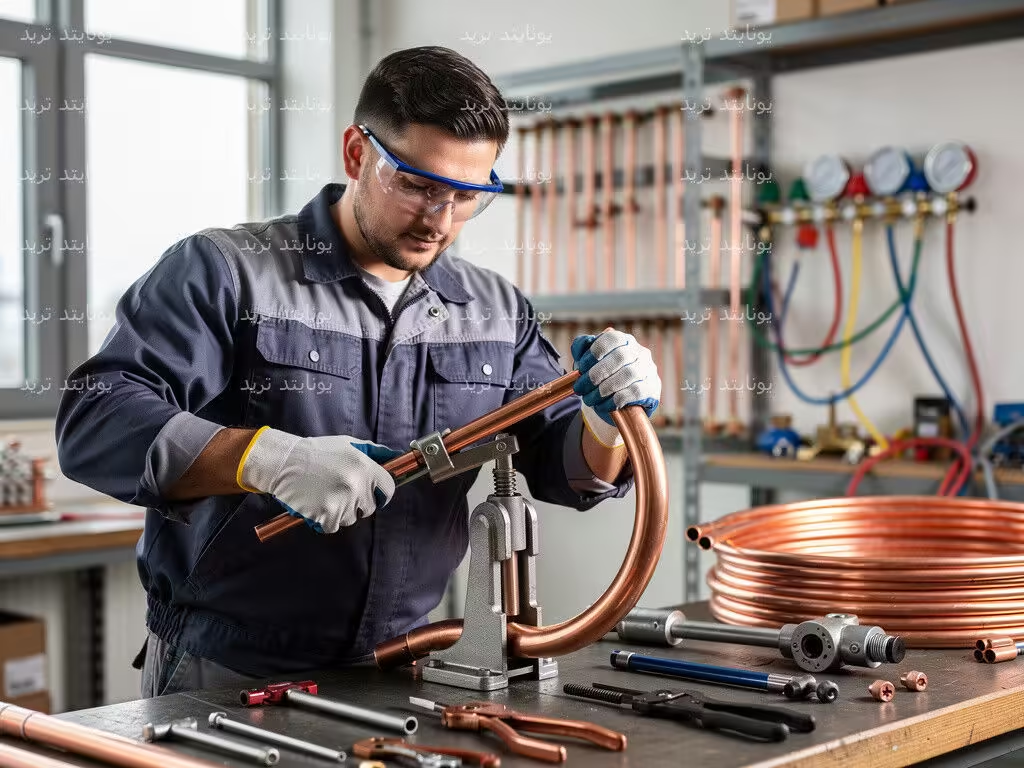
Installing copper pipes represents the basic foundation for ensuring the efficiency of cooling systems and transporting fluids without being exposed to the risk of leakage or low levels of mechanical stress. This practical article helps you understand the correct field implementation steps, starting from preparing the pipes until conducting final tests with the highest quality standards approved by engineering.
Quick Answer: What are the basic rules for installing copper pipes?
Installing copper pipes is an engineering process that aims to create tight paths for transporting cooling media or water, and depends on choosing the appropriate thickness and type of copper suitable for the pressure of the system. This process requires precise cutting of the pipes, removal of internal tarnish, and the use of silver or flash soldering techniques under a flow of nitrogen gas to prevent oxidation. Successful work is completed by a careful pressure check and complete deflation to ensure safe and stable operation.
Choosing pipe diameters and thicknesses according to system requirements
The determination of pipe diameter and wall thickness depends on the fluid flow rate and the magnitude of the operating pressures expected within the expanded network. As a result, inaccurate selection leads to loss of heat exchange efficiency or cracks resulting from constant mechanical stress.
Copper pipes are available in the market in several standard varieties that vary depending on wall thickness and tolerance level. For example, the thick type is used in gas and refrigeration lines with high pressures, while the medium types meet the needs of domestic water supply networks.
Operational differences between rigid and flexible pipes
Rigid pipes are superior in their ability to withstand pressures and long straight paths, giving the network an organized and stable geometric appearance. In contrast, flexible tubing provides great ease of shaping and bending in tight spaces without the need for many additional connections.
Furthermore, flexible copper reduces welded contact points, reducing the possibility of leaks in hidden paths within walls or concrete cavities.
| Copper tube type | Level of wall thickness | Typical field use | Pressure tolerance level |
|---|---|---|---|
| Type K (green) | Very thick | Underground installations and high pressures | Too high |
| Type L(Blue) | Medium thickness | Refrigeration, air conditioning and internal water networks | High and suitable for homes |
| Type M (red) | Thin | Internal drainage lines and light water supply | Medium to low |
| Type ACR | Vacuumed and dried with nitrogen | Closed circuit refrigeration and air conditioning | Designed for high refrigerants |
Tools and equipment needed to successfully complete extension work
Field fittings require specialized tools to preserve the structure of the copper and prevent deformation of its roundness during cutting and shaping. In addition, the use of proper equipment protects technicians from the risk of burns or inhalation of gases resulting from direct heating operations.
- Rotary tube cutter to ensure even cutting at right angles free of distortions.
- Internal deflation and removal tool to ensure free flow of fluid and prevent pressure turbulence.
- Mechanical pipe bends to avoid bending of the walls during twisting and bending.
- Conical flange device for connecting mechanical connections with complete precision.
- Oxygen and gas based dual welding torch to produce a uniform temperature flame.
Steps for processing and cutting pipes without distortion
The practical phase begins with precise measurement and determining the path to avoid wastage of materials and take into account thermal expansion angles. Therefore, handling copper with caution is an essential step to avoid any surface scratches that may weaken the metal's ability to resist stress.
Hold the cutter at the mark position and gently rotate it around the pipe while gradually tightening the handle after each complete revolution. It should be noted that excessive and sudden pressure causes the pipe cross-section to become oval and the internal flow space to narrow.
The importance of removing sharp edges and feathers
Internal cutting burrs create air vortices that increase frictional resistance and significantly reduce fluid flow velocity. Accordingly, a feather scraper should be used to clean the inner edge with the tube opening facing downward to prevent metal fragments from falling inside.
This simple step ensures that the connection fittings are securely fastened and prevents impurities from being trapped that could damage refrigeration system compressors or clog delicate diffusion valves.
Approved technical rules for bending pipes without reducing the diameter
Bending copper pipe requires the use of benders appropriate to the specified radius for each size to avoid breaking the outer wall of the pipe. In contrast, random manual bending reduces the cross-sectional area by more than thirty percent.
Therefore, the bending angle must be adjusted according to the guide templates accurately and quietly to ensure uniform thickness at the bending arc. Furthermore, bending and then straightening the tube should be avoided, because copper undergoes stress hardening, making it brittle and susceptible to instant breakage.
Mechanical bonding and welding techniques with copper and silver
The choice of connection method depends on the nature of the system and the location, as removable connections are preferred for external equipment and regular maintenance. It should be noted that fastening with a conical flange requires precisely adjusting the width of the flange without cracking its metal ends.
Silver soldering is the most reliable option for high-pressure systems and hidden pipes inside buildings to ensure a permanent leak-proof seal. In other words, this rigidly structured bond provides bond strength comparable to that of the original tube and withstands the operating vibrations of engines.
The next stage requires initiating steps Air conditioning installation With extreme precision to ensure proper mechanical connection between the internal and external units through these equipped pipes. This includes installing the holders and emptying the circuit of air and moisture before injecting the refrigerant gas to achieve the highest operating efficiency of the device.
The initial stage requires extreme precision in determining paths and preparing construction corridors before extending the network, as it includes a phase Establishing pipes Cooling avoids sharp bends and protects lines from constant friction and vibration. Tight fitting of insulators and substrates in this early step also contributes to maintaining pressure stability and preventing condensation in the future.
Completing the networking phase requires going directly to the following steps Air conditioning installation According to precise standards that ensure that the internal and external units are installed in a tight balance. This step includes connecting the refrigerant lines and carefully discharging the air from the circuit to avoid moisture, which ensures efficient refrigerant flow and the highest operational performance of the system.
Cooling efficiency does not stop at the quality of the initial installations only, but also extends to periodic follow-up via... Regular air conditioning maintenance Protects the system from sudden malfunctions. This continuous check ensures that Freon gas pressure and compressor efficiency are maintained, which increases the operational life of the system and reduces energy consumption.
requires Air conditioning duct extension Great care is taken in choosing the diameters and thicknesses of copper appropriate to the flow rates specified by the manufacturer, in order to avoid the accumulation of impurities and the occurrence of bottlenecks in the cooling cycle. Implementing preventative nitrogen network pressure testing procedures is also a critical step to ensure the path is free of moisture and blockages before the final gas is charged.
The safety of copper wiring is integrated with precision in implementation Air conditioning installation Air in a suitable place that ensures free flow of air away from obstacles and direct heat sources. Proper installation of the indoor and outdoor units allows for optimal cooling and maximum operational efficiency while reducing energy consumption and protecting mechanical components from premature fatigue.
Cooling efficiency does not depend only on the quality of the initial installation, but continuity of performance requires the adoption of procedures Regular air conditioning maintenance To detect any early leakage of Freon gas and treat blockages in the flow circuit. This regular checking contributes to maintaining stable mechanical stresses and extending the life of the piping system and vital components.
It requires an operation Establishing extension pipes High precision in routing and installing supports to ensure that pipes are not exposed to mechanical stress or vibrations during operation. Care should also be taken to insulate the pipes professionally to maintain the required temperatures and prevent condensation, which may lead to corrosion of structural structures in the long term.
Cooling efficiency does not depend only on the quality of the primary installations. Sustaining performance requires adherence to customized periodic programs that include checking filters and measuring refrigerant gas charges to avoid sudden malfunctions. Steps contribute Regular air conditioning maintenance In extending the life of the system and reducing energy consumption, which maintains stable temperatures inside the facility with the highest possible effectiveness.
The preliminary stage requires extreme precision in determining paths and adjusting geometric inclinations to ensure that the cooling media flows smoothly and safely. This includes carrying out work Establishing pipes Air conditioning and cooling according to architectural plans to avoid any sharp bends that may impede the movement of fluids or increase system stress in the future.
Nitrogen injection protocol during welding
The flow of low-pressure inert nitrogen gas into the tube prevents the formation of black copper oxide scales resulting from the reaction of the heated metal with oxygen. As a result, the inner surfaces of the tubes remain completely clean, protecting oil filters and coolant media from clogging and contamination.
It requires an operation Air conditioning installation Extreme precision in handling the copper paths to ensure that the refrigerant gas flows completely smoothly without obstructions. Care must be taken to use specialized bending tools to avoid any sharp bends that may affect the cooling efficiency or cause a weakening of the pressure of the entire system.
This procedure is applied by opening a slow flow path for nitrogen throughout the period of heating of the joint until its natural cooling, while being careful not to suddenly cool with water, which weakens the quality of the weld.
Thermal insulation and installation of tracks to ensure the sustainability of the extensions
Installing copper pipes in cooling systems represents an incomplete project unless it is completed by applying tight thermal insulation made of flexible, closed-cell rubber. In addition, good insulation prevents atmospheric water vapor from condensing on the outside cold surface, protecting buildings from moisture damage and corrosion of the loads.
The tracks must be fixed with clips lined with insulating materials that separate the copper and iron to avoid galvanic corrosion caused by the contact of heterogeneous metals. For example, it is important to leave regular installation distances of between one and a half meters to prevent the pipes from vibrating and sagging over time.
- Choose an insulator thickness that matches the ambient temperature and humidity differences at the site.
- Seal the insulation joints using specialized, weather-resistant adhesive tapes.
- Leave sufficient margins of movement at directional changes to account for natural thermal expansion and contraction.
- Protect pipes exposed to direct sunlight with protective aluminum films or covers.
Pressure and air discharge tests from the network
Dry nitrogen pressure testing is the critical step to verify the integrity and quality of all completed connections before the system is finally commissioned. Therefore, the pressure is gradually raised in stages until it reaches the specified design value, and then the network is monitored for a period of not less than twenty-four hours to ensure the stability of the pressure gauge.
After successfully passing the pressure check, there is a deep vacuum of air and moisture using a specialized suction pump and a highly sensitive micron gauge. This step ensures the complete elimination of any water droplets or non-condensable gases, ensuring efficient cooling and protecting the lubricating oil from acid decomposition.
Frequently asked questions about copper pipe installation
What is the best copper diameter for a home split air conditioner extension?
The diameter depends precisely on the cooling capacity of the unit, with 1.5-ton units often using a half-inch diameter intake tube with a quarter-inch diameter liquid tube. It should be noted that it is necessary to consult the manufacturer’s catalog because using inappropriate diameters weakens the cooling and damages the compressor.
How to avoid Freon leakage when installing copper pipes?
Leakage can be avoided by relying on precise flap tools that prevent cracking of the copper, and using the recommended tightening torques without excessive amounts to avoid breaking the nuts. In addition, silver welding under nitrogen gas and high-pressure network testing ensure that any faults are detected early and the system is completely secure.
Why should copper pipes not be bent by hand?
Random manual bending causes the pipe to buckle and its internal section to flatten, which impedes the flow of fluids and raises the pressure inside the system dangerously. Therefore, the use of a mechanical bending tool or springs maintains the roundness of the pipe and prevents cracking of the metal.
Can copper pipes be mixed with iron pipes in the same line?
Direct bonding between copper and iron is not recommended because this generates the phenomenon of electrogalvanic corrosion, which quickly destroys iron due to the difference in electrochemical potential. If necessary, non-conductive insulating joints should be used that completely separate the two metals to prevent corrosion.
What is the difference between K type and L type copper pipe?
The main difference lies in the thickness of the outer wall and the mechanical bearing capacity; Type K has a thicker wall and can withstand direct burial conditions and extreme pressures. In contrast, Type L has a medium thickness and is the most common standard choice for air conditioning and internal plumbing.
When should a copper pipe be replaced instead of repaired by welding?
The pipe must be replaced when it is subjected to a severe dent that significantly reduces its internal diameter, or if there is extensive chemical corrosion or longitudinal cracks in the metal structure. Moreover, if the pipe is exposed to excessive burning and loses its mechanical flexibility, replacing it ensures the safety of the entire system.
In conclusion, mastering the installation of copper pipes requires strict adherence to engineering standards and the use of appropriate specialized tools at every stage of the installation. If you plan to implement a new cooling or supply network, always apply approved pressure and insulation tests, or hire a professional technician to ensure sustainable operational efficiency in the long term.
















TQTAG76 Community dialogue
0 comments