
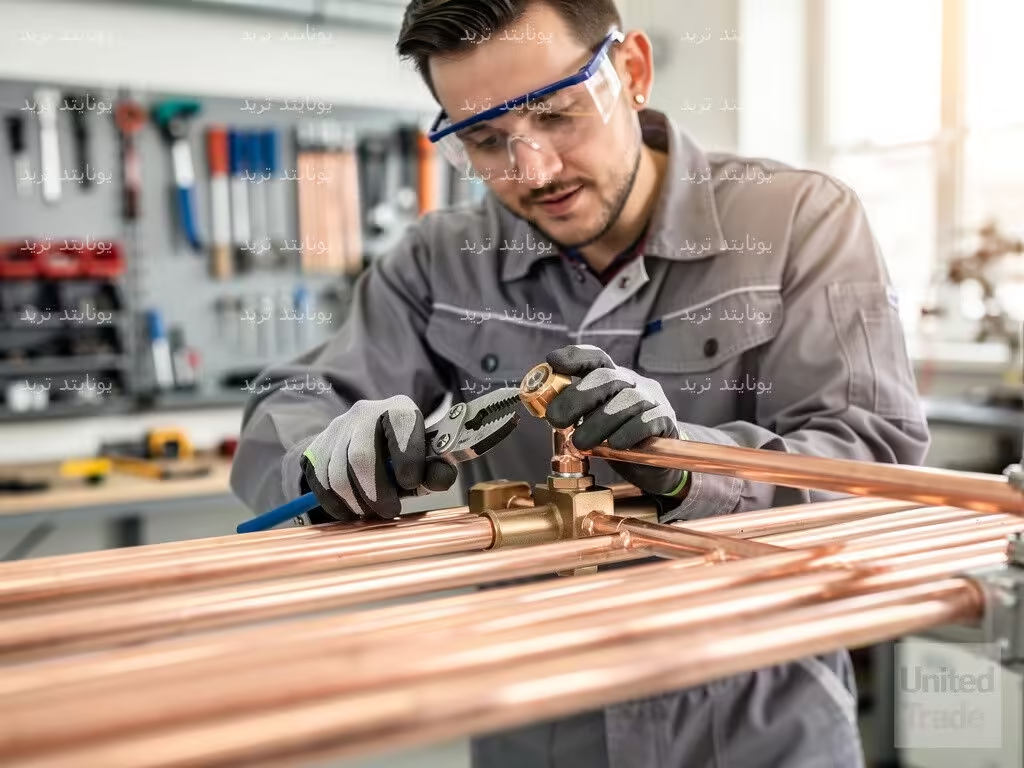
Installing copper pipes requires precise technical skill to ensure the sustainability of water and refrigerant transportation networks within residential and commercial buildings without leakage. This practical guide provides comprehensive instructions covering the work stages from cutting and shaping to installation and final welding to increase the efficiency of the system for the longest possible period.
Quick answer
Copper piping installation is a technical process aimed at installing copper lines through precise cutting, expanding nozzles, and joining by silver or mechanical welding under specific pressure. This method ensures highly efficient fluid transfer and excellent resistance to abrasion and extreme temperatures without leakage.
Choose diameters and thicknesses of copper pipes appropriate for the project
Pipe specifications depend on the operating pressure and the nature of the fluid passing through it to ensure that subsequent cracks do not occur. It should be noted that sizes vary between standard categories for water feed service or complex cooling systems.
Main categories of pipe sizes and thicknesses
The first type is thick-walled pipes intended for high pressure underground and main air conditioning lines. In addition, there are medium thickness options that are suitable for prominent internal extensions and aseptic sewer networks.
In contrast, light tubes provide a practical solution for short, low-pressure runs inside closed rooms. Therefore, checking the approved classification code helps avoid financial and material waste during purchase.
Criteria for suitability of pipe diameter to flow rate
Choosing a narrow inner diameter increases the fluid velocity and thus wears out the inner walls over time due to constant friction. As a result, it is always recommended to calculate the flow rate in liters per minute to choose a measurement that prevents noise and vibration in long lines.
| Tube class | Relative thickness | Most prominent uses | Degree of pressure tolerance |
|---|---|---|---|
| Type K | Extremely thick | Underground burial and central air conditioning | Very high |
| L type | Medium thickness | Water supply and cooling extensions | Medium to high |
| Type M | Low thickness | Home heating and drain lines | Low to medium |
| Type ACR | Variable thickness dried | Sensitive refrigeration and air conditioning circuits | Ultra high |
Basic equipment used in extending and processing copper lines
Professional work requires specialized equipment that maintains the circular cross-section of the pipes and prevents internal deformation or blockage during conditioning. For example, the use of specialized tools greatly reduces the chances of hidden leaks.
- Rotary tube cutter with solid steel blade for perfectly clean, even cuts.
- Internal and external metal removal tool to avoid disruption of the flow path.
- Mechanical bends with appropriate radius to avoid compression of the inner diameter when bending.
- Mechanical expansion device to efficiently connect overlapping ends before welding.
- A propane or gas-powered welding torch to adjust the bonding temperature.
Steps to install copper pipes with high engineering precision
The stages of preparing the tracks begin by determining the appropriate inclinations and calculating the distances between the suspension points with extreme accuracy to avoid the lines falling. Furthermore, implementation drawings should be reviewed to avoid intersection with power cables or high heat sources.
Correct cutting and blanking of metal edges
The tube should be placed inside the jaws of the cutter while turning the handle gradually and slowly to prevent dents in the outer shell during cutting. After completing the separation process, a metal edge file is used to remove all the formed debris to prevent clogging of the internal filters later.
Surface cleaning and application of fusing aid
The outer area of the tube and the inner area of the accessory are rubbed with coarse wire wool until the original, oxidation-free copper luster appears. Next, the deoxidation paste is applied in a thin, even layer to ensure capillary penetration of the welding material without leaving air voids.
Therefore, attention to surface cleanliness is the basic foundation for the success of copper pipe fittings and ensuring that they do not separate under severe mechanical pressure.
Copper connection welding techniques ensure no leakage
The quality of copper soldering depends on uniform heat distribution around the joint bond area without excessive heating that weakens the base metal. It should be noted that the welding torch must move in a balanced circular motion to reach the appropriate temperature.
- Heat the tube first to transfer the heat towards the inner joint by thermal induction.
- Direct the flame to the base of the copper joint until the surface turns dark copper.
- Touching the welding wire to the edge of the joint away from the direct flame, so that the metal melts itself with the heat of the metal.
- Pull the wire once the alloy has spread uniformly and completely into the depth of the circular void.
- Allow the connection to cool naturally without sudden water spills to avoid thermal breakage stress.
Soft welding compared to hard welding for vital networks
Soft welding is based on tin and copper alloys and is carried out at low temperatures of less than 450 degrees Celsius for normal uses. In contrast, hard welding requires silver and phosphor copper bars and temperatures exceeding 600°C to withstand high vibrations and extreme pressures.
The accuracy of laying refrigerant lines is closely related to the success of the process Air conditioning installation air and ensure its operation with the highest possible thermal efficiency. The tight connection of the pipes between the internal and external units prevents the leakage of Freon gas and protects the compressor from sudden malfunctions in the long term.
Thermal insulation and installation of pipes to protect them from environmental factors
Good encapsulation protects the copper mesh from surface water condensation that corrodes adjacent structural structures over time. In addition, insulation reduces thermal losses of hot water and maintains the stability of the cooling media.
The efficiency of water installations begins with the pre-planning stage and preparing the wall and floor paths with great care before starting the insulation and finishing work. Adherence to sound engineering standards during... Establishing feeding pipes Drainage is the real guarantee to avoid future collapse and blockage of networks under the pressures of continuous use.
Likewise, quality installations are incomplete without attention to Air conditioning maintenance A periodic period that ensures the safe flow of cooling media through these pipes. Periodic inspection of the system contributes to detecting any premature corrosion in the connections, which protects the device from sudden malfunctions and maintains the required level of cooling performance.
The success of extending cooling networks is closely linked to following the principles How to install air conditioning Correct ensures efficient flow of cooling media without loss of pressure. This requires applying engineering installation standards for the units to reduce vibrations and achieve the highest operational performance and lowest energy consumption.
Commitment is an application Insulation requirements and Freon line routes An essential pillar to prevent thermal energy loss and ensure smooth flow of refrigerant between the indoor and outdoor units. Precise engineering of pipe bends and coating with high-quality insulating materials contribute to protecting the compressor from mechanical stress and avoiding moisture condensation inside the walls.
The efficiency of the entire system starts from stage accuracy Establishing copper pipes Inside the walls and floors according to studied paths and correct geometric tendencies. Proper planning in this step ensures that the network is protected from mechanical stresses and facilitates subsequent insulation and installation operations with the highest safety standards.
The quality of laying these networks is closely related to the integrity of the flow of cooling media, which makes procedures Air conditioning maintenance Periodicity is imperative to maintain ideal operating pressures. Regular inspection of the contact points and ensuring the integrity of the thermal insulation helps avoid Freon leakage and protect the compressor from premature wear, ensuring stable cooling efficiency and balanced energy consumption in the long term.
The quality of extending these networks is closely related to their effectiveness Air conditioning maintenance Periodic, as continuous inspection protects copper cooling lines from moisture build-up and internal corrosion. Preventive technical intervention also ensures that any vibrations that may lead to cracking of the welds are addressed, which maintains ideal Freon pressure and extends the operational life of the cooling units.
These copper connections are of utmost importance when starting... Air conditioning installation Efficient pneumatic, precise pipe routing and insulation prevent Freon leakage and maintain compressor efficiency. The tight fit of the indoor and outdoor units also ensures a balanced flow of refrigerant, achieving the highest temperature control performance inside the building.
It is a stage Establishing pipes Water and drainage are the cornerstone of any building, as the efficient and safe flow of fluids within walls and floors depends on them. This work requires careful engineering planning of the extension paths, with the selection of the finest materials to ensure that they can withstand high pressures and avoid future construction problems.
The efficiency of the refrigeration cycle depends entirely on the accuracy of the work carried out Air conditioning installation According to the approved technical standards, the units are connected to copper tracks completely securely. This ensures refrigerant flow without loss of pressure or risk of Freon leakage, extending the life of the compressor and maintaining optimal cooling performance in all seasons.
Choose moisture-resistant rubber packaging materials
Closed-cell elastomer foam is the best choice for insulating refrigerant lines and feed pipes against atmospheric moisture penetration. As a result, the pipe remains protected from external moisture and rust, especially in coastal locations or humid air passages.
Installation distances and use of isolated jumpers
Fixing gloves lined with insulating rubber should be placed approximately every 1.5 meters to prevent transmission of vibrations and avoid direct contact with other metals. Furthermore, this thoughtful spacing allows the pipe to expand and contract thermally freely without exposing the connection joints to severe shear loads.
Testing and network pressure standards before the final commissioning phase
Compression testing is the crucial step to ensure the integrity of all assembly points and ensure that the tracks are free of any invisible holes. For example, professional technicians rely on filling lines with dry nitrogen gas rather than compressed, moisture-laden air.
The pressure is gradually increased to 1.5 times the design operating pressure, then the system is left under monitoring for a minimum of 24 hours. Therefore, the stability of the pressure gauge indicator is conclusive evidence of the exceptional quality of all copper connections implemented.
Frequently asked questions
What is the best type of copper pipes for air conditioning extension?
Type ACR or Type L are the most suitable options since they are dried and chemically treated internally to withstand high gas pressures and prevent damage to the compressors.
How is the quality of copper pipe installation tested?
The system is tested by dry nitrogen pressure at specific operating values and the connections are checked with specialized soap foam, followed by vacuuming for a sufficient period of time.
Does copper pipes corrode when they come into contact with iron?
Yes, rapid galvanic corrosion of copper occurs when in direct contact with iron in the presence of moisture, therefore dielectric spacers must be used when jointing.
Why is copper preferred over plastic in cooling networks?
Copper can withstand extreme mechanical pressures and wide thermal changes without cracking. It also has a superior ability to prevent the penetration of gases through its solid walls.
What is the importance of nitrogen during steel welding?
Passing low-pressure nitrogen into the pipe prevents the formation of carbon black oxide scales that cause clogging of expansion valves and fine strainers.
When should you change the pipe route instead of welding a new elbow?
It is preferable to bend the pipe geometrically using mechanical bends instead of elbows to avoid excess welding points and reduce flow resistance within the network to a minimum.
In conclusion, mastering the installation of copper pipes represents a long-term investment that guarantees the safety of facilities and the efficient operation of associated equipment for many years. Start now by checking the connections and applying the correct standards to ensure a safe and hassle-free system.
















TQTAG76 Community dialogue
0 comments