
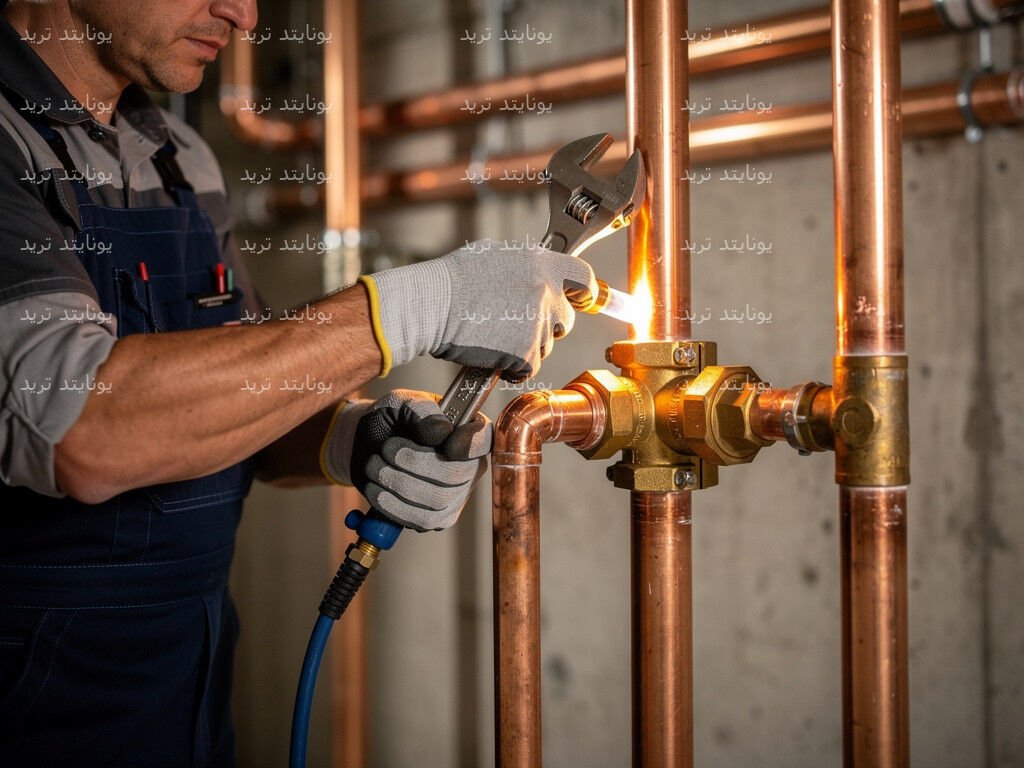
[Installation of copper pipes](https://unitedtrad.com/wp-content/uploads/2026/10/auto_img_1791579916_178.jpg)!
The installation of copper pipes represents the basic foundation for creating reliable and highly efficient air conditioning and water supply networks within residential and commercial buildings. In this article, you will discover the technical standards and correct field steps for handling copper lines to ensure safe flow of liquids and gases, avoiding costly maintenance costs resulting from installation errors.
table of contents
– [Quick Answer](#toc-heading-1)
– Choosing the appropriate pipe diameters and thicknesses for the project
– Basic equipment and tools for processing copper lines
– Professional stages of installing copper pipes
– Technical comparison between copper pipe connection methods
– Requirements for insulation and protection of copper extensions
– Pressure testing and leak detection procedures
– Frequently asked questions
-Bottom line
##Quick answer
Installing copper pipes is a precise mechanical process that requires cutting the pipes with specialized tools and removing the burrs, then forming the joints either by high-heat welding or mechanical joining, while maintaining straight paths and supporting the pipes with mounting gloves to prevent vibration and leakage. The success of this process depends entirely on insulating the lines well and testing the pressure before actual operation.
## Choosing the appropriate pipe diameters and thicknesses for the project
Choosing the appropriate copper pipe requires careful study of the nature of the fluid and the operating pressure rate within the system. For example, the thickness of pipes used in gas and cooling networks differs from those intended for domestic drinking water, and miscalculation leads to premature cracks under the influence of high pressures.
Copper pipes are divided commercially and in engineering into standard classifications that determine the thickness of the internal and external wall, and they include the following types:
– Type K: It has the thickest metal wall, and is therefore used in underground extensions and main lines with very high pressures.
– Type L: It is considered the medium and most common option, and is widely used in internal plumbing lines and refrigeration and air conditioning installations.
Type M: It is characterized by a thin wall, and its use is often limited to heating and low-pressure water distribution lines inside residential apartments.
Moreover, distances must be measured accurately before starting cutting to avoid waste, taking into account the rate of thermal expansion and contraction that copper undergoes during the change of seasons.
## Basic equipment and tools for processing copper lines
The efficiency of installing copper pipes depends on providing specialized equipment that prevents deformation of the circular section of the pipe during work. Using a regular hand saw, for example, causes rough edges and the accumulation of impurities, which later leads to partial blockage or failure of the weld joints.
## Internal cutting and cleaning tools
The rotary pipe cutter produces a straight, vertical cut at a ninety degree angle without applying pressure to the pipe. In addition, the Reamer is an indispensable complementary step to smooth the internal cavity and ensure a smooth flow without hydraulic turbulence within the network.
## Flexion and extension devices
Mechanical pipe benders or external bending springs help shape curves smoothly without breaking the pipe or choking the fluid path. In contrast, flanging tools are used to make tight mechanical connections without welding, especially in separate cooling systems.
📊 Successfully
## Professional stages of installing copper pipes
The network extension goes through several chronological stages that ensure the highest levels of durability and cohesion of the building’s structural structure. Failure to respect the correct order of these stages exposes technicians to re-disassembly problems and incurs huge financial losses.
– Path planning: drawing the shortest and safest path for the lines away from power cables and direct sources of ignition.
– Installing supports: Installing rubber mounting cages at least every meter and a half to prevent sagging and absorb mechanical vibrations.
– Preparing the edges: Clean the external and internal surfaces with steel wool until the metal shines and the layers of oxidation are completely removed.
– Applying Flux Aid: Gently coat the outside of the pipe to facilitate the flow of welding material and completely cover the gaps.
– Mechanical or thermal connection: Applying the connection technology approved for the project and taking into account the gradual cooling of the air without sudden spilling of water.
As a result, the mechanical line is able to withstand periodic vibrations from pumps and compressors without sagging at the junctions.
## Technical comparison between copper pipe connection methods
There are many connection methods, including solid welding, light welding, and mechanical pressure connections, and each method has a specific application environment. The following table shows the engineering differences to help you make the optimal decision according to your system requirements:
Delivery method — Required temperature — Best practical use — Durability and ease of maintenance —
Brazing — Above 450°C — Cooling networks and high-pressure lines — Extreme durability, disassembling the connection requires heating —
Soldering — Below 450°C — Drinking water supply and drainage — Good durability, quick execution and corrosion resistance —
Flaring — Does not require heating — Connecting air conditioners and measuring units — Flexible, removable and quick to install —
Press-fit hydraulic press — No heating required — Fast, modern commercial projects — High speed of completion, requires custom equipment —
It should be noted that gas and refrigeration networks inevitably prefer silver welding as it provides mechanical cohesion that resists the expansion of Freon gas molecules under extreme pressures.
## Requirements for insulation and protection of copper extensions
Thermal insulation constitutes a crucial element for the success of the copper pipe installation system, especially in areas of extreme humidity and heat. The absence of proper insulation leads to the formation of drops of water condensation, which causes damage to false ceilings and significantly reduces energy efficiency.
The quality of the system does not stop at the integrity of the installations only, but also extends to taking into account the smallest engineering details during the implementation of the air conditioning installation according to technical standards that guarantee ideal air distribution and achieving the highest operational efficiency with the lowest energy consumption. This mechanical integrity ensures that the compressor is protected from premature fatigue, and radically reduces the possibility of refrigerant leakage over time.
Achieving the highest levels of safety requires applying the secrets of extending copper pipes with extreme precision, from flawless cutting and welding operations to tightly fixing the connections. This engineering commitment protects lines from internal corrosion and pressure fluctuations, ensuring leak-free operation of networks for many years.
The lines are covered with closed-cell elastomeric foam insulation with a thickness appropriate to the diameter of the pipe. In addition, exterior insulators exposed to sunlight should be protected with UV-resistant packing tapes to protect them from cracking and rapid deterioration.
On the other hand, if the extensions pass through concrete walls, they must be passed inside protective plastic sleeves that prevent direct contact with cement, since some chemical compounds in concrete cause local corrosion of copper over the years.
## Pressure testing and leak detection procedures
Pressure testing is the crucial step before approving the network and burying it or closing the gypsum ceilings behind it. Neglecting this step represents a real risk to the safety of the facility, as it is difficult to determine the location of a small leak after the complete completion of the finishing work.
## Testing using dry nitrogen gas
Moisture-free nitrogen is injected into the network at pressures fifty percent greater than the design operating pressure. In other words, if the operating pressure is two hundred pounds per square inch, the test pressure is raised to three hundred pounds and monitored on a calibration gauge for twenty-four continuous hours to ensure that the indicator is stable.
## Soap foam method and electronic reagents
All welding points and mechanical connections are inspected with specialized foam solutions that detect leaking gas bubbles immediately. Moreover, major projects use advanced electronic leak detection devices that detect the smallest gas emissions down to the micron, enhancing engineers' confidence in the quality of the entire system.
## Frequently asked questions
## What is the expected lifespan of copper pipes?
The lifespan of copper pipes ranges from fifty to seventy years when installed correctly and the water is free of excessive acidity. This material has a high natural resistance to rust and environmental corrosion compared to other metals.
## Can copper pipes be installed without welding?
Yes, mechanical joining techniques such as flange or press fittings can be used. These solutions are ideal for locations where open flames are prohibited, such as warehouses or sensitive facilities.
## Why does the HVAC technician isolate the suction line and the liquid line separately?
Each line is individually insulated to prevent direct heat exchange between the cold intake gas and the warm high-pressure fluid. This thermal separation maintains the efficiency of the refrigeration cycle and protects the compressor from consuming additional electrical energy.
## How can I ensure the quality of copper pipe welding?
This can be confirmed by observing that the solder alloy is spread homogeneously around the perimeter of the joint without any air holes or irregular metal clumps. The critical step is always to perform a nitrogen pressure check to ensure complete tightness.
## What is the difference between flexible and rigid copper pipes?
Flexible tubes come in coils and are heat-treated to facilitate manual bending into narrow and complex paths. In contrast, rigid tubes come in the form of straight bars and provide superior structural strength and a structured appearance on long, open runs.
## Does copper cause a change in the taste or safety of drinking water?
No, copper does not change the taste of water and does not pose a health risk as long as the water acidity is within engineering approved limits. Copper actually possesses natural antibacterial properties that prevent the growth of microbes on the inner walls of pipes.
##Bottom line
Mastery in installing copper pipes requires a careful combination of choosing the appropriate thickness, proper mechanical preparation, and mastering connection and insulation techniques. By choosing custom tools and adhering to pressure testing standards, you will ensure a durable network that will last for decades without leaks, providing you and your family with a safe and comfortable environment.
















Community dialogue
0 comments