
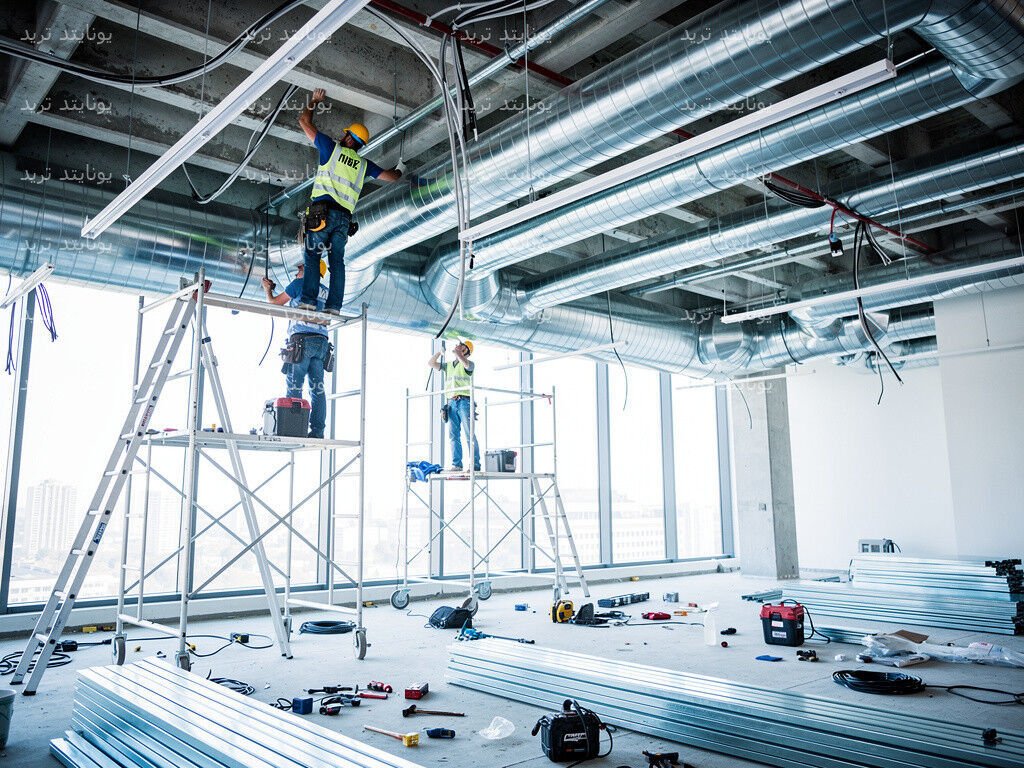
represents Establishing pipes Air conditioning during the construction phase is an essential step to ensuring a comfortable indoor environment and avoiding costly construction modifications in the future. This technical measure aims to protect walls and luxury finishes from water leaks and sudden Freon damage. Moreover, proper planning gives you absolute freedom to choose the appropriate cooling capacities for each space within the building without engineering constraints.
Establishing pipes HVAC is the pre-installation of insulated copper piping and drain lines within walls or false ceilings prior to the plastering and finishing stage. Successful establishment is characterized by the selection of copper diameters corresponding to the capacity of the device with tight thermal insulation and discharge inclinations of at least one centimeter per linear meter. As a result, this work ensures a safe flow of Freon gas and prevents water leakage or paint damage permanently.
The importance of early planning when establishing air conditioning pipes
Proficient foundation begins with determining the locations of furniture distribution and natural air movement paths within the rooms before starting electrical and plumbing work. In addition, determining the piping route early helps reduce the path lengths between the indoor and outdoor units as much as possible. It should be noted that shortening the distance maintains ideal Freon pressure and increases the overall cooling efficiency.
On the other hand, the lack of prior planning leads to the technician being forced to break the walls after the painting is completed or to distort the external facades of the external units. Therefore, full coordination should be made with the architect to specify air conditioning skylights and concrete openings for mechanical services. Accordingly, the structural structure is protected from the risk of random cracking in load-bearing concrete columns or beams.
Engineering standards for selecting copper diameters and insulation materials
The diameters of copper pipes used in cooling networks depend directly on the ton capacity of the air conditioning device selected for each room. For example, small air conditioners need diameters that are completely different from those designated for central air conditioners or concealed units. Furthermore, copper of high purity and wall thickness compatible with ASCE standards must be used.
Thermal insulation plays a major role in protecting Freon pathways from water condensation that damages gypsum ceilings. Therefore, it is preferable to use high-density closed elastomeric foam insulation with a thickness of at least nine millimeters per tube. As a result, this insulation prevents external heat gain and keeps the fluid cool as it travels to the indoor unit.
| Air conditioner capacity | Tow line diameter in inches | Liquid line diameter in inches | Recommended insulation thickness |
|---|---|---|---|
| 1.5 hp | 1/2 | 1/4 | 9 mm |
| 2.25 hp | 5/8 | 1/4 | 9 mm |
| 3 hp | 5/8 | 3/8 | 13 mm |
| 5 hp | 3/4 | 3/8 | 19 mm |
Stages of implementing a cooling extension network, step by step
Completing the extensions requires following a strict implementation sequence that begins with defining the paths and ending with tight stress tests. The following illustration shows the engineering arrangement adopted to ensure the quality of the installation and its freedom from defects:
flowchart TD
    A[\"تحديد مواقع الوحدات الداخلية والخارجية\"] --> B[\"تكسير المسارات وتثبيت الجلب العازلة\"]
    B --> C[\"سحب أنابيب النحاس داخل خراطيم الحماية\"]
    C --> D[\"تركيب خطوط الصرف بميول هندسي منتظم\"]
    D --> E[\"حقن شبكة النحاس بغاز النيتروجين المضغوط\"]
    E --> F{\"هل ثبت مقياس الضغط لمدة 24 ساعة؟\"}
    F -->|\"نعم\"| G[\"إغلاق المسارات وبدء أعمال اللياسة\"]
    F -->|\"لا\"| H[\"كشف التسريب وإعادة اللحام\"]
    H --> E
Actual on-site implementation steps include:
- Locate the indoor units at a suitable height above the level of the false ceiling to ensure air flow.
- Installing flexible plastic pipes inside the walls to facilitate pulling and changing copper lines in the future without breaking them.
- Pull the electrical control wires parallel to the insulated copper lines, away from the main power cables.
- Welding connections using inert nitrogen gas to prevent the formation of a carbon oxide layer inside the pipes.
- Close the ends of the pipes with tight copper plugs to prevent the entry of dust and construction waste during finishing.
Ideal path for water drainage and ventilation lines
Water drainage resulting from the cooling process is the biggest challenge facing facilities when hydraulic tilt rules are neglected. Therefore, it must Installing pipes The plastic drain is made of non-flexible PVC material to avoid bending over time. Furthermore, each air conditioner should be assigned a separate drain line and avoid connecting them directly to the sewer without an odor trap.
The culmination of these preparations requires a stage Air conditioning installation Air has high geometric precision to connect the internal and external units to the pre-prepared pipes in a tight manner. This procedure ensures that the devices are installed to the highest safety standards, while adjusting water drainage paths and insulating connections to avoid any loss of cooling efficiency or energy leakage. This completes the ventilation system to operate with the utmost efficiency and quiet within the residential space.
The Water Odor Trap prevents unpleasant gases from refluxing into rooms through air ducts and indoor units. In contrast, direct connection causes corrosion of copper cooling coils due to harmful hydrogen sulfide gas emissions. Therefore, it is always recommended to connect air conditioning lines to the external rain drainage network or drain them into designated, partially exposed gray water collection points.
To ensure the sustainability and operational efficiency of these extensions in the long term, the importance of conducting... Regular air conditioning maintenance For early detection of any decline in gas levels or blockages in drains. This regular inspection helps maintain compressor performance and protect the entire system from sudden malfunctions that may harm indoor air quality.
Maintaining cooling efficiency requires applying rules Professional extension of copper pipesStarting from choosing the appropriate diameters and wall thicknesses that match the specifications, all the way to the precision of welding and ensuring tight thermal insulation. These engineering standards contribute to preventing Freon leakage and ensuring stable gas pressures, giving the network a long operational life without unexpected malfunctions.
With the completion of the infrastructure, the efficiency of this equipment remains dependent on the extent of adherence to a procedure Regular air conditioning maintenance Ensures fresh air flow and long-term stability of cooling pressures. This periodic inspection helps in early detection of any blockages in the drain lines and prevents corrosion of the copper coils before they become worse. This ensures that your investment in the air conditioning system is protected and that the highest levels of operational performance are maintained with the lowest possible energy consumption.
The next stage requires executing an operation Professional air conditioning installation It ensures that the internal and external units are installed with utmost precision, matching the previously prepared paths without damaging the extensions. This technical commitment contributes to avoiding annoying vibrations and ensuring proper air flow, which increases cooling efficiency and extends the operational life of the system.
This system is not complete without careful action Regular air conditioning maintenance Ensures efficient airflow and reduces high energy consumption. Periodic inspection of internal and external units helps in early detection of any blockages in the drain lines and avoids sudden malfunctions. Thus, the devices maintain stable performance and lifespan for many years.
The next stage requires executing an operation Air conditioning installation Professionalism ensures that internal and external units are installed with utmost precision in accordance with approved engineering standards. This technical commitment helps achieve the highest air distribution efficiency while reducing energy consumption and avoiding premature operational failures.
Common mistakes to avoid when installing air conditioning pipes
Some technicians make construction errors that cost a lot of money to correct after the final construction stages are completed. Avoiding these negative practices protects your real estate investment:
- Bend copper pipes directly by hand without using a dedicated mechanical bending tool to prevent gas path choking.
- Combined liquid and gas lines within a single thermal insulator resulting in negative heat exchange that impairs cooling.
- Ignore the nitrogen pressure test and rely only on visual inspection of the pipes inside the walls.
- Use drainpipes with narrow diameters of less than one inch, which speeds up their clogging with algae.
- Leave distances of more than twenty meters between units without adding oil traps to protect the air conditioning compressor.
Frequently asked questions
❓ What is the appropriate time to start installing air conditioning ducts in the building?
The ideal time is after the completion of construction work and before the start of plastering work and establishing electricity. This timing allows the pipe runners to be safely opened and the drainage network installed accurately without damaging any other installations.
❓ Is it possible to install one insulator for gas and liquid pipes together?
It is not engineering permissible to combine the two pipes in one insulator because each line has a completely different temperature. Merging the two tubes leads to heat transfer between them, which reduces the efficiency of the device and increases electrical energy consumption by a large percentage.
❓ How do I ensure the safety of copper pipes before burying them in the wall?
This is confirmed by compressing the network with dry nitrogen gas under a pressure of up to three hundred pounds per square inch. The pressure watch must be left for twenty-four hours to ensure that the indicator is stable and that there are no microscopic leaks.
❓ What is the preferred diameter for air conditioner water drain pipes?
It is best to use downspouts at least a full inch in diameter made of thick, high-pressure plastic. This diameter prevents the accumulation of impurities and sticky bacterial deposits that usually cause water overflow inside rooms.
❓ Where should the ends of the air conditioner pipes exit in the room?
The ends usually come out at a height ranging between two meters and two meters and forty centimeters above the level of the finished floor. This height ensures efficient cold air flow while leaving enough space for maintenance and subsequent filter removal.
Represents investment in Establishing pipes Air conditioning according to sound engineering controls is a permanent guarantee of the safety of your home and the efficiency of your appliances for many years. Always make sure to choose certified technicians and apply pressure tests before completely closing the walls to enjoy a cool and comfortable atmosphere without annoying surprises.
















Community dialogue
0 comments