
Choosing the ideal location for the indoor and outdoor units
The performance of any cooling device depends radically on where it is installed, as the correct distribution of units affects the efficiency of heat exchange and the life of the device. When determining the location of the indoor unit, you should avoid places directly in front of heat sources such as stoves or ovens, and also stay away from places with high humidity such as unventilated kitchens, to ensure accurate temperature sensing.
Outdoor unit installation considerations
For an outdoor unit, good ventilation is the most important factor. You must ensure that there is sufficient space around it to allow air to circulate, taking into account the following points:
- Install the unit in a shaded location as much as possible to reduce the burden on the compressor.
- Stay away from areas where dust or dry leaves accumulate, which may clog the condenser fins.
- Providing a sturdy, level base to reduce annoying vibrations and noises during operation.
- Maintain an appropriate distance between the unit and the back wall to ensure free air flow.
Comparison table between types of copper tracks
Copper piping is the main artery for transporting refrigerant between the two units, and the choice of diameter and quality affects system pressure. The following table shows the importance of choosing the appropriate diameter according to the device’s capacity:
| Air conditioning capacity (hp) | Liquid tube diameter (inch) | Gas pipe diameter (inch) |
|---|---|---|
| 1.5 hp | 1/4 | 3/8 |
| 2.25 hp | 1/4 | 1/2 |
| 3 hp | 3/8 | 5/8 |
Common errors during expansion and unloading operations
Minute technical steps are often overlooked during the process Air conditioning installation, leading to premature malfunctions. The most notable of these errors are:
- Not using a vacuum pump: Leaving air and moisture inside the copper circuit leads to a chemical reaction with the compressor oil, which reduces cooling efficiency and ultimately leads to damage to the compressor.
- Bend pipes in a sharp manner: Using violent manual bending tools leads to suffocation of the pipe, which raises the system pressure abnormally and causes a leakage of Freon gas.
- Neglecting to insulate pipes: Lack of thermal insulation leads to the loss of a large portion of the coolness of the gas during its transmission, in addition to water condensation on the pipes, causing wet spots on the walls.
requires Air conditioning installation The air in the house takes into account precise engineering standards to ensure the highest possible cooling efficiency and reduce electrical current consumption. This article explains the technical steps that must be followed to choose the appropriate capacity and install the internal and external units professionally, which extends the life of the device and prevents sudden malfunctions.
Quick answer
Air conditioning installation Airing properly requires selecting the appropriate horsepower for the room size, installing the indoor unit on a sturdy wall with a slight slope to drain water, then connecting it to the outdoor unit via insulated copper pipes and completely emptying the air using a vacuum pump before opening the refrigerant valves to ensure maximum cooling performance.
Basic preparations before starting the installation of home air conditioning
Field installation begins with an inspection of the installation site to ensure smooth airflow around the units without any wall obstructions. Accordingly, the room area must be accurately measured, the level of thermal insulation calculated, and the number of windows exposed to the sun to determine the required cooling capacity. Furthermore, the electrical panel should be checked to ensure that it can handle the additional load of the device.
Calculate the cooling capacity required for the room
The cooling capacity depends on the volume of the room in cubic meters multiplied by the appropriate heat load coefficient. For example, a room with an area of 15 square meters and a height of 3 meters needs a 1.5 HP air conditioner under normal conditions. In contrast, the required power increases to 2.25 horsepower if the room is on the last floor or has wide glass facades.
Necessary technical tools and equipment
Professional equipment ensures the integrity of the mechanical and electrical connection of all parts of the cooling system. It should be noted that the basic tools include a water level to adjust the level, a vacuum device to empty the circuit of moisture, in addition to copper flap tools to make tight connections without leaking.
Accurately install the indoor unit steps
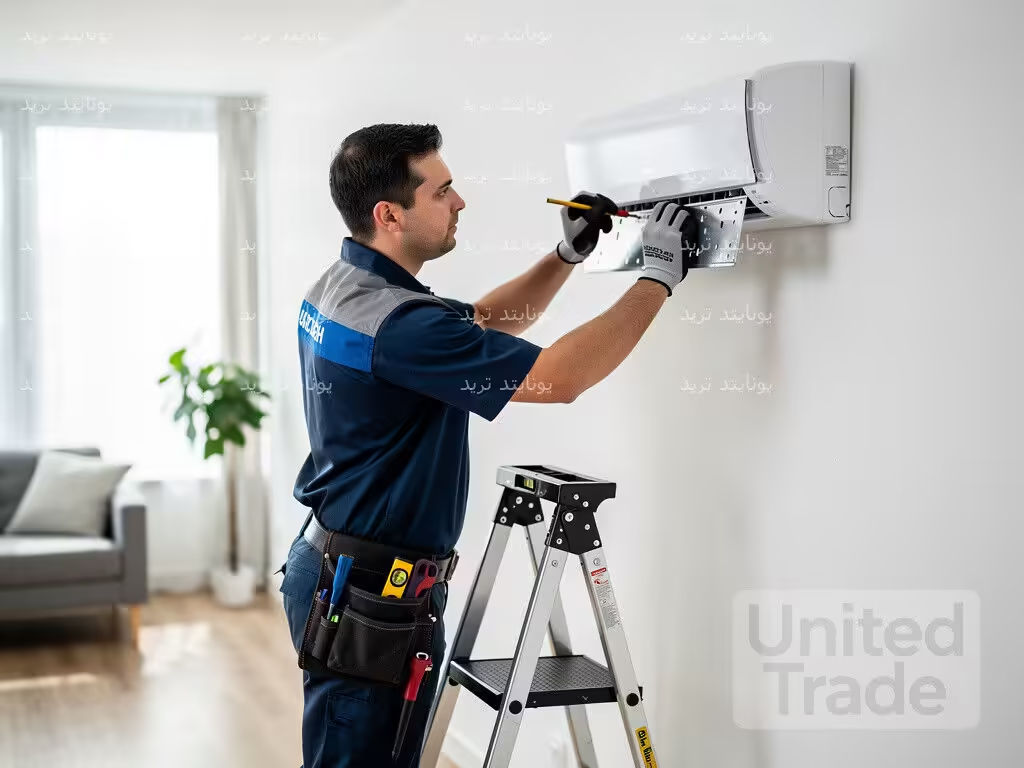
The indoor unit is installed by fixing the supporting metal plate to the wall with strong screws and using a water level. Therefore, the technician is careful to leave a distance of at least 15 centimeters between the top of the unit and the ceiling to allow the return air to be drawn freely. As a result, the evaporator works quite efficiently and the coolness is distributed evenly throughout the room.
The process also includes making a hole in the wall with a diameter of 6.5 to 7.5 cm with a slight outward slope to facilitate the drainage of condensation water. Moreover, control cables, drainage pipes and cooling pipes are wrapped with insulating tape to protect them from weather elements.
Correct criteria for installing the outdoor unit
The outdoor unit requires a well-ventilated location away from direct sunlight and heat sources to ensure effective heat dissipation. In addition, metal stands should be secured with strong screws capable of absorbing vibrations and rubber feet should be used under the unit's legs to prevent noise transmission through the walls.
Once you have settled on the appropriate locations for the units, comes step Establishing pipes Cooling with great care to ensure a smooth and hidden path connecting them. This procedure requires precision engineering in determining the paths of the copper extensions and protecting them inside the walls, which prevents any future leaks and maintains the efficiency of the cooling cycle for as long as possible.
It is recommended to leave a distance of at least 30 cm behind the outdoor unit and 100 cm in front of the exhaust fan. This distribution allows a continuous flow of air, which prevents high pressure inside the compressor and maintains electricity consumption efficiency.
To ensure that the device continues to operate at peak efficiency after installation, care must be taken to ensure that the device continues to operate at peak efficiency after installation Regular air conditioning maintenance It includes cleaning filters and checking refrigerant gas levels to avoid sudden malfunctions. This regular inspection helps reduce energy consumption and extend the life of all mechanical parts.
Cooling efficiency does not stop at mastering the installation and pipe connection stages only, but is directly linked to adherence to a periodic program aimed at Air conditioning maintenance Houses and various units to protect them from sudden malfunctions. Continuous checking of vital components such as filters and refrigerant level ensures reduced energy consumption and extends the life of the device for years longer.
The efficiency of the refrigeration cycle depends entirely on the accuracy of its implementation Air conditioning duct extension Choosing high-quality copper materials capable of withstanding variable pressures. Therefore, performing a nitrogen pressure test before final shutdown is an essential step to avoid Freon gas leakage and ensure that the system operates at the highest efficiency for many years.
Maintaining cooling efficiency requires continuity of operation Regular air conditioning maintenance It includes checking the level of Freon gas and cleaning the filters from accumulated impurities. Neglecting to treat minor faults early leads to a decline in compressor capacity and an increase in electrical energy consumption, which reduces the quality of the air flowing into the room.
requires Establishing cooling pipes Carefully consider the shortest path between the two units and reduce bends as much as possible to reduce compressor stress. Care must also be taken to choose appropriate copper diameters and good thermal insulation for the pipes to prevent Freon leakage and water condensation inside the walls.
Maintaining this ideal performance requires adherence to a regular schedule that includes procedures Regular air conditioning maintenance To clean filters and carefully check refrigerant levels. Early inspection of electrical circuits and mechanical parts also contributes to avoiding sudden malfunctions and ensuring clean air flow with the highest possible operational efficiency.
requires Accurately installing air conditioning ducts Highly consider the recommended distances between the two units and reduce bends as much as possible to reduce obstruction to the flow of Freon. It is also necessary to use excellent quality copper pipes and cover them with appropriate thermal insulation to prevent cold leakage and water condensation inside the walls.
Connecting the copper network and vacuuming the air
Connecting refrigerant intake and exhaust lines constitutes the most critical step in the entire refrigeration cycle. As a result, connections must be carefully observed to avoid Freon leakage, by following the following steps:
- Cut copper pipes with a dedicated cutting tool and smooth the inner edges to completely remove metal tarnish.
- Widen the end of the pipe using a filler kit at an angle corresponding to the cone of the air conditioning valve.
- Tighten the nuts by hand first, then tighten them using a torque wrench according to the manufacturer's standards.
- Connect the vacuum pump to the pressure watch to empty the air and moisture from the circuit for a period of not less than 20 minutes.
- Monitor the stability of the negative pressure indicator below zero to ensure that there are no leaks before releasing the refrigerant gas.
Comparison between different cooling systems when installing
Installation requirements and costs vary depending on the type of HVAC system chosen for the building. The following table shows the most important technical and operational differences between common systems:
| Type of air conditioning system | The nature of installation and foundation works | Noise level inside the building | Energy efficiency | Flexibility in large spaces |
|---|---|---|---|---|
| Split wall air conditioning | Simple and quick installation with one wall hole | Very low and almost silent | High in modern models | Limited to one room only |
| Ceiling cassette air conditioning | Requires suspended ceiling and interior fall space | Very low and evenly distributed | High and suitable for open spaces | Medium for offices and halls |
| Concealed air conditioning | It requires an air duct network and an insulated duct | Non-existent inside refrigerated rooms | Excellent with separate control | Very high for villas and houses |
| Central package air conditioning | Huge structural foundation and large external duct | Completely isolated outside the building | Medium to high depending on the load | Inclusive of the entire building |
Technical errors that must be avoided while carrying out the work
Some wrong practices lead to reduced cooling efficiency and frequent compressor malfunctions. To avoid these problems, be sure to review the following points:
- Neglecting to use a vacuum pump and relying on expelling the air with Freon, which causes moisture to mix with the oil and damage the compressor.
- Bending copper pipes at sharp angles leads to suffocation of the refrigerant gas path and high operational load.
- Ignoring the proper inclination of the drain hose, which leads to backflow and leakage of water into the room.
- Increasing the length of cooling pipes beyond the permissible limit without adding a calculated compensatory amount of Freon.
- Installing the outdoor unit in a closed place prevents the dissipation of heat expelled from the condenser.
Frequently asked questions
What is the appropriate distance between the indoor and outdoor units?
The preferred standard distance is between 3 to 5 meters to maintain cooling efficiency without heat loss. However, the distance can be extended up to 15 meters in some devices provided that refrigerant oil and an additional Freon charge are added according to the manufacturer's catalog.
Is it possible to install air conditioning without vacuuming copper pipes?
It is not permissible to completely dispense with the vacuum process, because emptying the circuit removes the air and moisture trapped inside the pipes. It should be noted that remaining moisture reacts with the lubricating oil and forms acids that lead to the compressor burning within a short period.
How do I ensure that the air conditioner water drains successfully after installation?
The drain path is confirmed by slowly pouring half a liter of water into the drain pan of the indoor unit and observing the water emerge smoothly from the outer end. In addition, this test ensures that there are no blockages or water leaks behind the device.
How long does it usually take to complete the installation process?
The process takes between two to three hours if the equipment and foundation paths are prepared in advance. On the other hand, the work may extend to four hours if it is necessary to make additional concrete holes or lay new power lines.
What is the difference between regular air conditioning and inverter air conditioning in connections?
The mechanical duct connections between the two systems are identical, but inverter air conditioning requires additional control cables to accurately transmit electronic control signals. Moreover, inverter air conditioning needs proper electrical grounding to protect sensitive electronic boards from current fluctuations.
Why does the air conditioner drip water from the indoor unit after turning on?
Dripping water is usually caused by the indoor unit not being leveled with the water level or the drain hose being clogged with dust. As a result, the interior water catchment basin overflows and leaks down the walls instead of out through the exterior drain path.
Adherence to engineering standards when installing air conditioning provides a comfortable environment and optimal cooling with economical electricity consumption. Always make sure to hire certified technicians and carefully implement the inspection steps to ensure safe and stable operation throughout the summer.
















TQTAG76 Community dialogue
0 comments