
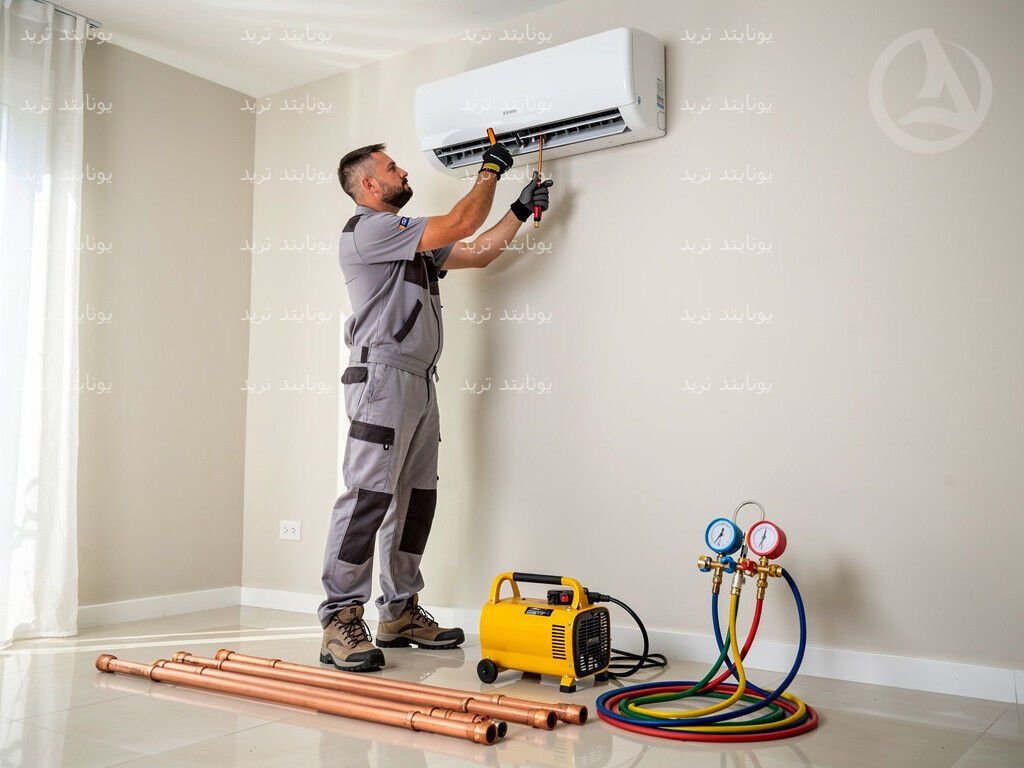
represents implementation Air conditioning installation In your residential or practical space, it is a direct investment to ensure thermal comfort and indoor air quality throughout the seasons of the year. This technical guide is intended to provide you with the engineering standards and field steps necessary to ensure that the equipment operates at maximum efficiency, while avoiding premature failure that often results from poor installation.
Quick answer: How to install the air conditioner correctly?
Air conditioning installation Airing is a technical process that involves installing the indoor unit with a slight inclination towards the drain path, installing the outdoor unit in a well-ventilated place, then connecting them with insulated copper tubes and completely emptying the circuit of moisture and air using a vacuum pump before opening the refrigerant valves. This careful procedure ensures that Freon leakage is avoided and that the compressor is protected from premature damage.
Choose the ideal location to install the units
The success of room cooling directly depends on the chosen position for installing both the indoor and outdoor unit. Therefore, air movement within the space must be carefully studied to avoid unbalanced heat distribution.
Requirements for installing the indoor unit
Vertical distance: is the space required between the top of the device and the ceiling to ensure free air intake. This distance should not be less than 15 centimeters to ensure that the air flows through the evaporator completely smoothly. In addition, you should avoid placing the unit above electrical appliances or near direct heat sources to protect sensitive control circuits.
Outdoor unit placement criteria
The outdoor unit requires a well-ventilated space to facilitate the removal of heat expelled through the condenser. Accordingly, it is recommended to leave a distance of at least 30 cm behind the unit and 100 cm in front of the exhaust fan. As a result, the voltage applied to the compressor is reduced and the electrical current consumption remains within normal design limits.
Tools and technical equipment necessary for the installation process
A professional technician needs a specialized set of equipment to ensure tight mechanical and electrical connections. The use of specialized tools reduces the risk of gas leakage and ensures the structural integrity of the walls.
- Digital water level or bubbler to level the metal ruler and drain water safely.
- Vacuum Pump to remove moisture and impurities from copper pipes.
- Dual pressure gauge device (Manifold Gauge) to monitor the stability of refrigerant gas pressure.
- Copper Flaring Tool for tightening nuts without cracking the copper edges.
- Torque wrench to tighten the tightening according to the measurements specified by the manufacturer.
Implementation stages of performing an efficient air conditioning installation
Installing cooling devices requires adherence to a sequential and strict procedural sequence without skipping any technical stage. For example, neglecting to test for leakage before insulation later results in double maintenance costs.
- Fix the metal pegboard to the wall using anchor bolts suitable for concrete or brick.
- Make a pipe passage hole in the wall with a diameter ranging from 65 to 70 mm, taking into account a slight outward slope to facilitate the drainage of condensate.
- Insulated copper pipe extension with electrical connection cable and drain hose, wrapping the package with non-adhesive protective tape.
- Install the outdoor unit on sturdy metal cables and use rubber feet to absorb vibrations and noise.
- Tightly connect the copper connections between the two units using a clean, impurities-free connection flange.
- Discharge air and moisture from the closed circuit using a vacuum pump for a period of not less than 15 continuous minutes.
- Gradually open gas valves and perform a foam test or electronic leak detector to ensure the connection points are secure.
Comparison of common home air conditioning systems
Systems available on the market vary in terms of structural requirements, performance efficiency, and ease of implementation Air conditioning installation For every space. The following table helps determine which option best suits your residential and commercial requirements:
| System type | Main advantages | Installation requirements | Total cost level |
|---|---|---|---|
| Split wall air conditioner | Ultra quiet, excellent energy efficiency, modern appearance | Simple wall mount with small passage hole for pipes | Average and economical in consumption |
| Cassette ceiling air conditioner | Four-way air distribution, saving wall space | Requires a suspended ceiling with a depth of at least 30 cm | It is higher than the detached one and requires special decoration |
| Concealed Split | Complete concealment of the units and uniform air distribution via ducts | Wide vertical spaces for ductwork and insulation | High and requires advance engineering planning |
| Floor Standing Air Conditioner | Massive air flow for large spaces and halls | Sufficient floor space with short copper extension path | Medium to high depending on horsepower |
Electrical connections and structural safety standards
Electrical safety is the cornerstone of operating air conditioners with high cooling capacities. Moreover, electricity must never be drawn from regular socket outlets to avoid burning the wires.
Cutter size and cable cross-sectional area
Dedicated circuit breaker: It is an independent means of protection that automatically disconnects the current when a sudden electrical surge occurs. Therefore, it is always recommended to install a C-Curve breaker whose amperage is proportional to the capacity of the air conditioner, and to choose an approved copper electrical cable with a cross-section of no less than 4 mm for medium-sized devices, which ensures a safe flow of voltage without overheating of the conductors.
It is a stage Establishing cooling pipes Copper with high precision engineering and axial step that protects the entire air conditioning system from the dangers of Freon gas leakage and moisture accumulation inside the circuit. This procedure requires choosing copper diameters that match the manufacturer’s specifications, while strictly adhering to smooth paths that reduce sharp bends to ensure efficient flow of the cooling medium and smooth drainage of condensation water.
The importance of protective grounding
The grounding line drains static electrical charges and excess voltages to the ground safely and directly. It should be noted that the absence of grounding may expose users to the risk of electrocution and damage the electronic control cards of modern inverter-type systems.
Regular technical follow-up is the basic foundation for maintaining cooling efficiency and extending the lifespan of the air conditioning system after its operation. This requires implementing procedures Regular air conditioning maintenance It includes cleaning filters and checking refrigerant levels to ensure clean airflow and reduce energy consumption.
To ensure the sustainability of this operational efficiency and protect mechanical components from premature wear, an integrated program must be implemented Air conditioning maintenance According to precise timetables and approved periodic inspections. This technical commitment helps avoid common errors during operation, which directly contributes to reducing energy consumption and extending the life of cooling units.
require Air conditioner cooling networks Applying precise engineering standards when laying and thermally insulating pipes to protect the compressor from stress and reduce energy waste. Tight control of refrigerant levels and pressures also ensures the highest operational efficiency and avoids premature refrigeration cycle malfunctions.
Regular technical follow-up is the basic foundation for maintaining this investment and ensuring the sustainability of its performance Regular air conditioning maintenance In early detection of refrigerant gas leaks and cleaning clogged filters and condensers. This preventive check helps prevent sudden compressor breakdown and reduce power consumption to normal levels.
It is a stage Installing air conditioning ducts Copper is the backbone of the entire cooling network, as it requires extreme precision in determining the paths and insulating the lines to avoid moisture condensation or Freon gas leakage. The use of appropriate geometric diameters also ensures smooth flow of refrigerant between the indoor and outdoor units without stress on the system compressor.
To ensure that this operational efficiency is sustainable over the long term, it is important Air conditioning maintenance Periodically to avoid the accumulation of deposits inside the cooling system and to protect the compressor from mechanical stress. Regularly checking refrigerant levels and filter cleanliness helps reduce energy consumption and prevent sudden performance degradation in the peak of summer.
It is considered a stage Establishing copper pipes Thermal insulation is the cornerstone on which the success of the entire system is built, as its extension requires careful consideration of diameters and slopes to avoid any bottleneck in the flow of the cooling medium. Choosing the appropriate extension paths and installing them securely also contributes to protecting the network from future vibrations and leaks, ensuring stable and long-term performance of the device.
Field errors impair cooling efficiency
Some imprecise practices during work lead to reducing the life of the device by more than 40%. On the other hand, careful attention to engineering details maintains factory performance levels for many years.
First, neglect the process of emptying the air with the vacuum pump and simply expel the air using a cooling medium. This behavior leaves moisture inside the pipes that react with the lubricating oil and form acids that damage the compressor valves. Secondly, copper pipes are bent at sharp angles without using a bending zipper, which causes suffocation in the gas path and raises the internal pressure on the engine.
Frequently asked questions
What is the standard time for the device installation process?
The process of installing a new split air conditioner takes two to three hours under normal conditions. The period may increase if long copper extensions or additional drainage paths in the walls are required.
How do I ensure that the air conditioner is working efficiently after turning it on?
Efficiency can be verified by measuring the temperature difference between the return air inlet and outlet in the indoor unit; The difference should range between 8 to 12 degrees Celsius after 15 minutes of continuous operation.
Does the length of the copper path affect cooling efficiency?
Yes, length directly affects gas flow, and the ideal distance is usually between 3 to 5 metres. If the path exceeds 7 metres, a calculated amount of refrigerant must be added according to the manufacturer's table.
Why does water leak from the indoor unit inside the room?
Internal water leakage is often due to failure to level the unit with a proper inclination towards the drain outlet, blockage of the hose duct as a result of dust accumulation, or a bend in the external drain line.
When should gas pressure be checked for the first time?
Gas pressure is measured immediately after completion of installation and while the compressor is operating at at least half its capacity. After that, the air conditioner does not need to be recharged at all unless there is a real mechanical leak in the circuit.
Your next steps to ensure an ideal environment
Completing the air conditioning installation according to sound engineering rules gives you clean air and economical operation for many years without technical hassles. Always be sure to check the mounting points and insulation of the external pipes regularly, and do not hesitate to call a qualified technician as soon as you notice any unusual sound or gradual weakening of the cooling flow.
















Community dialogue
0 comments