
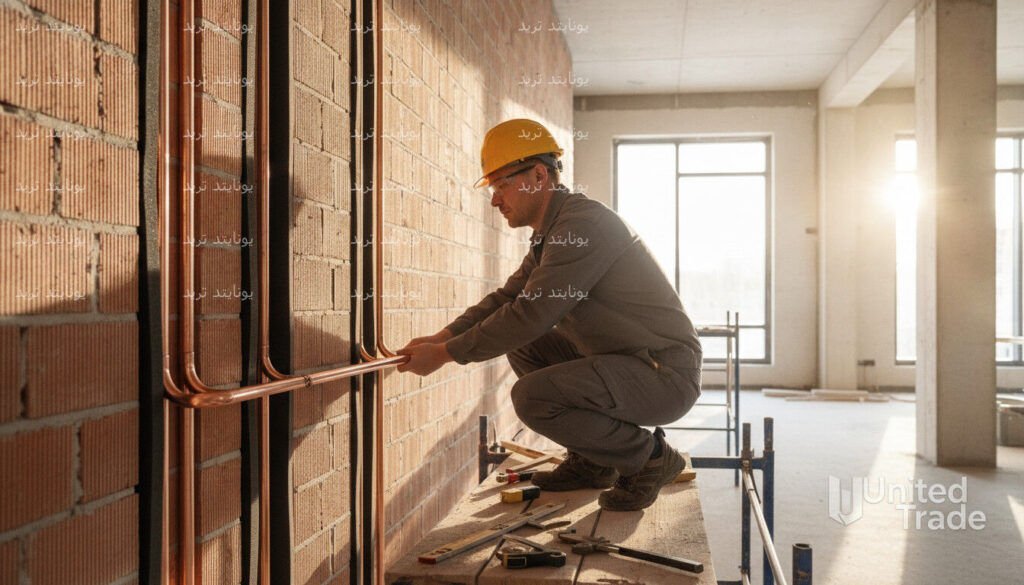
represents Establishing pipes Air conditioning The first engineering step to protect the finishing investment and prevent thermal problems inside the building. This stage ensures efficient, balanced refrigerant flow between the indoor and outdoor units without stressing the gas compressor, saving homeowners from subsequent crushing costs after the painting and decorating work is complete.
What is the engineering concept of the process of installing air conditioning ducts?
Establishing pipes Air conditioningIt is a pre-construction path that includes thermally insulated copper intake and exhaust lines, along with electrical control cables and water drainage pipes. This installation relies on burying the extensions inside the walls or false ceilings during the bone construction phase or the initial shell work, which provides a safe environment for the cooling system for many decades without architectural distortion.
Furthermore, this path requires choosing precise pipe diameters that match the horsepower of the target cooling device, because an imbalance in diameter reduces the efficiency of refrigerant flow and leads to higher electrical energy consumption. Therefore, specialized technical companies are keen to study the thermal loads of each room before determining the paths of the walls to ensure homogeneous air distribution.
What are the technical standards for selecting copper and insulation materials?
The operational quality of the cooling network depends on the use of standard materials that comply with strict international specifications. For example, air conditioning engineers prefer to use Korean or American copper pipes with a purity exceeding 99.9%, due to their high ability to withstand high gas pressures and resist internal corrosion.
In addition, thermal insulation plays a crucial role in cooling efficiency and preventing harmful water condensation on the walls. It should be noted that flexible rubber insulators called elastomeric, e.g Armaflex insulator A minimum thickness of 13 to 19 mm prevents moisture absorption and cold loss compared to traditional polyethylene insulation.
The previous table shows the technical standards that must be met in each structural component before closing the wall tracks, which confirms that investing in excellent raw materials protects property owners from expensive maintenance later.
Stages of implementing the installation of air conditioning piping, step by step
The extension process requires a technical sequence that begins with the engineering planning of the locations of the indoor units away from hot air ducts or direct sunlight. As a result, correct distribution ensures balanced cooling performance covering all room areas with the lowest possible unit operating effort.
On the other hand, the actual implementation phase is subject to strict controls that include opening wall drains and extending flexible protection hoses. After that, the copper lines and insulators are extended inside them, taking care to avoid sharp bends that may obstruct the path of the coolant or cause the thin copper tubes to break.
This diagram reflects the sequential time course of engineering preparation work, and highlights the importance of the mechanical inspection phase before proceeding with the final cement covering of the walls.
The most common mistakes while extending air conditioning networks and how to avoid them
Some unqualified technicians make the mistake of combining the intake and exhaust pipes within one thermal insulator, which is a behavior that causes a negative heat exchange between the cold gas line and the hot line. Therefore, each copper line must be completely independently insulated before they are grouped together inside the outer shielding tape.
Furthermore, neglecting the oil trap operation in long vertical runs is a major cause of damage to air conditioning compressors. In other words, if the vertical difference between the outdoor unit and the indoor unit exceeds 5 metres, the installation of oil traps becomes necessary to ensure that the lubricating oil returns to the compressor smoothly and that it continues to operate with complete mechanical efficiency.
It requires an operation Air conditioning installation Extreme precision in determining the locations of the units to ensure ideal air distribution, taking into account the selection of high-quality copper tracks that can withstand operational pressure for many years. Adherence to precise engineering standards at this stage prevents water or refrigerant leaks, which maintains cooling efficiency and extends the life of the device.
- Ignore the nitrogen test: Some leave the mesh untested to a pressure of 250 to 300 psi for 24 hours, masking minute leaks until the finish is finished.
- Use mismatched solderThe use of a low-silver soldering alloy causes the joints to become brittle and subsequently disintegrate under the weight of constant vibrations.
- Tighten bending anglesBending copper by hand without using a dedicated hydraulic crimp or crimp will choke the inner diameter of the pipe and choke the refrigerant.
How to adjust the inclinations of air conditioning drain pipes to prevent water leakage
The water drainage path forms the water substrate parallel to the gas cooling network inside the building. Therefore, PVC air conditioning drain pipes must be installed with a hydraulic fluid slope of at least 1 cm per linear meter to ensure water movement by natural gravity without stagnation.
The importance of this system does not stop only at the establishment stage, but extends to include periodic preventive measures that maintain efficient performance. So a procedure Air conditioning maintenance Regular use effectively contributes to prolonging the operational life of devices and avoiding sudden malfunctions that may drain your budget. Adhering to a careful inspection schedule will ensure long-term cooling sustainability and energy savings.
It is worth noting that the efficiency of the system is not complete without following the principles Home air conditioning installation According to specific technical standards, it ensures smooth air distribution and protects the compressor from overloads. Compliance with these field controls increases cooling efficiency to its maximum levels and significantly reduces electrical energy consumption in the long term.
Completing this stage requires strict adherence to the principles Professional installation of copper pipesStarting from choosing compatible diameters and appropriate wall thicknesses to withstand high gas pressures, all the way to applying precise welding techniques and tight thermal insulation. This geometric adjustment prevents coolant leakage and protects the network from corrosion and moisture condensation, ensuring smooth flow and long operational life of the entire system.
With the completion of the installation stages, the urgent need arises Air conditioning maintenance Regular to maintain Freon pressures and clean heat exchange paths from deposits. This regular procedure ensures sustained cooling efficiency, protects mechanical parts from premature wear, and reduces energy consumption to a minimum.
It requires an operation Air conditioning installation Extreme precision in locating the units to ensure perfect air distribution and avoid annoying direct drafts. The success of this process depends on the tight installation of the modules and the precise connection of the electrical and copper connections, ensuring a long life of the device and stable, energy-efficient cooling performance.
However, the quality of foundation alone is not sufficient to ensure sustainable performance without commitment to programmes Regular air conditioning maintenance Check the refrigeration cycle and gas pressures carefully. This preventive measure helps in early detection of any blockage in drain lines or dust accumulation on filters and coils, which extends the life of the device and keeps electricity consumption at its lowest levels.
comes next Air conditioning installation Air as a delicate process requires integrating devices with the interior design of the place in a manner that combines aesthetics and optimal functionality. The success of this step depends on adjusting the installation levels and securing the electrical and mechanical connections in accordance with international safety standards to ensure quiet and sustainable operation.
In addition, experts recommend connecting the air conditioning drain to the sewage network via a dedicated siphon that prevents the reflux of unpleasant odors into the air-conditioned rooms. On the other hand, it should be avoided to connect the drain directly to the manholes without an insulating water barrier to avoid the entry of insects and harmful organic gases through the openings of the internal unit.
- Install drain pipe jumpers at close intervals not exceeding 1.5 meters to prevent sagging of the plastic path.
- Test the flow of water by pouring two liters of water into the unit’s basin before closing the gypsum board.
- Cover the ends of the pipes with tight caps during the painting stages to prevent them from being clogged with putty and gypsum residues.
Comparison between hidden and visible air conditioning pathways
Residential project owners face a trade-off between hidden extension within walls and surface path. It should be noted that Establishing pipes Buried air conditioning maintains the uniformity of the decor and provides permanent protection for the ducts from oxidation, while the visible extension allows for easy adjustments and maintenance later on.
| Comparison | The foundation buried within the walls | The apparent extension is via decorative ducts |
|---|---|---|
| Architectural and aesthetic appearance | Completely hidden and maintains the purity of the interior design | Visible on the wall and requires plastic covering ducts |
| Implementation and processing cost | Requires prior crushing and plastering work during construction | Low cost and high speed in installation and operation |
| The expected life of the pipes | Very long thanks to protection from moisture and sunlight | Exposed to mechanical damage and direct climate influences |
| Easy maintenance and troubleshooting | Requires electronic detectors to locate leaks | Easy and direct without any need for any cracking in the walls |
| Flexibility to modify the unit path | Limited after painting and decoration work is completed | Flexible and the unit can be moved with simple structural modifications |
This comparison shows that choosing hidden foundation represents the optimal solution for buildings under construction, while the visible system remains a practical solution for occupied buildings where wall crushing is not possible.
Frequently asked questions
❓ What is the ideal timing to start installing air conditioning ducts in the building?
The ideal foundation begins after completing the electrical installations and before plastering begins. This timing allows wall tracks to be drilled without damaging finishes, while leaving sufficient lead time to check mesh pressures before sealing ceilings.
❓ How many meters should the length of copper pipes between the two units not exceed?
It is preferable that the length of the copper line does not exceed 15 to 25 meters, depending on the manufacturer’s specifications. It should be noted that longer distances require additional gas charging and auxiliary pumps to ensure cooling delivery with balanced efficiency.
❓ Can the same old air conditioning ducts be used with modern appliances?
It is not recommended to use old pipes without thorough chemical cleaning and checking the thickness of the copper. New gases vary in their operating pressures and the quality of the combined oils, which may cause blockage of the valves if deposits are present.
❓ Why must the two copper lines be insulated completely separately?
Separate insulation prevents heat transfer between the liquid line and the gas line, which increases cooling efficiency. In addition, this procedure prevents wet water droplets from condensing between the two pipes, which could damage the plaster layers.
❓ What is the importance of compressing the copper mesh with nitrogen before sealing the walls?
Nitrogen testing at 250 psi detects any microscopic holes before the pipes are buried. As a result, this test ensures full network integrity and avoids costly post-housing cracking.
represents implementation Installing air conditioning ducts Professionally, it is a real investment that guarantees the comfort of the building’s residents and protects the integrity of the interior decoration in the long term. Take your first step today by planning ahead with qualified technicians to ensure efficient cooling for years to come.
















Community dialogue
0 comments