
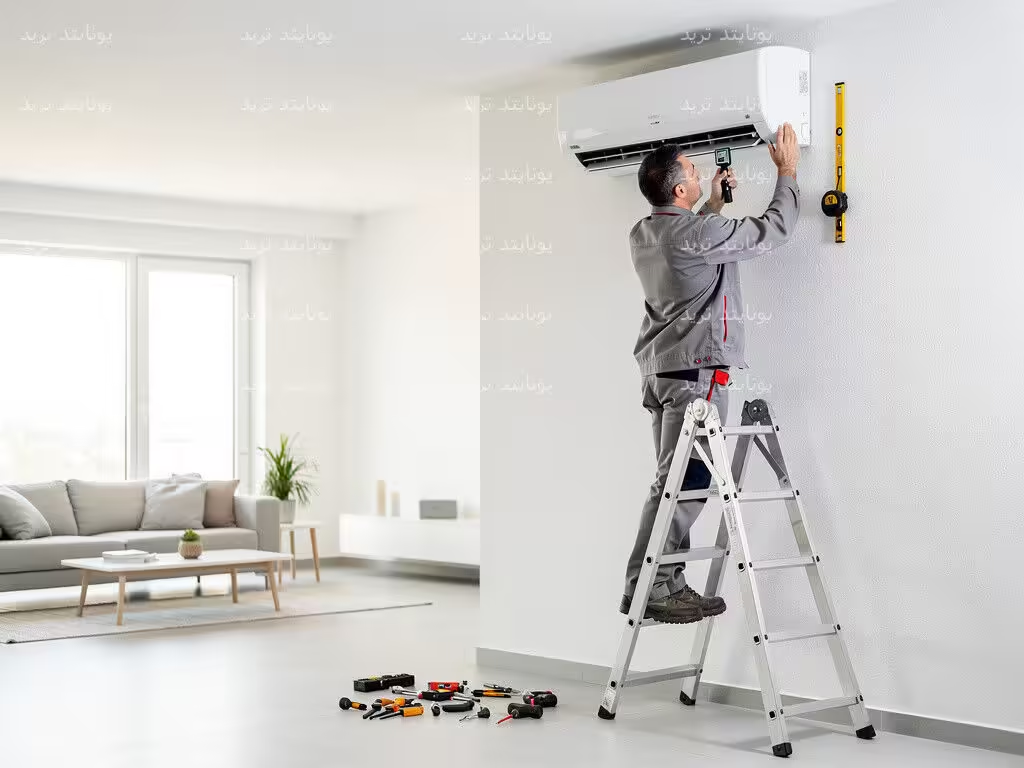
The most important tools and equipment used in installing cooling devices
The professional technician relies on a complete set of precision equipment to ensure that installation tasks are carried out without causing damage to sensitive device components or wasting refrigerant. These tools include the following:
- Vacuum Pump To remove moisture and air from the closed circuit before pumping the refrigerant.
- Dual gas pressure gauge (Manifold Gauge) to monitor high and low pressure stability.
- Flaring and Swaging Tool set to prepare the ends of the pipes tightly to prevent leakage.
- Digital or manual water level to adjust the level of indoor and outdoor units with extreme accuracy.
- Copper pipe cutters are designed to cut pipes without leaving any metal debris inside the path.
Table of compatibility between room area and required cooling capacity
Accurately determining the cooling capacity before purchasing helps save energy consumption and extend the life of the compressor. The following is a table showing the ideal capacity for each space:
| Approximate room area | Cooling capacity in horsepower (HP) | Capacity in British Thermal Unit (BTU/h) | Nature of use and location |
|---|---|---|---|
| Up to 12 square metres | 1.5 hp | 12000 units | Bedrooms with good insulation and without direct solar exposure |
| From 13 to 18 square meters | 2.25 hp | 18000 units | Medium living rooms or upper floors exposed to the sun |
| From 19 to 24 square meters | 3 hp | 24,000 units | Spacious reception halls or rooms with large glass windows |
| From 25 to 32 square meters | 4 hp | 30,000 units | Open commercial offices or connected reception halls |
| From 33 to 40 square meters | 5 hp | 36,000 units | Completely open spaces or commercial areas with constant traffic |
Additional factors affect the choice of cooling capacity
The calculations do not depend only on the area in square meters, but also the height of the ceiling, the quality of thermal insulation of the walls, the number of electrical appliances that produce heat inside the place, as well as the density of people regularly present in the room.
It requires an operation Air conditioning installation Air has comprehensive technical know-how to ensure that fresh air is distributed with high efficiency within residential and office rooms. Properly engineered installation helps reduce electrical energy consumption by up to 25% while extending the life of your Freon compressor. In this specialized guide, we review field requirements, work stages, and ways to avoid common mistakes during implementation to ensure maximum home comfort.
Quick answer
Air conditioning installation Airing is a technical process that involves installing the indoor and outdoor units, connecting them with insulated copper tubes, and carefully vacuuming the air to ensure a leak-free flow of cooling. System efficiency is determined by successfully testing the refrigerant pressure and adjusting the water balance to avoid moisture dripping into the chamber.
Pre-planning to determine the location of refrigeration units
Preparation begins with choosing a strong wall capable of withstanding the vibrations of the indoor unit without making noise while the air distribution fan rotates. Therefore, an upper clearance of at least 15 centimeters must be left to ensure sufficient amounts of warm room air are drawn in and cooled efficiently.
On the other hand, the outdoor unit requires a shaded, well-ventilated location away from sources of dust and direct sunlight. Furthermore, this open location facilitates periodic inspections and subsequent cleaning of the thermal condenser.
Calculating the appropriate cooling capacity for the space
Cooling calculations are based on the equation of the room size in square meters and the level of thermal insulation of the windows and external walls. For example, a 15 square meter room needs a 1.5 HP appliance, while larger spaces up to 24 square meters require 2.25 HP cooling capacity to avoid motor fatigue.
Choosing a pipe extension route
The shorter path between the two units determines the efficiency of refrigerant flow and reduces cold loss through the walls. As a result, technicians prefer that the copper refrigerant line be no more than five meters long to avoid the need to charge additional amounts of lubricating oil to the air compressor.
Tools and equipment needed before starting implementation
The quality of work depends on the use of specialized tools that prevent damage to sensitive metal components during bonding and welding. It should be noted that the use of a digital water scale ensures that condensation water automatically flows into the external drain without accumulating inside the basin of the indoor unit.
- Scale for adjusting water level and verticality.
- Vacuum pump for dehumidification.
- A set of knives for cutting and bending copper pipes without cutting.
- Electronic Freon leak detection device.
- Torque wrench for precision tightening of brass fastening nuts.
Technical stages of implementing home air conditioning installation
The practical path to installing the cooling system requires strict adherence to sequential engineering steps to protect the closed circuit from impurities. This organized arrangement shows how to complete the task with the utmost professionalism:
- Fix the metal plate holding the indoor unit to the wall using strong screws and a water level.
- Make a circular hole in the wall with a diameter of 65 mm and a slight outward slope to facilitate water drainage.
- Pass the bundle of copper pipes, electrical connection cables and drain hose through the wall hole.
- Install the rubber bases of the outdoor unit on iron stands treated against rust to absorb vibration.
- Tighten the flange nuts between the two units using a torque wrench with the manufacturer's recommended strength.
The importance of air intake and Freon pressure testing
The process of removing air and moisture from the refrigeration cycle using a vacuum pump is a pivotal step that cannot be skipped at all. Accordingly, the presence of air or water vapor inside the pipes causes it to freeze at the expansion valve, causing complete blockage and a devastating rise in compressor pressure.
The process of installing cooling networks requires extreme precision in preparing the copper paths to ensure that the refrigerant flows efficiently and without any possible leakage. So the implementation Installing air conditioning ducts According to sound engineering standards, it ensures that the circuit is protected from blockage and damage in the long term.
The periodic maintenance phase comes as a crucial step to ensure the sustainability of cooling efficiency and avoid sudden malfunctions that may affect the life of the device. So, action Comprehensive preventive examination It effectively contributes to early detection of refrigerant gas leaks and cleaning of filters to ensure clean and healthy air flow to the place.
Successful implementation of the cooling network requires the application of precise standards Air conditioning duct extension To ensure the refrigerant flows efficiently and without any potential leaks. This step includes using specialized tools to bend and pull copper tubes according to the appropriate geometric diameters for each device.
The efficiency of the cooling system does not stop at the stage of proper installation, but continuity of performance requires action Regular air conditioning maintenance To protect mechanical and electrical parts. Regular cleaning of filters and inspection of evaporator and condenser coils helps maintain fresh air flow and reduce energy consumption, ensuring efficient cooling for as long as possible.
The process of installing the air conditioning network requires extreme precision at one stage Establishing copper pipes To ensure efficient refrigerant flow and prevent any future leakage. This includes choosing the appropriate diameters and carefully insulating them thermally to protect the walls and avoid energy loss during operation.
require Air conditioning maintenance Conduct regular inspection of internal components to reduce sudden malfunctions and ensure brilliant airflow. This regular procedure contributes to cleaning the filters and checking gas levels to increase the efficiency of the device and significantly reduce energy consumption.
To ensure sustained cooling efficiency and protect internal parts from sudden malfunctions, action is required Regular air conditioning maintenance Ensure that gas levels are checked and filters and condensers are cleaned regularly. These preventive measures contribute to reducing energy consumption and significantly extending the life of the device.
In addition, the pressure gauge should be monitored for 15 minutes after stopping the pump to ensure that the vacuum level remains constant at 500 microns. This test ensures that all connections are sealed and that there is no porosity in the weld points or connection nuts.
It is a process Establishing cooling pipes Copper is the most vital stage in pre-preparing the site, as it ensures that the cooling paths are directed accurately and with high professionalism inside the walls before starting the final finishing works. This procedure requires skill in bending and extending pipes without kinks or jams that impede gas flow, ensuring long-term operational efficiency of the air conditioning system.
Comparison of different air conditioner installation methods
Installation requirements vary depending on the model of air conditioner chosen and the nature of the architectural space to be cooled. The following table shows the most important technical and operational differences between common systems:
| Type of air conditioning system | Ease of installation process | Indoor noise level | Air distribution efficiency | Wall foundation requirements |
|---|---|---|---|---|
| Split wall air conditioning | Medium and fast | Very low | Excellent for single rooms | Only a small wall opening |
| Ceiling cassette air conditioning | You need advanced experience | Almost non-existent | Four-way distribution | False ceiling and hanging space |
| Concealed air conditioning | Complex and requires planning | Very quiet | Comprehensive coverage via air ducts | Duct network and wide ceiling areas |
| Traditional window air conditioning | Very simple | Medium to high | Direct and limited in scope | Complete rectangular wall discharge |
Standards for electrical conductivity and protection against fluctuation
The air conditioning system requires an independent electrical line connected directly to the main distribution panel via an appropriate automatic circuit breaker. Therefore, a copper cable section must be chosen that is proportional to the starting current intensity of the device to avoid overheating of the wires and burning of the insulators.
Furthermore, installing an isolator switch next to the outdoor unit helps ensure the safety of technicians while performing routine maintenance. Proper grounding prevents any electrical shorts that could damage the sensitive electronic board inside the device.
Frequently asked questions
What is the appropriate distance between the indoor unit and the ceiling?
A distance of at least 15 to 20 centimeters must be left between the top of the device and the ceiling. This space ensures that air freely enters the purification filter and achieves optimal cooling efficiency in the space.
Can air conditioning be installed without using a vacuum pump?
It is not recommended at all to install the device without drawing air through a specialized vacuum pump. Neglecting this step will result in moisture remaining, damage to the compressor, decreased cooling capacity, and increased sound of the air conditioner.
How do I make sure there is no Freon leak?
This is confirmed by checking all copper connections using specialized soap foam or sensitive electronic detectors. The stability of the pressure gauge indicator for a specified period reveals the integrity of the entire circuit.
Why does water drip from the indoor unit after operation?
Dripping water is caused by the unit's scale not being set properly towards the drain outlet or the moisture drain hose being clogged. This malfunction can be corrected by re-leveling the installation and cleaning the drain.
When should an additional amount of Freon be added during installation?
Additional gas is added only if the length of copper pipe exceeds the manufacturer's pre-specified standard distance. This distance is usually more than five meters according to the instructions in the technician's manual.
Requires completion Air conditioning installation My home successfully follows technical standards and monitors initial operating tests to ensure cooling quality. Communicate with qualified technicians to ensure that your work is carried out accurately and professionally and enjoy a refreshing atmosphere throughout the year.
















TQTAG76 Community dialogue
0 comments