
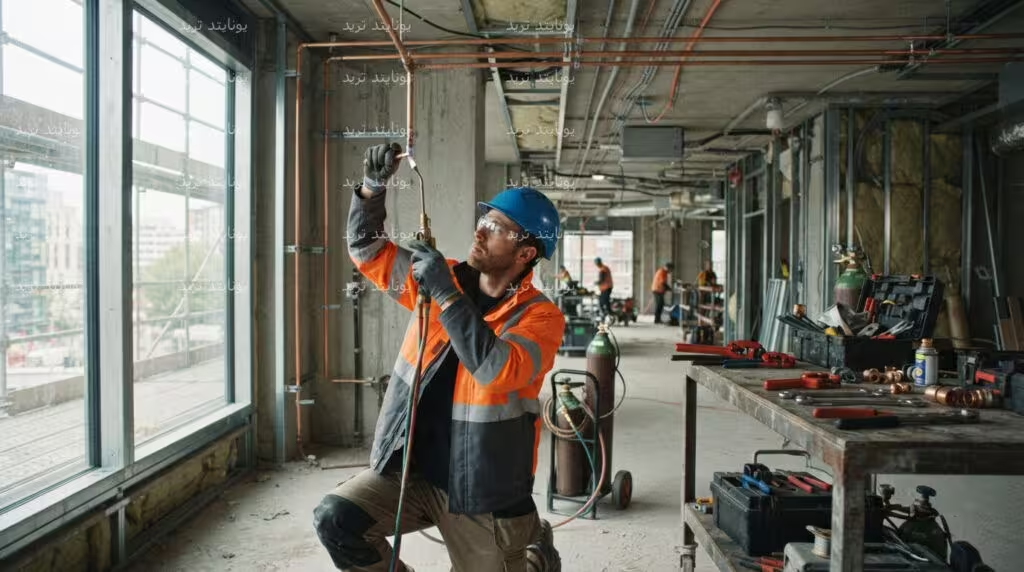
practical Establishing pipes Air conditioning It is the fundamental basis for ensuring sustainable cooling performance and avoiding any subsequent technical problems that arise after the finishes are completed. The success of this procedure depends on the selection of high-quality copper materials and the application of precise engineering practices during the installation, which ensures efficient refrigerant transmission and protects the building structure from moisture or sudden water leaks. By following the approved technical rules, the property owner guarantees optimal operation of his equipment in the long term.
Raw material requirements and diameter standards for copper
Selection of copper pipes according to international specifications such as: ASTM B280 or JIS-H3300 It represents a sure guarantee of resistance to high gas pressures. The appropriate diameter must be carefully selected based on the cooling capacity of the air conditioner, with common sizes ranging from 1/4" to 5/8" being used to accommodate the required flow.
❓ The importance of thermal insulation of pipes
Pipes must be covered with a thermal insulation layer Foam or rubber With a thickness ranging from 3/8 to 1/2 inch, to prevent water condensation that damages the walls. This insulation is also necessary to reduce energy loss, which directly contributes to increasing cooling efficiency and significantly reducing electricity consumption.
❓ Avoid mistakes in bending pipes
Use Pipe bending Customized is an indispensable option to avoid loosening of pipes or reducing their inner diameter during routing. Manual bending often chokes off the flow of Freon, which places additional stress on the air conditioning compressor and significantly reduces its lifespan.
Water drainage paths and engineering tendencies
It requires a process Establishing pipes Air conditioning Directing water drainage pipes with a precise geometric slope to ensure fluid flow and non-accumulation. Relying on the right tendencies prevents clogged pipes and prevents internal water leaks that may spoil the decor or cause mold to grow in the walls.
The following data shows the distribution of insulation thickness and copper diameter according to air conditioning capacity:
| Air conditioner capacity (tons) | Pipe diameter (inch) | Insulation thickness (in. ) |
|---|---|---|
| 1.5 tons | 1/4 – 1/2 | 3/8 |
| 2.25 tons | 1/4 – 5/8 | 1/2 |
| 3 tons | 3/8 – 3/4 | 1/2 |
Pressure tests before final closure
Perform a pressure test using... Nitrogen gas A mandatory step before starting the finishing stage and closing the walls permanently. This process detects any minute leaks in connections or welds, saving expensive repair costs that may result from discovering the problem after installing and operating the device.
This sequential path explains the practical steps to ensure the integrity of the extensions, as it prevents moving to the next stage before ensuring the integrity of the previous test.
require Air conditioning installation process Extreme accuracy in determining the locations of indoor and outdoor units to ensure ideal air distribution and facilitate future regular maintenance. Coordination must also be made between specialized technicians to ensure that electrical connections and water drains are connected in accordance with approved technical standards, which protects the system from sudden malfunctions and extends the life of the device.
Adhere to safety protocols during implementation
Any action is strictly prohibited Welding for pipes Inside the walls to ensure that there are no potential weak points from which gases may leak in the future. All connections must be in visible and maintainable places, and the pipes must be cleaned well before installation to remove any dust or impurities that may impede the movement of the refrigerant.
The efficiency of the cooling system does not stop at proper establishment only, but also extends to implementation Regular air conditioning maintenance It maintains the readiness of the units and prevents dust from accumulating inside the filters and air paths. This continuous inspection contributes to the early detection of any Freon gas leak or defect in electrical components, which extends the life of the device and ensures stable energy consumption rates.
Maintaining this level of performance requires recognizing the importance of avoidance Avoid technical errors to ensure efficient coolingSuch as sharp bends in pipes or neglect of the quality of thermal insulation. Any deficiency in this preliminary stage leads to obstructing the path of the refrigerant and stressing the compressor, which negatively affects energy consumption and the lifespan of the system.
requires Air conditioning duct extension Careful planning of the copper paths to avoid sharp bends that may impede the flow of Freon and impair the cooling efficiency in the rooms. Tight insulation and geometric diameters also help prevent gas leakage and reduce stress on the compressor to ensure quiet, sustainable operation.
The long-term effectiveness of this system is not complete merely by proper installation, but rather requires a regular schedule that includes procedures Regular air conditioning maintenance To monitor gas pressures and the integrity of drain lines. This continuous inspection protects copper connections from corrosion and prevents deposit build-up that could hinder cooling efficiency or increase energy consumption.
A stage comes Air conditioning installation Air is the culmination of the previous establishment efforts, as it required extreme precision in installing the indoor and outdoor units to ensure the ideal pressure and airflow balance. Adherence to precise technical standards during installation prevents annoying vibrations and extends the life of the device, making the most of cooling efficiency within residential spaces.
The efficiency of the cooling system does not stop at the proper installation stage only, but also extends to compliance with programs Regular air conditioning maintenance It maintains the stability of Freon gas pressure and the cleanliness of internal and external filters and condensers. This continuous inspection helps detect any early leakage in the copper tracks and handle sudden faults, ensuring maximum operational efficiency and extending the life of the device with minimal power consumption.
After completing the basic stretches, there comes a stage Air conditioning installation Actual air to begin installing the indoor and outdoor units according to precise standards that ensure balanced thermal distribution. This work requires installing the units with engineering skill and connecting them to the cooling and electrical circuits, while ensuring that the connections are insulated to prevent Freon gas leakage or water condensation, which ensures ideal operation of the device.
Frequently asked questions
❓ What are the risks resulting from poor installation of air conditioning ducts?
Poor foundation often leads to Freon leaks, water condensation on the walls, and reduced cooling efficiency, requiring expensive gutting to repair.
❓ Can thin copper pipes be used to reduce costs?
This is never recommended; Because thin copper does not withstand high operating pressures and may explode or puncture quickly, causing serious failures.
❓ How to ensure that there are no leaks in the pipes?
This is done by pressurizing the pipes with nitrogen gas for a specific period of time and monitoring the pressure gauge. If the indicator decreases, this means there is a leak.
❓ Does the route of the pipes affect the efficiency of the air conditioning?
Yes, the longer the path or the more sharp bends, the greater the load on the compressor and the lower the cooling efficiency, so it is always preferable to choose the shorter and straighter path.
❓ When should you start installing air conditioning ducts?
This phase should be started immediately after the initial construction work is completed and before plastering or painting work begins, to ensure it is properly integrated within the structure.
conclusion
Attention to detail Establishing pipes Air conditioning From the beginning, it represents a smart investment that protects you from frequent air conditioning malfunctions and maintains the efficiency of your home. We always recommend hiring specialized technicians and adhering to engineering standards to ensure lasting comfort in your home.
















TQTAG76 Community dialogue
0 comments