
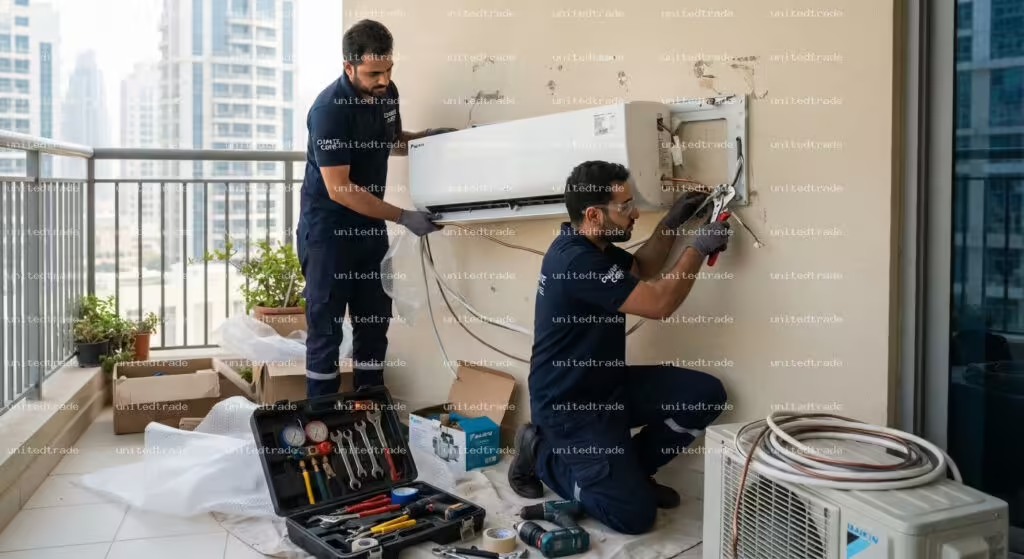
Installation considerations in the new location to ensure optimal performance
After completing the unpacking processSplit air conditioning transfer Successfully, comes the reassembly stage, which is no less important than the disassembly. The new location is not just a place to install the equipment, it is an essential element in determining the life of the unit. A solid interior wall must be chosen that is able to bear the weight of the unit without vibrations, and it is necessary to stay away from direct heat sources such as kitchen ovens or places exposed to strong sunlight, as this increases energy consumption and reduces cooling capacity.
Air distribution and flows
Legal distances around the indoor unit must be observed to facilitate the process of drawing and distributing air. Installing too close to ceilings or in tight corners will hinder the movement of the fan and cause annoying noise. You should also make sure that the indoor unit is slightly inclined towards the water drainage hole to ensure that it does not leak into the room.
Comparison table of common malfunctions after transportation
| Type of malfunction | Possible cause | Corrective action |
|---|---|---|
| Ice accumulation on the evaporator | Lack of Freon charge | Checking for leaks and charging Freon |
| Internal water leak | Clogged drain hose | Track cleaning and tilt adjustment |
| Excessive vibration | The mounting base is not level | Reset unit balance |
| Loud friction sound | Damage to the fan bearing | Replace the damaged part |
Technical steps for cycle pressure testing
Before operating the equipment permanently in the new location, stress testing is a preventive step that cannot be ignored. A vacuum pump is used to remove moisture and air from new copper pipes. Leaving air inside the cycle causes chemical reactions between the oil and Freon, creating acidity that can damage the internal compressor coils.
Leak testing requirements
- Ensure that the nuts of the copper connections are tightened using a torque wrench to avoid excessive pressure.
- Use soap suds or an electronic detector to ensure there are no bubbles at the bonding areas.
- Monitor the pressure gauge for at least 15 minutes to ensure that it is stable and that there is no drop that indicates an invisible leak.
After ensuring that the cycle is safe, the service valves are gradually opened to allow the Freon to circulate. It is always recommended to start operation in fan-only mode for a few minutes to ensure the oil is distributed within the system before activating the compressor, which reduces mechanical friction in the first minutes of operation after the idle period resulting from the shifting process.
Requires disassembly processSplit air conditioning transfer High precision and specialized technical expertise to ensure that the system is not damaged and that the refrigerant gas is preserved inside the unit. Many people face technical challenges when trying to move air conditioners from one place to another, but by following the correct procedures, the task can be completed successfully without affecting the cooling efficiency in the future. This article aims to provide you with a comprehensive guide that covers the professional standards necessary to dismantle and move a split air conditioner in a professional manner that protects your investment in the device.
Quick answer
The decoding process is doneSplit air conditioning transfer By closing the liquid valve, then turning on the air conditioner to trap the Freon in the outdoor unit (collection process), followed by closing the gas valve and turning off the power. It is always recommended to seek the help of a certified air conditioning technician to avoid leaking Freon gas or damaging the copper connections during the dismantling process.
Basic tools needed to disassemble the unit
A basic toolkit must be prepared to ensure safe handling of the delicate components of the air conditioner during the disassembly and installation process. Relying on inappropriate equipment may result in kinked copper piping or damage to service valves, causing future failures in the refrigeration cycle.
List of required technical equipment
- Wrench (French key) in multiple sizes to remove copper connections.
- An electric screwdriver and a regular screwdriver to remove plastic caps and screws.
- Freon pressure gauge to ensure that the gas is completely trapped.
- Strong adhesive tape and plastic covers to protect the openings from dust and moisture.
- Pipe scissors or custom copper cutters if necessary.
Procedures for collecting Freon gas inside the outdoor unit
The most important step when dismantling and transporting a split air conditioner is to collect the Freon (Pump Down) inside the external unit to protect it from loss. Freon is the coolant responsible for heat exchange, and its loss means additional costs for recharging and less efficient pressures for the device.
Safe gas withdrawal steps
- Run the air conditioner on maximum cooling mode for five minutes.
- Remove the service valve covers on the outdoor unit.
- Close the liquid valve (thin tube) completely using the wrench.
- Wait about a minute for the compressor to draw out the remaining gas in the pipes.
- Close the gas valve (thick tube) quickly and disconnect the power directly.
Care for copper pipes and electrical connections
When dismantling and transporting a split air conditioner, copper pipes require very careful handling to avoid any holes or sharp bends that may hinder the flow of Freon later. The ends of the pipes must be insulated immediately after dismantling them to prevent the entry of moisture or impurities that may cause corrosion of the compressor in the long term.
Protection tips during transportation
The pipes must be emptied of any remaining oil or liquids before packaging to ensure the cleanliness of the cycle. Using the original protective caps or wrapping the ends with insulating tape is a necessary preventive measure that non-professionals overlook.
You can also benefit from additional related content via Air conditioning maintenance To expand your knowledge of this aspect.
To understand this point more deeply, we advise you to review Air conditioning installation Which covers the topic in more detail.
You can also benefit from additional related content via Air conditioning maintenance To expand your knowledge of this aspect.
For more details on this topic, you can see Installing air conditioning ducts For additional information.
This aspect is related to another topic that is worth looking at, as choosing the ideal location for the indoor and outdoor unit. Choosing the appropriate place to install air conditioners is one of the crucial factors that affect the cooling efficiency and longevity of the device., as explained in Air conditioning installation steps.
For those who want to expand further, the importance of periodically checking Freon gas is that the refrigerant gas or Freon is the vital lifeline for any air conditioning unit, and its deficiency leads to a significant decrease in cooling efficiency. It is not consumed, and this can be reviewed in detail via Air conditioning maintenance to ensure performance.
It should be noted that there are additional useful details about this aspect that can be reviewed via Installing air conditioning ducts.
For more details on this topic, you can see Air conditioning installation For additional information.
To understand this point more deeply, we advise you to review Installing air conditioning ducts Which covers the topic in more detail.
To understand this point more deeply, we advise you to review Air conditioning installation Which covers the topic in more detail.
Summary table of transportation and installation steps
| Step | Action required |
|---|---|
| Assembly | Pulling Freon into the outdoor unit |
| the chapter | Dismantle the copper and electrical connections |
| Packaging | Protect pipes from moisture and dust |
| Installation | Installing the units and reconnecting them |
| Testing | Ensure that there are no Freon leaks and pressure |
Challenges of choosing a new location for installation
The choice of the new location directly affects the performance of the air conditioner after dismantling and moving the split air conditioner and installing it in another location. The wall chosen must be strong enough to bear the weight of the indoor unit, while ensuring that there is sufficient space around the outdoor unit to ensure good ventilation and heat drainage.
It should be noted that there are additional useful details about this aspect that can be reviewed via Air conditioning maintenance.
Ideal location criteria
Avoid installing the indoor unit in front of doors or in places exposed to strong direct sunlight. Also ensure that there is a slight slope for the water drainage pipe to prevent drops from falling into the room, and the copper extension distances must be reduced as much as possible to increase cooling efficiency.
Frequently asked questions
Can I remove and move the split air conditioner myself?
This is not recommended unless you have the technical expertise and appropriate equipment; Because any error in trapping Freon or loosening the connections may lead to gas leakage and damage to the compressor.
How long does it take to move the air conditioner from one place to another?
The process usually takes between two and four hours, depending on the difficulty of the installation site and the length of the copper extensions required.
What happens if Freon leaks during transportation?
Freon leakage leads to a significant decrease in cooling efficiency, which requires the entire cycle to be recharged by a specialized technician and the use of pressure measuring devices.
Should copper pipes be changed during transportation?
It is not always necessary, but if the pipes are old or exposed to sharp bends during dismantling, it is preferable to replace them to avoid Freon leaks in the future.
Why must the ends of pipes be insulated when dismantling?
The ends are insulated to prevent moisture and dust from entering the refrigeration cycle, as the presence of any impurities inside the air conditioning system may lead to blockage of the expansion valve and damage to the compressor.
Final evaluation of the transfer process
| Standard | Rating |
|---|---|
| Difficulty in implementation | 4.5/5 |
| The need for professional equipment | 5/5 |
| The importance of technical experience | 5/5 |
| Cost versus risk | 4/5 |
Ultimately, disassembling and transporting a split air conditioner represents a precise engineering process that requires adherence to safety steps and preservation of the device’s components. Hiring professionals ensures that your device continues to operate at the same efficiency as before and avoids the costs of repairs resulting from human errors.
















TQTAG76 Community dialogue
0 comments