
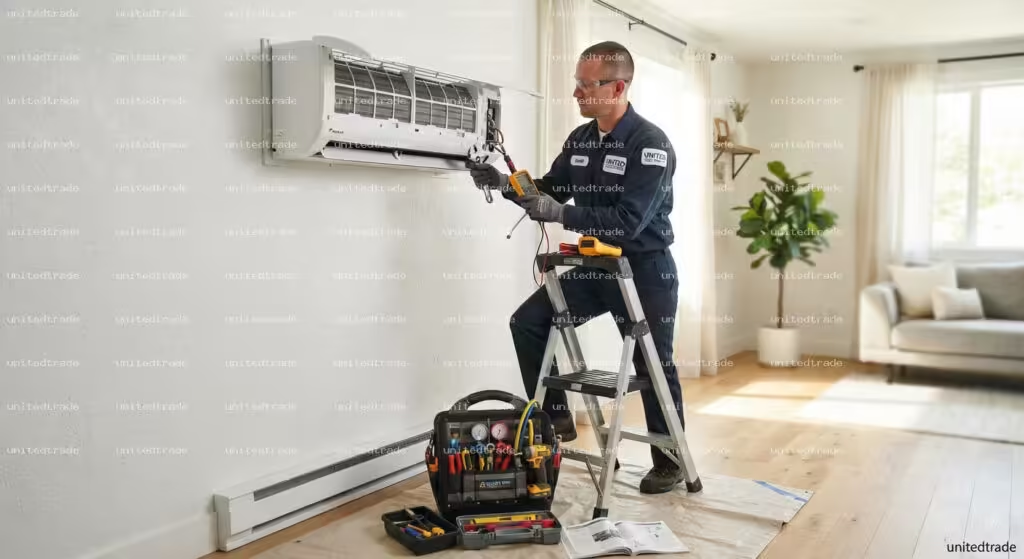
Choose the ideal location for the indoor and outdoor unit
Choosing the right place forAir conditioning installation Air is a critical factor that affects cooling efficiency and device longevity. As for the indoor unit, you must be careful to place it in a place that allows air to be distributed evenly throughout the room, while avoiding placing it directly above electrical appliances or near heat sources such as stoves, as this will make the thermostat read an inaccurate temperature, which will lead to the compressor running for longer periods than necessary and additional energy consumption.
As for the outdoor unit, it must be installed in a well-ventilated area away from direct sunlight as much as possible, to reduce the heat load on the cooler. It is also necessary to leave enough space around the outdoor unit to allow air to circulate and facilitate regular maintenance. Avoid installing the unit in tight or enclosed spaces as this may cause hot air to reflux, which reduces the device's ability to efficiently exchange heat.
Factors affecting air distribution efficiency
- Avoid obstacles such as heavy curtains or large furniture in front of the indoor unit.
- Installing the device at a suitable height ensures that the cool air reaches the sitting level.
- Stay away from closed corners that obstruct the circular flow of air inside the room.
Comparison table between types of copper connections
| Connection type | Features | Disadvantages |
|---|---|---|
| Thermal insulated copper | Prevent condensation and keep the gas cool | Slightly higher cost |
| Uninsulated copper | Ease of formation and installation | Loss of cooling efficiency and formation of water droplets |
| Welded pipes | High pressure tolerance | Requires careful technical expertise to prevent leakage |
Common mistakes while extending cooling paths
Technicians often encounter problems resulting from faulty wiring. One of the most common mistakes is bending copper pipes at sharp angles, which reduces the inner diameter of the pipe and thus impedes the flow of refrigerant, which causes additional stress on the compressor. It is always recommended to use a spring bender to ensure a smooth bend without causing any dents in the copper wall.
Another mistake is not insulating the pull and push lines separately. If the two lines touch without sufficient thermal insulation, heat exchange occurs between them, which leads to a significant decrease in cooling effectiveness. Moreover, you must ensure that the openings in the wall are closed using insulating materials to prevent the leakage of outside air or the entry of insects and dust that may accumulate inside the room and affect the quality of the air emitted from the air conditioning.
Testing and verification procedures after installation
After completing the installation and connection process, comes the stage of checking the quality of performance. Copper circuits should be pressure tested using nitrogen gas to ensure there are no minute leaks that may not appear in conventional tests. This measure protects the device from long-term loss of refrigerant.
The electrical current drawn by the clamp meter must also be monitored during initial operation, to ensure that the compressor is operating within the permissible range mentioned in the instruction booklet. If the current is higher than normal, this may indicate a problem with the electrical connections or an overload in the cooling circuit. Finally, the operation of the air-directing blades must be checked and ensured that they respond fully to the commands of the remote control, while ensuring that there are no abnormal sounds or excessive vibrations in the outdoor unit during full operation.
It is considered practical Air conditioning installation Air is a crucial step to ensure optimal device performance and long-term energy savings. This work requires high technical precision and experience in dealing with electrical connections and cooling pipes to ensure that leaks do not occur. This article aims to provide you with basic information about the correct standards to follow when starting to install refrigeration units in your home or office.
Quick answer about air conditioning basics
Includes process Air conditioning installation Air Choose a suitable place for the indoor unit away from heat sources, and install the metal stand precisely horizontally. The copper tubes are then connected and the air is emptied from the cycle using a vacuum pump to ensure efficient cooling before final operation.
Criteria for choosing the location of the indoor and outdoor unit
The success of the cooling system mainly depends on choosing the correct location for both the indoor unit and the outdoor unit. The indoor unit must be installed in a place that allows air to be distributed evenly in the room, away from obstacles such as curtains or large pieces of furniture that may prevent air flow.
Outdoor unit installation requirements
The outdoor unit needs a well-ventilated place to ensure efficient heat removal, preferably in a shaded area as much as possible to reduce the heat load on the compressor. You must also ensure that the metal base is stable to avoid annoying vibrations during operation.
For more details on this topic, you can see Air conditioning maintenance For additional information.
Steps to carry out professional air conditioning installation
The process of installing air conditioners is carried out through a series of organized steps that ensure safety and high performance. The technician begins by carefully identifying the drilling points, followed by installing the indoor unit stand, after which copper pipes and electricity cables are extended between the two units.
In a related context, you can refer to: Installing air conditioning ducts To learn more about this topic.
To understand this point more deeply, we advise you to review Split air conditioning transfer Which covers the topic in more detail.
It should be noted that there are additional useful details about this aspect that can be reviewed via Installing air conditioning ducts.
For those who want to expand further, when you think about moving to a new home or even reorganizing your room’s decor, the first thing that comes to mind is how to deal with sensitive appliances such as air conditioners. The decoding process can be reviewed in detail here Principles of the disassembly and installation process.
This aspect is related to another topic that is worth looking into, as it is important to periodically check Freon gas. The refrigerant gas or Freon is considered the vital lifeline of any air conditioning unit, and its deficiency leads to a significant decrease in cooling efficiency. It is not consumed, as shown in Air conditioning maintenance to ensure performance.
It should be noted that there are additional useful details about this aspect that can be reviewed via Split air conditioning transfer.
To understand this point more deeply, we advise you to review Split air conditioning transfer Which covers the topic in more detail.
For more details on this topic, you can see Air conditioning maintenance For additional information.
For more details on this topic, you can see Installing air conditioning ducts For additional information.
You can also benefit from additional related content via Air conditioning maintenance To expand your knowledge of this aspect.
- Locate the inner stand and ensure it is completely level using a water level.
- Drill a wall hole of appropriate diameter with a slight outward slope to drain condensation water.
- Connect insulated copper pipes and install electrical cables according to the manufacturer's diagram.
- Exhaust the air from the system using a vacuum device to prevent moisture from damaging the compressor.
- Open the cooling valves, test the gas pressure, and ensure that there are no leaks.
Summary table of the most important installation requirements
| Composition element | Technical details |
|---|---|
| Distance to indoor unit | Not less than 15 cm from the ceiling |
| The inclination of the drain pipe | At a slight outward angle of descent |
| Air discharge | It should take 15-20 minutes |
| External ventilation | Save 50cm space behind the unit |
Common mistakes to avoid when establishing
Many technicians make mistakes that may shorten the life of the device or significantly impair cooling. The most prominent of these mistakes is not insulating copper pipes well, which leads to loss of energy and the formation of water droplets inside the walls.
The effect of inaccurate electrical connections
Poor or mismatched electrical connections can lead to overheating of wires and damage to the electronic control board. A suitable circuit breaker should be used that matches the air conditioning capacity to ensure protection against electrical short circuits.
The importance of regular maintenance after installation
The importance of installing air conditioners does not stop at the first day of operation, but rather extends to regular regular maintenance that maintains the system’s efficiency. Cleaning the filters and checking the Freon gas level annually ensures that the device remains operating at factory efficiency for many years.
Frequently asked questions
How do I know that the air conditioning location is suitable?
The appropriate location is one that allows air to flow freely in the room, and is away from direct sunlight and heat sources such as ovens, while ensuring easy access for maintenance.
Can I install the air conditioner myself?
This is not recommended because installing air conditioners requires special tools such as a vacuum device and pressure gauges, in addition to experience in dealing with refrigerant gas to avoid health and technical risks.
Why does the air conditioner drip water inside the room?
This is often caused by a clogged water drain pipe or insufficient slope in the installations, which prevents water from escaping outside and collecting inside the indoor unit.
What is the role of the vacuum when installing air conditioning?
Vacuum extracts air and moisture from copper pipes before opening the gas valves, preventing moisture from interacting with oil and gas inside the compressor and preventing blockages.
Final evaluation of installation steps
| Standard | Rating |
|---|---|
| Ease of implementation | 2/5 |
| Required tools | 4/5 |
| Accuracy of connections | 5/5 |
| Final quality | 5/5 |
The overall rating for adherence to correct installation standards is 4/5, as the process requires careful attention to technical details to ensure safety. Following these guidelines will give you a comfortable and cool home environment without annoying technical problems.
















TQTAG76 Community dialogue
0 comments