
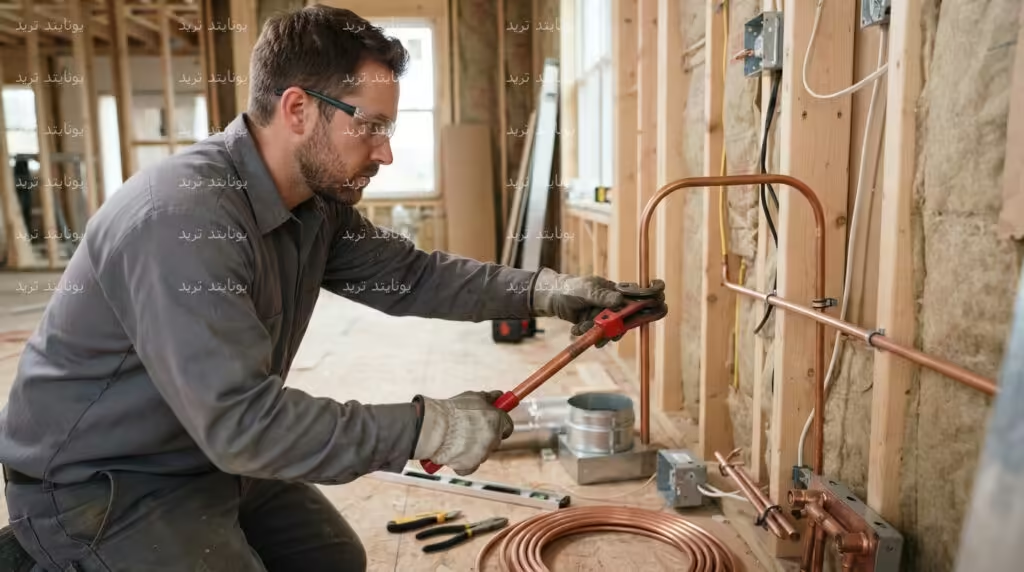
He promises Air conditioning duct extension A very precise engineering process that requires high technical skill to ensure efficient transfer of the refrigerant (Freon) between the internal and external units. Relying on copper materials that conform to international specifications, while following the correct installation principles, prevents Freon leaks or annoying water condensation inside the walls. Through this article, we reveal to you the technical standards and practical steps that experts follow to achieve ideal cooling performance, while reducing pressure on the compressor and extending the lifespan of your device.
The importance of choosing the correct diameter of copper pipes
The efficiency of any cooling system depends directly on the compatibility of the diameter of the pipes with the capacity of the air conditioner (BTU); Choosing an inappropriate size leads to obstructing the movement of the coolant and increasing energy consumption. A 1.5 HP air conditioner requires 1/4 inch diameter copper pipe for the liquid line and 3/8 inch diameter for the gas line.
❓ Requirements for high-capacity systems
In contrast, large air conditioners up to 5 horsepower require 1/2-inch diameter pipes for liquid and 3/4-inch diameter for gas. This progression of sizes ensures an ideal flow of Freon without loss of pressure, which maintains stable performance Air conditioning duct extension In the long term.
The role of thermal insulation in protecting infrastructure
Thermal insulation represents an essential basis for preventing the phenomenon of condensation, or what is known as sweating, as the pipes are coated with an insulating material with a thickness of no less than 9 mm. This insulation prevents moist air from coming into contact with cold pipes, protecting walls and ceilings from moisture that may lead to cracks or mold.
Furthermore, insulation reduces cold loss as it travels through the piping, significantly reducing the operating load on the compressor. Air conditioning duct extension Without good insulation, this practically means losing a large percentage of the device’s efficiency and a significant increase in the monthly electricity bill.
The above flow chart shows the geometric sequence adopted forEstablishing pipes, starting from on-site inspection to the crucial testing phase before final commissioning.
Technical standards are indispensable during extension
Must use Bending Tool Customized instead of manual bending, in order to avoid narrowing of the cross-section of the copper pipe that may disrupt the flow. Pipes and electrical wires must also be protected inside protective plastic pipes with a diameter of 2 inches when installed inside walls.
- It is necessary to use silver solder for the connections to ensure strength and durability.
- Avoid having any welds inside hidden tracks as much as possible.
- Secure the pipes inside the walls to prevent vibration while the compressor is running.
- Ensure that the water drainage line is tilted regularly to ensure fluid flow smoothly.
Test the tightness to ensure there are no leaks
Prepare the system pressure test using Nitrogen The most important step that cannot be skipped before closing the tracks with final finishes. Nitrogen gas is pumped into the pipes under high pressure and the measuring meters are monitored to ensure that the pressure remains stable for a sufficient period. Any drop in the indicator clearly indicates the presence of a leak that must be repaired immediately, as repairing the Freon leak after closing the walls costs huge sums of money.
Here the importance of implementation emerges Air conditioning installation According to strict professional standards, the tight installation of the units and the adjustment of the electrical connections ensure the highest possible cooling efficiency. This also directly contributes to extending the life of the device and reducing energy consumption to a minimum.
Here the quality of the extensions is integrated with the accuracy of the implementation of the stages Air conditioning installation The air is in accordance with sound technical standards, as the tight installation of the two units and adjusting the water drainage angles ensure the stability of the entire cooling cycle. Choosing the ideal location away from direct heat sources also contributes to reducing energy consumption and extending the life of the device.
Once proper establishment is in place, it is important to adhere to a regular schedule of procedures Air conditioning maintenance To ensure the sustainability of the device's high performance. Undergoing preventive inspection and cleaning filters and evaporators on a regular basis extends the life of the compressor and prevents sudden breakdowns that may strain your budget.
Hence the utmost importance of this stage Installing air conditioning ducts In the first construction stages, copper and water drainage tracks are buried and installed with studied diameters and inclinations inside the walls and ceilings. This procedure ensures that the lines are protected from future damage, and provides a safe operating environment that maintains the aesthetic appearance of the place without the need for any subsequent breakage.
The importance of air conditioning does not stop only at the installation stage, but extends to include procedures Air conditioning maintenance Periodicity ensures continued efficient performance and extends the life of the device. Regular cleaning of filters and checking refrigerant gas levels protects the system from sudden malfunctions and maintains the quality of the air flowing inside the space.
Once the proper foundation is in place, the priority shifts to programs Regular air conditioning maintenance Ensures continued cooling efficiency and extends the life of the device. Regular cleaning of filters and regularly checking Freon gas levels prevents sudden malfunctions and reduces excessive energy consumption.
| Technical standard | Recommended details |
|---|---|
| Thickness of thermal insulation | Not less than 9 mm |
| Bending type | Use of automatic pipe bender |
| Pipe protection | 2-inch diameter plastic pipe |
| Test method | Dry nitrogen gas |
Frequently asked questions
❓ Why is it necessary to use a pipe bender?
Using the bender maintains the inner circular diameter of the tube, while manual bending causes dents that narrow the passage and negatively affect the movement of Freon.
Hence the importance of this stage Installing air conditioning ducts During the first construction stages, the copper lines and drainage pipes are carefully routed before the final finishing works. This procedure ensures that the extensions are protected from damage and avoids future cracking in the walls, which increases the cooling efficiency and maintains the aesthetic appearance of the place.
Here the importance of implementation emerges Air conditioning installation Air conditioning is carried out according to strict professional standards, as the process is not limited to wall installation only, but also includes adjusting the water drainage tendency and discharging air from the circuit via a vacuum pump. This careful application ensures that the compressor is protected from damage and extends the life of the device while maximizing energy consumption.
❓ Does extension length affect air conditioning performance?
Yes, the longer the piping length exceeds the manufacturer's limit, the lower the cooling efficiency and the more electrical energy the compressor consumes.
❓ When should you start installing air conditioning ducts?
It is preferable to start the foundation stage for the pipes during the initial construction and finishing works, in order to ensure that the paths are hidden aesthetically and safely within the walls.
❓ How do I ensure that water does not leak into the walls?
This is done by ensuring the quality of thermal insulation of the copper pipes and adjusting the inclination angle of the water drainage pipe to allow water to flow out effectively.
❓ Can air conditioning pipes be combined with other extensions?
It is always preferable to separate copper pipe routes from any other extensions, especially high-voltage electrical wires, to avoid any interference or technical malfunctions.
Final evaluation
| Evaluation standard | Rating |
|---|---|
| Engineering precision | 5/5 |
| Insulation efficiency | 4.5/5 |
| Value for life | 5/5 |
Adherence to these precise standards in Air conditioning duct extension It guarantees peace of mind and excellent performance of your device for many years. Start planning your paths with a specialized technician who follows these principles, and do not compromise on the quality of the materials used.
















TQTAG76 Community dialogue
0 comments