
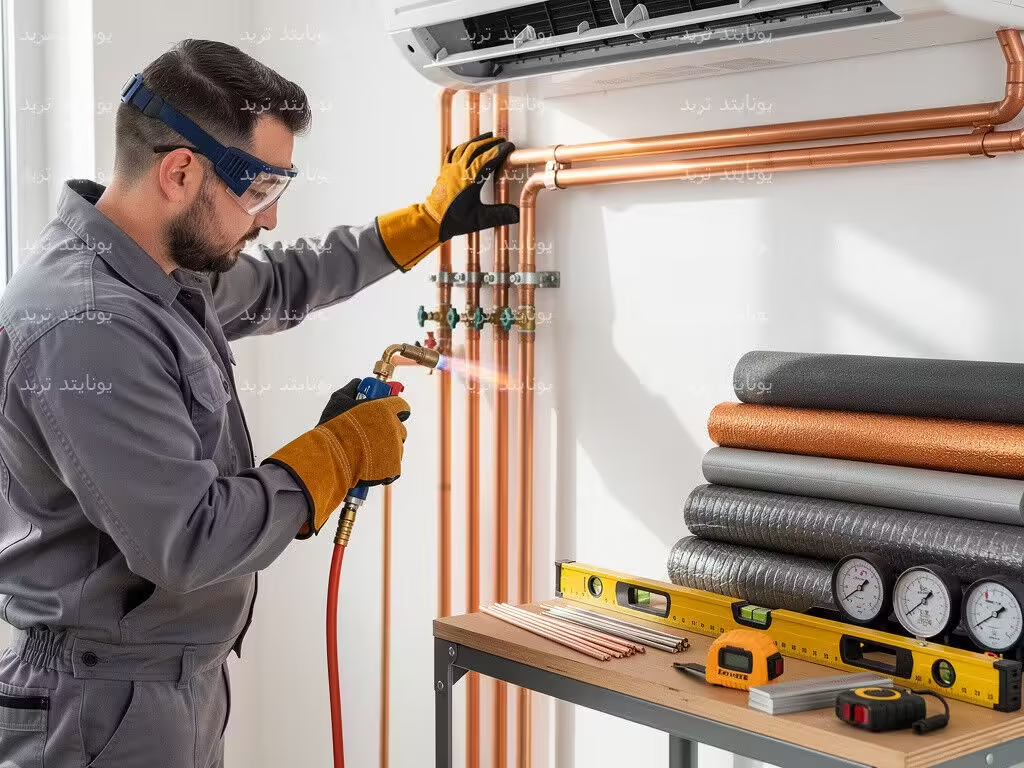
Basic tools and equipment for preparing and preparing pipes
Completing extension work professionally requires the use of a specific set of tools that ensure that the metal does not deform or weaken its walls during shaping. The most prominent of these tools are:
- Circular pipe cutter for even edges at exactly right angles.
- Edge cleaning tool and internal defogger to prevent any obstructions in the coolant flow.
- Manual or hydraulic pipe bender to avoid bending the pipe at curves.
- Flanging device for making conical flanges that tightly connect nuts.
Table of differences between the types of welding used in connections
| Welding method | Required temperature | Filling material used | Mechanical endurance level |
|---|---|---|---|
| Silver welding | Very high, exceeding 600 Celsius | Silver alloy with phosphorus | Excellent for resistance to high vibrations and pressures |
| Soldering | Low below 450 Celsius | An alloy of tin, lead or copper | Medium and suitable for applications with limited pressure |
Installation instructions and reduction of mechanical vibrations
Proper installation helps protect the refrigerant network from premature damage, as compressor vibration fatigues the attachment points over time. The following steps must be followed during implementation:
- Use rubber-lined jumpers to isolate the pipes from the walls and absorb shocks resulting from fluid movement.
- Leave sufficient spaces between the fixing points to ensure the stability of the line and not sagging over long distances.
- Design oil traps in vertical lines to ensure regular return of lubricating oil to the compressor and avoid burning.
The process of installing copper pipes is the cornerstone of the efficiency of any central or separate air conditioning system, as these pipes ensure the flow of the refrigerant between the indoor and outdoor units completely smoothly. Relying on precise technical standards during construction saves home and business owners the problems of Freon gas leakage and compressor damage in the long term. In this article, we review the field steps adopted to ensure quality performance and extend the life of the device.
Quick answer
Copper duct installation is the process of connecting refrigerant ducts between air conditioning units using precision tools such as a pipe cutter, reaming tool, and oxy-welding equipment. The quality of the installation depends on choosing a type of high-thick copper, tight thermal insulation, and avoiding sharp bends that may impede gas movement.
Basic tools and equipment for extension
Implementing a copper pipe installation project requires a set of specialized tools that ensure accuracy of work and safety of connections. Using poor quality tools often causes tiny cracks in the copper, causing silent leaks that are difficult to detect later.
List of necessary technical equipment
- Copper pipe cutter (Tubing Cutter): To ensure that the ends are cut perfectly evenly.
- Flaring Tool: To create a precise nozzle that fits the fastening nuts.
- Pipe Bender: To prevent twisting of copper during routing.
- Oxy-acetylene soldering kit: for joining copper connections with silver solder.
- Water level: to ensure the inclination of pipes and the drainage of condensation water.
Furthermore, thermal insulation (Armaflex) must be provided with a thickness appropriate to the local climate to prevent external condensation. The availability of these tools on the job site reduces wasted time and increases the professionalism of the final results.
Choose the quality of copper and its specifications
Choosing the quality of copper used in the wiring is the decisive factor in resisting the high pressures generated by modern Freon gas. It is never recommended to use thin or recycled pipes, as they cannot withstand operating pressures and may burst or puncture under the influence of changing temperatures.
Technical standards for air conditioning copper
The copper piping used must comply with international standards, specifically the ASTM B280 standard for refrigeration and air conditioning. These pipes are characterized by high purity in copper content, which facilitates the welding process and makes them more flexible when bent without breaking. Therefore, always ensure that the manufacturer's logo and wall thickness are clearly written along the length of the pipe.
| Specification | Recommended value |
|---|---|
| Wall thickness | Not less than 0.8mm for small diameter |
| Cooling type | Compatible with Freon R410A or R32 |
| Packaging method | End plugs to prevent dust from entering |
| State of matter | Annealed copper for easy shaping |
Steps to install copper pipes professionally
The process of installing copper pipes takes place through a series of interconnected steps that begin with planning and end with pressure and vacuum testing. The skilled technician begins by carefully measuring the paths, taking into account the number of bends to reduce pressure loss inside the pipes.
Stages of field work
First, the pipes are passed within their designated paths in the walls or false ceilings, while maintaining a safe distance from any electrical wires. Secondly, the process of widening (flaring) the limbs is performed with great care; Any slight scratch on the copper nozzle will inevitably lead to a Freon leak after operation. Third, the nuts are tightened using two torque wrenches to ensure proper tightening force without damaging the nut thread or crushing the copper.
Challenges of bending and steering in tracks
Technicians face the challenge of bending in tight spaces while installing copper pipes, as copper tends to compress or bend sharply. The use of a spring bender or mechanical device is very necessary to keep the inner diameter of the pipe open, allowing the Freon to pass freely without any obstructions.
Edge cleaning toolRemoval of feathers The fine filings that result from cutting, to ensure straight edges and avoid any future leaks. The pipe bender also plays an essential role in directing the extension paths without causing any dents, which ensures that the refrigerant flows very efficiently within the system.
Common mistakes to avoid
The most common mistake is leaving pipes exposed without thermal insulation in places where they pass through external walls. As a result, water condensation forms, which leads to moisture inside the walls and subsequent damage to the paint. In addition, care must be taken that the intake pipes (large pipe) and push pipes (small pipe) do not touch without insulation, because this contact reduces the efficiency of heat exchange.
The efficiency of the supply and drain networks depends mainly on the phase accuracy Establishing water and drainage pipes According to pre-studied engineering paths, the tight installation and proper inclinations ensure the avoidance of future blockages or leaks, giving the system a longer lifespan and highly reliable performance.
These precise equipment are considered the cornerstone of preventing refrigerant gas leakage and maintaining the efficiency of the system for the longest possible period, as they effectively contribute to facilitating operations. Air conditioning maintenance air and avoid sudden compressor malfunctions. Adherence to engineering standards in pipe preparation reduces the need for frequent technical interventions and ensures stability of the refrigeration cycle under various operating conditions.
Successful installation requires following Engineering criteria for choosing a site Precision units to ensure efficient cooling and easy airflow. These steps are completed by avoiding common installation errors and implementing safe operating procedures that ensure the stability of the system and protect it from premature malfunctions.
The efficiency of the refrigeration cycle depends entirely on the implementation Air conditioning duct extension According to precise engineering standards that maintain stable gas pressure. Following tight installation methods prevents the formation of micro-cracks in the connection points, ensuring that Freon leakage is avoided and the compressor is protected from constant mechanical stress.
It is considered a stage Establishing extension pipes A crucial step that requires extreme accuracy in measurements and determining the correct paths to avoid any future blockages. Tight fitting of pipes and appropriate slope angles also ensure smooth flow of fluids and protect the structural structure from the dangers of leaks in the long term.
Precision in preparing and connecting cooling lines is an essential preventive step to facilitate procedures Air conditioning maintenance air in the future and avoid sudden gas leaks. Adherence to technical standards during pipe installation reduces mechanical failures and maintains compressor efficiency for as long as possible.
The quality of preparing these connections is a pivotal step to ensuring the efficiency of cooling and avoiding any leakage of Freon gas that may lead to future malfunctions. Therefore, implementation Air conditioning maintenance Periodicity ensures the safety of these extensions and pipes, and directly contributes to prolonging the life of the device and maintaining low energy consumption.
These preparations are completed by the initial start-up stage Air conditioning installation Correctly, the internal and external units are installed and the cooling pipes are connected precisely to ensure that no Freon gas leakage occurs. It also requires taking into account standard dimensions and securing electrical connections to ensure that the device operates with the highest possible operational efficiency.
It is considered a stage Establishing pipes Extensions with high precision axial step to ensure safe and efficient flow of liquids and gases without any future leakage. Success at this stage depends on choosing appropriate paths and good installation to avoid mechanical stresses on the network.
These preparations are completed by starting the stage Air conditioning installation Strictly according to technical standards, the internal and external units are installed and the cooling pipes are connected to ensure highly efficient air flow. This step is the key to ensuring the safety of the system and the sustainability of its performance in the long term.
The importance of pressure and vacuum testing (Vacuum)
After completing the installations, the device cannot be operated without performing a nitrogen pressure test, which is an indispensable procedure in the installation of copper pipes to ensure that there are no leaks. Nitrogen is pumped at high pressure for 24 hours to monitor the stability of the indicator, which gives complete guarantee of the safety of all connections.
Air intake steps
After ensuring that there is no leakage, a vacuum pump is used to extract moisture and air from inside the pipes. This step is vital because any moisture remaining inside the copper circuit reacts with oil and gas, leading to the formation of acids that destroy the compressor core over time.
Frequently asked questions
How do I ensure the quality of installing copper pipes in my home?
You can ensure the quality by examining the thermal insulation covering the entire pipes, ensuring that there are no sharp bends (dents) in the path, in addition to requesting a nitrogen pressure test report from the technician before starting operation.
What is the difference between lined and regular copper in extension?
Lined copper (pre-insulated) provides better protection against moisture and is quicker to implement, while regular copper requires installing the insulation manually, and it is a good option if it is installed professionally and covers all areas.
Why should copper pipes be insulated separately?
Each pipe must be individually insulated to prevent heat exchange between the cold intake line and the hot exhaust line, ensuring efficient cooling and preventing water condensation that causes moisture on the walls.
How much time is allowed for copper pipes without soldering?
It is always preferable to use one continuous length of pipe to reduce the number of welds. The fewer welds, the less likely a leak will occur in the future, as the weld area is considered the weakest link in the network.
Does the length of the piping route affect air conditioning performance?
Yes, length directly affects; As the length of the path exceeds the limit allowed by the manufacturer, the cooling performance decreases and the system needs an additional charge of Freon gas to compensate for the loss.
Can copper pipes be repaired if a hole occurs?
Yes, it can be repaired by cutting the damaged part, installing a new copper coupling, and soldering it well, but it is always preferable to replace the entire damaged part if the hole results from corrosion of the copper itself.
Evaluation of technical standards for installation
| Standard | Rating |
|---|---|
| Quality of materials | 5/5 |
| Accuracy of thermal insulation | 4.5/5 |
| Leak test | 5/5 |
| Consider paths | 4/5 |
| Overall rating | 4.6/5 |
Investing in installing copper pipes according to the correct engineering standards represents a real guarantee of the performance of the air conditioner for many years. We always advise you to contract with specialized technicians who have the appropriate tools and carefully follow inspection and pressure procedures before starting operation.
















TQTAG76 Community dialogue
0 comments