
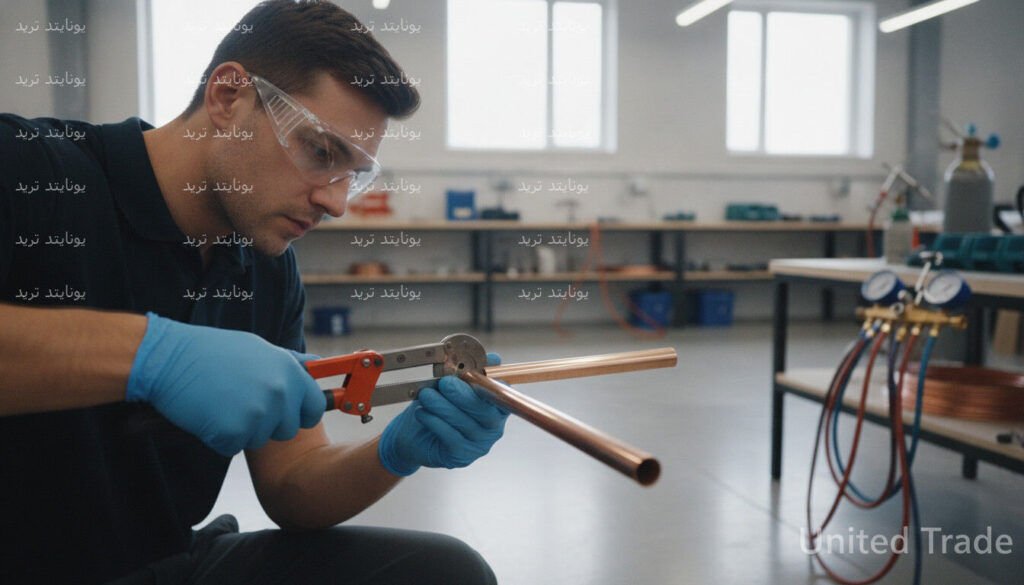
requires Installation of copper pipes Extreme precision and a deep engineering understanding of the properties of metal and the behavior of fluids and gases under varying pressures. Copper is the standard choice for cooling and water supply networks thanks to its high corrosion resistance and ability to withstand extreme temperatures. This technical presentation aims to provide you with professional rules for choosing appropriate diameters, adjusting connection techniques, and avoiding insulation errors, ensuring smooth flow and an operational life spanning decades.
How do engineering standards affect the efficiency of copper pipe installation?
It starts Installation of copper pipes By properly selecting the appropriate type of pressure and temperature of the transported liquid or gas. Interior wall thickness varies according to the international engineering classification adopted in industrial and residential facilities.
In addition, structural copper is divided into three common types: Groups K, L, and M. Type K provides maximum wall thickness and is suitable for underground installations and heavy central cooling networks. In contrast, the L type represents the preferred choice for internal water installations and separate air conditioning systems due to its balance between durability and ease of formation. It should be noted that Type M has thin walls and its use is limited to light drain lines and low-pressure internal feeds.
Furthermore, a distinction must be made between solid copper, which comes in straight lengths and requires heat to bend it, and flexible copper, which is available in circular coils and can be bent manually without the need for extensive mechanical connections.
Technical comparison between grades and thicknesses of copper pipes
Accurate determination of pipe properties helps reduce operational costs and ensure maximum safety against explosion or high-pressure damage.
| Technical classification | Relative wall thickness | Maximum operating pressure (bar) | Main areas of use | Nature of supply |
|---|---|---|---|---|
| Type K (heaviest) | Very high | Up to 100 bar | Ground burial and industrial cooling networks | Straight and coil |
| L type (medium) | Medium | Up to 70 bar | Split air conditioners and potable water networks | Straight and coil |
| Type M (light) | Few | Up to 45 bar | Domestic central heating and light drainage | Straight bars |
| Specialized ACR tubes | Calibrated for cooling | Up to 120 bar | Refrigeration and air conditioning systems charged with R410A gas | Dried and sealed with nitrogen |
The previous data shows that taking into account the operating pressure prevents cracks in the walls of pipes in the long term, especially with modern environmentally friendly gases.
What tools are required to ensure professional pipe cutting and processing?
The preparation stage requires specialized equipment that maintains the circular cross-section of the pipe and prevents narrowing of the flow channel during the initial preparation of the connection.
For example, using a regular hand saw will warp the edges of copper and leave sharp burrs that obstruct the flow. Therefore, the use of advanced measuring and cutting equipment is an essential condition for the successful completion of the work:
- Circular pipe cutter: It ensures an even cut at exactly right angles without creating an oval dent in the pipe.
- Reamer: It scrapes the inner and outer edges to prevent air vortex and fluid turbulence.
- Flaring & Swaging Tools Kits: Provides identical ends for mechanical joining or overlay welding.
- Mechanical pipe benders: Prevents suffocation of the track when making sharp curves at various geometric angles.
As a result, the internal flow path is free of any hydraulic obstructions that cause excessive friction or sudden pressure drops.
Stages of implementing the installation of copper pipes and the technical work process
Field success depends on following a tight, logical sequence that begins with route planning and ends with hydrostatic or nitrogen inspection and testing.
The previous diagram represents the methodology used to prevent any technical defect in complex copper wiring systems in vital facilities.
How to choose between silver soldering and mechanical bonding technology?
The nature of the application and internal pressure determine the ideal means of joining copper tubing with complete efficiency and safety.
On the other hand, brazing at temperatures exceeding 450 degrees Celsius is the standard method for cooling and air conditioning networks, due to its ability to resist constant engine vibrations and sudden temperature changes. In other words, the soldering alloy capillarily penetrates the identical gap between the two tubes to form a strong, tight molecular bond.
A process is done Air conditioning installation According to strict technical standards that guarantee efficient heat exchange and longevity of the compressor, starting with choosing the ideal location for the units to ensure smooth air flow, all the way to tightening the electrical and mechanical connections. Adhering to these precise steps enhances system performance and prevents potential leaks that may affect cooling efficiency and energy consumption.
In addition, drinking water installations require the use of lead-free soldering, or reliance on modern press-fit fittings that eliminate the need for direct flame and provide extremely fast implementation. It should be noted that mechanical flap connections are mainly used to connect separate units to facilitate maintenance and disassembly in the future without the need for thermal cutting.
A process is done Establishing copper pipes By planning precise paths that ensure smooth movement and avoid structural weaknesses that may lead to future leaks. The success of this pivotal step depends on choosing the appropriate diameters and applying professional welding and bonding techniques to ensure the integrity of the network and its operational efficiency.
The efficiency of the cooling system does not stop only at the quality of the initial installations, but also extends to procedures Regular air conditioning maintenance Ensures integrity checking of copper circuits and precise adjustment of refrigerant levels. This regular preventive intervention helps detect any microscopic leaks early and maintains compressor efficiency and energy consumption rates.
This mastery in extending copper networks is combined with the necessity of implementing Proficient air conditioning installation Proper mechanical installation and precise adjustment of flow paths are observed. Taking care of these operational details ensures achieving the highest possible cooling efficiency, reduces excessive energy consumption while prolonging the lifespan of the entire air conditioning system.
The efficiency of the cooling system directly depends on the accuracy Air conditioning duct extensionThe streamlined paths and perfect welds ensure ideal pressure, protecting the compressor from premature operational fatigue. Adhering to engineering standards when distributing these networks protects the system from common refrigerant gas leaks, which extends the life of the device and prevents sudden mechanical failures.
The real construction phase begins with the implementation of works Establishing extension pipes According to well-studied engineering paths that ensure smooth flow and reduce mechanical stress points. This includes carefully taking into account line diameters and bend angles to avoid any sudden drop in operating pressure, while installing insulating supports to prevent vibrations and protect the walls from cracking.
The efficiency of these extensions does not depend only on the quality of the initial installation, but also extends to following periodic procedures that include checking the refrigerant levels and early detection of any mechanical leaks. Commitment to programs Air conditioning maintenance Regularity is the mainstay to protect the compressor from thermal stress and ensure the stability of the refrigeration cycle for the longest possible operational period.
Ensuring cooling efficiency is not limited to the quality of the primary installations, but is also closely linked to regular work Air conditioning maintenance Rotating air for early detection of any leakage in the cooling medium or blockage in filters and coils. This continuous technical inspection contributes to protecting the compressor and extending the life of the system as a whole with the highest possible operational efficiency.
The technical installation process relies on tight connections using silver brazing techniques to ensure no refrigerant leakage, which extends the life of the system and maintains efficient performance. Mastering the steps Air conditioning installation It ensures a balanced distribution of Freon pressure within the closed circuit, which prevents common malfunctions resulting from poor wiring.
The first implementation phase begins Establishing pipes Laying according to well-studied geometric paths that ensure smooth flow and reduce mechanical stress points. This procedure is based on precisely installing the supports and determining the permissible bending angles to avoid any sudden drop in operating pressure, which gives the network structural stability that protects it from leaks in the long term.
Bypass process Air conditioning installation Air merely mechanically stabilizes the units, becoming an integrated formulation that ensures efficient heat exchange and longevity of the system. This procedure requires strict adherence to thermal insulation standards and adjustment of refrigerant flow paths, which turns installation from a routine task into precision engineering that ensures optimal performance of the device.
Quality performance indicators in copper pipe networks
The following field indicators illustrate the most important quality control standards adopted in evaluating the safety of the implemented lines:
This technical data confirms that adherence to proper installation protocols raises the overall reliability of the network to levels of near operational perfection.
What are the mandatory steps to protect pipes and avoid condensation?
Maintaining copper pipes requires the application of tight thermal insulation that prevents energy transmission and prevents the destructive phenomenon of water condensation on ceilings and walls.
Therefore, cold intake lines must be wrapped with closed foam insulation hoses, such as elastomer, with a studied thickness that is proportional to the relative humidity of the site, making sure to cover all joints with vapor-resistant adhesive tapes. Furthermore, pipe holders and anchors must be installed at regular distances not exceeding one and a half metres, with rubber pads placed between copper and other metals to prevent galvanic corrosion resulting from contact with dissimilar metals.
- Cleaning external surfaces: Removing oils and grease to ensure permanent adhesion of the insulating materials.
- Installing insulators without pressure: Avoid compressing the foam material so that its insulating air pockets do not lose their intended efficiency.
- UV protection: Paint exposed parts or wrap them with aluminum protective layers in external installations.
- Securing expansion joints: Leave enough flexibility for the pipes to expand and contract thermally without breaking the welds.
As a result, the system remains protected from energy waste and the appearance of mold spots or water drops inside the building.
Frequently asked questions
❓ What are the causes of gas leakage after installing copper pipes?
Leakage is often due to the flap edge not being adjusted symmetrically or the presence of an internal wrinkle that prevents a mechanical seal. In addition, leakage may result from excessive soldering temperature, which leads to porosity in the silver alloy and gradual gas escape.
❓ How can copper pipes be blocked during the bending process?
Mechanical benders with sizes exactly matching the diameter of the pipe must be used and random manual bending should be avoided. Furthermore, it is recommended to fill large pipes with clean sand or internal bending springs to prevent wall snapping while forming sharp corners.
❓ Does the diameter of the copper pipe affect the efficiency of the air conditioner?
Absolutely yes, reducing the diameter beyond the manufacturer's recommended size increases friction and chokes off the coolant flow. As a result, the load on the compressor increases, cooling efficiency decreases, and the motor may burn out over time.
❓ Why is it preferable to use nitrogen gas during copper welding?
Low-pressure dry nitrogen flow into the pipe prevents the formation of black copper oxide scales resulting from the reaction of hot copper with oxygen. This process ensures that the line remains clean and avoids clogging of expansion valves or oil filters in the circuit.
❓ When should the old copper piping network be completely replaced?
It must be changed when microscopic holes occur repeatedly due to chemical corrosion or when oxidized oils are deposited that cannot be washed off with cleaning agents. In addition, the transition to modern ultra-high pressure refrigerants requires larger piping thicknesses to safely withstand mechanical stress.
Embodies mastery Installation of copper pipes A strategic investment that protects the facility from leakage disasters and high maintenance costs. Start implementing these technical standards today and communicate with qualified specialists to ensure the implementation of advanced networks that meet the highest levels of efficiency and security.
















Community dialogue
0 comments