
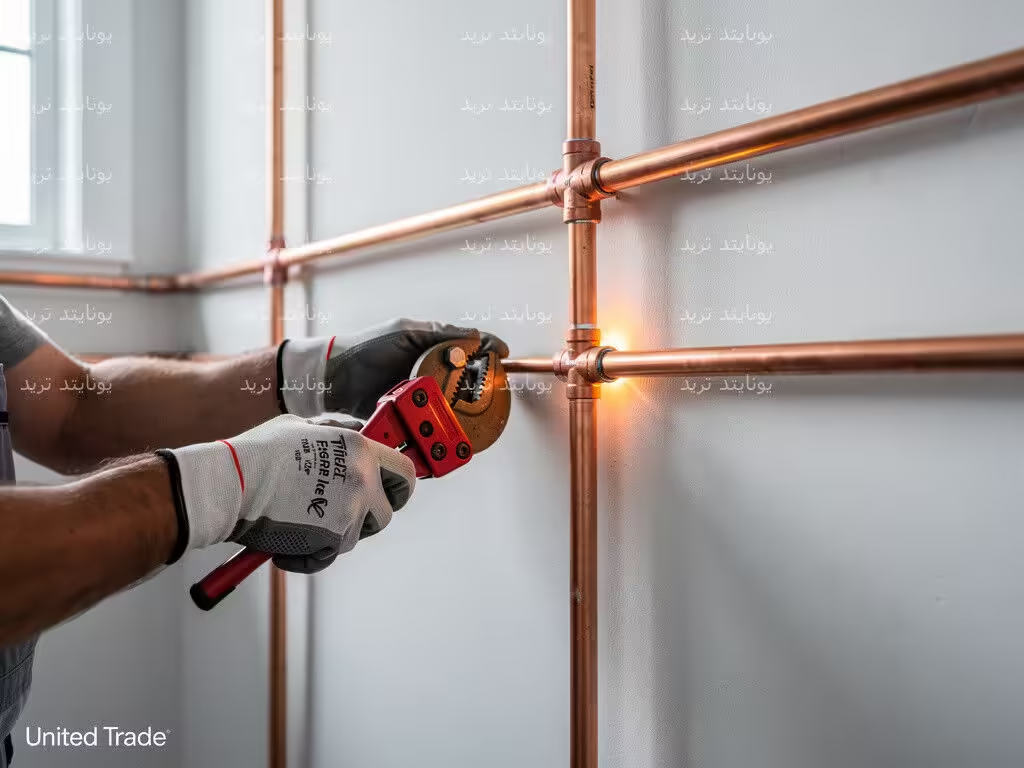
Common mistakes during installation of copper pipes and how to avoid them
Many novice technicians make technical lapses that may reduce the efficiency of the system or cause serious leaks in the long run. The most prominent of these wrong practices are:
- Neglecting to remove internal metal excesses after the cutting process, which creates a disturbance in the flow of fluids and leads to corrosion of the internal walls due to constant friction.
- Excessive use of the melting aid (flex), as the residue deposited inside the pipe causes chemical pitting of the metal over time.
- The tracks are not stabilized by rubber-lined jumpers, which generates mechanical friction and hissing resulting from repeated thermal expansion and contraction.
- Overheating of the connections during welding, which leads to burning of the silver alloy and the connection losing its flexibility and strength.
Classifications of copper pipes according to standard standards
Choosing the appropriate type depends on the nature of use and the operational pressures applied within the facility. The following table shows the fundamental differences between the internationally approved categories:
| Standard category | Wall thickness | Color coding | Main areas of use |
|---|---|---|---|
| Type K | Highest thickness and durability | Green | Buried underground installations, high-tension lines and heavy-duty services |
| L type | Balanced medium thickness | Blue | Internal supply networks for hot and cold water and central heating systems |
| Type M | Thin walls, economical | Red | Light domestic applications, interior drain lines and non-pressurized ventilation |
Guidelines for taking into account thermal expansion in long lines
Copper expands at a significant rate when exposed to high temperatures, and to avoid bending of pipes or cracking of fixed connection points, U-shaped expansion rings must be created or flexible joints must be installed in straight paths exceeding ten metres, while leaving sufficient safety distances between walls and right angles to ensure freedom of movement resulting from seasonal temperature changes.
Installing copper pipes represents the basic foundation for creating durable water and cooling networks that resist corrosion and high pressures for many years. This specialized guide helps you understand the field principles of laying and connecting feed lines, while clarifying the differences between different stiffness grades to ensure professional implementation and avoid costly leaks.
Quick Answer: How are metal pipe networks installed?
Copper piping installation is an engineering process that involves cutting, preparing and connecting copper piping using heat welding or mechanical connections to create safe paths for transporting liquids and gases. The work requires thoroughly cleaning the ends, applying a fusing aid, and then installing with spaced supports to absorb thermal expansion and prevent structural subsidence.
Field tools and equipment for processing copper lines
The quality of work on site depends on the use of tools designed specifically for the metal to avoid distortion of the inner diameter of the pipe. For example, the rotary pipe cutter ensures a straight cut at a perfect right angle, making the connection gap-free. In addition, the deburring tool plays an essential role in cleaning the internal sharp edges, as this reduces water flow turbulence and prevents corrosion cavitation phenomenon over time.
Precision measuring and cutting tools
Metric measuring rulers and sharp wheel cutters are used to set the required lengths with millimeter precision before beginning the fastening phase. This is followed by using a wire cleaning brush to prepare the outer and inner surfaces of the connectors, because surface oxidation hinders the fusion of the solder alloy.
Heating and mechanical shaping equipment
Work equipment includes mobile gas torches and manual or hydraulic pipe benders to change directions without breaking the metal wall. External bending springs help maintain the roundness of the soft tubing's cross-section while forming difficult curves in tight spaces.
Steps for installing copper pipes using hot welding
The correct implementation process begins with preparing the construction route and adjusting the measurements with extreme precision before applying any heat source. As a result, there is less material waste and the mesh stays in place without additional mechanical stresses that could subsequently weaken the connection points.
- Cut the copper tube to the specified length using the rotary cutter at a perfect right angle to avoid voids.
- Remove internal and external metal excess with a reamer to facilitate the flow of liquid.
- Sand the outside of the pipe end and the inside of the fitting until it shows a pure metallic luster.
- Apply a thin layer of flexo to prevent rapid oxidation during heating.
- Insert the tube completely into the joint, then heat the joint with a balanced flame until the soldering alloy melts by capillary action.
- Allow the joint to cool gradually in the open air without pouring sudden cold water to avoid brittle cracking.
Comparison of copper varieties and their common uses
The thickness of the walls of copper pipes varies according to the international standard classification, which determines their ability to withstand mechanical stresses and environmental conditions. Accordingly, the appropriate type must be chosen for the nature of the application, whether it is buried underground or visible inside the technical rooms.
| Standard type | Metal wall thickness | Commercial color coding | Best areas of use | Pressure tolerance level |
|---|---|---|---|---|
| Type K | Very thick | Green | Underground burial and main feeding | Too high |
| L type | Average thickness | Blue | Interior plumbing and cooling installations | Medium to high |
| Type M | Relatively thin | Red | Closed home heating systems | moderate |
| Type DWV | Very thin wall | Yellow | Drainage and ventilation drainage networks without pressure | low |
Methods of installation and reduction of noise resulting from expansion
Copper expands with heat at a significant rate compared to solid building materials, which requires it to be fixed with flexibility that allows longitudinal movement without damaging the joints. It should be noted that the use of cleats insulated with damping rubber absorbs vibrations resulting from the movement of fluids, and reduces the transmission of the sound of water flow to adjacent structural walls.
It requires an operation Air conditioning installation Air: Following precise engineering standards to ensure the safety of the entire refrigeration cycle and insulating the connections perfectly to avoid loss of energy. Correct installation of the indoor and outdoor units also contributes to reducing vibrations and protecting the compressor from sudden malfunctions in the long term.
The quality of the installation of copper pipes depends mainly on the accuracy in choosing the paths and securing them against external factors, as tight installation ensures the safety of the network from mechanical vibrations and thermal stress. So, take care of Establishing extension pipes It directly contributes to extending the life of the system and avoiding sudden malfunctions.
Therefore, it requires implementation steps Accurate air conditioning installation Careful consideration of sound engineering standards to avoid damage to the compressor and blockage of mechanical circuits. Mastering these interconnected stages ensures stability of the refrigeration cycle and maximum operational efficiency of the devices.
Protecting the pipe network requires regular periodic inspection to ensure early detection of any corrosion or blockage, as it is grounded Air conditioning maintenance Air is mainly used to treat weaknesses in the refrigeration cycle before they become worse. This preventive measure helps maintain ideal gas pressure and reduce energy consumption for many years.
Extending Freon lines requires extreme care Principles of installing air conditioner copper To ensure that no leakage occurs that weakens the cooling efficiency over time. The process begins with preparing the appropriate paths and installing the insulators tightly to protect the network from mechanical and thermal stress factors. This adherence to technical standards ensures that the refrigerant flows smoothly within the cycle without loss of pressure.
The efficiency of air conditioning systems depends radically on the accuracy of implementing copper wiring networks Installation of copper pipes In a professional manner, the first standard to prevent refrigerant gas leakage and ensure the longevity of the device. Following technical principles in bonding and welding reduces heat loss, which is directly reflected in the stability of the cooling level and saving energy consumption.
These problems require professional intervention including a procedure Regular air conditioning maintenance To detect early blockages or microscopic cracks in cooling lines before they worsen. This regular monitoring contributes to controlling refrigerant pressure levels and protecting the compressor from premature damage, ensuring that the system operates at the highest possible operational efficiency.
Addressing these challenges begins from the first moments by following principles Establishing pipes Extensions with utmost precision according to approved engineering plans. Correctly selecting the appropriate paths and diameters ensures stable operational pressures and avoids any future damage to the copper network.
These problems require professional intervention based on procedures Accurate air conditioning maintenance It comprehensively detects any blockages or defects in the connections before they become worse. This continuous inspection contributes to maintaining the appropriate refrigerant pressure and ensuring that the units operate at the highest operational efficiency for the longest possible period.
Extension networks require extreme care from the first moment, as the success and sustainability of the system depends on the accuracy of the work carried out Establishing pipes Plumbing and air conditioning according to sound engineering standards. This advance planning protects the tracks from sudden mechanical stresses and reduces the possibility of corrosion or clogging over time.
Determine the interspaces of fasteners
The distance between stands of small diameter horizontal pipes should not exceed one and a half meters to ensure that gradual bends do not occur in the path. In contrast, this distance can be increased to two and a half meters in larger diameters, provided that there are fixed fixing points near each directional joint.
Therefore, it requires implementation steps Air conditioning installation High efficiency, taking great care of the pipe paths and installing them according to precise technical standards to avoid damage to the compressor. Adherence to insulation and vacuum protocols also ensures that the circuit is protected from moisture and impurities, which reflects positively on the life of the device and the quality of cooling.
Treatment of water hammer phenomenon
Water hammer occurs when valves close too quickly, generating a powerful shock wave within the network that may damage weak connections. Therefore, network design requires the addition of vertical air chambers or mechanical shock absorbers to absorb sudden pressure surges and protect the lines.
Pressure checking procedures before final operation
Pressure testing is a mandatory step to ensure that the system is free of any leaks that are not visible behind the walls or under the floors. Furthermore, this inspection gives complete reliability to the owner and contractor that the network is resilient to above normal operating levels with a sufficient margin of safety.
- Seal all temporary outlets with threaded plugs sealed with Teflon tape.
- Fill the grate with clean water to expel the trapped air through the highest available drain point in the path.
- Raise the water pressure using a hand pump to one and a half times the continuous operating pressure for two hours.
- Monitor the carefully calibrated pressure gauge to detect any indicator drops that may indicate the presence of local filtration.
- Inspect all welding points visually and by dry touch to ensure that there are no small water dew drops.
Frequently asked questions
What are the common mistakes during installation of copper pipes?
The most common mistakes are excessive flex placement, which causes premature internal corrosion of the metal. Failure to clean the pipe ends carefully also causes failure of weld adhesion and subsequent leaks under constant pressure.
Can buried copper pipes be installed without insulation?
Copper should not be buried directly into concrete or wet soil without a protective casing, because the chemical reaction causes rapid puncture corrosion. Placing protective flexible tubing around it helps insulate it mechanically and allows it freedom for natural thermal expansion.
How do you choose between welding and mechanical quick connects?
Hot melt welding is the most economical permanent option for hidden tracks within walls and ceilings. While quick mechanical connections such as snaps are preferred in places where live flames are prohibited for security and environmental reasons.
Why is copper preferred over plastic in gas networks?
Copper is characterized by its superior hardness, its complete impermeability to gases under various temperatures, and its high resistance to sudden fires. Unlike plastics, copper withstands occasional mechanical shock without breaking or cracking.
What is the expected lifespan of copper pipes?
The operational life of copper networks exceeds fifty years if they are installed in accordance with the technical principles and the water acidity is controlled. The quality of the feed water and the absence of severe limescale play a major role in extending the life of the metal inner walls.
Completing network extension work requires thoughtful planning and the use of precise tools that ensure flow efficiency and the safety of the facility from structural damage. Always invest in preparing your paths according to engineering rules to ensure that your water network operates for many years without interruption.
















TQTAG76 Community dialogue
0 comments