
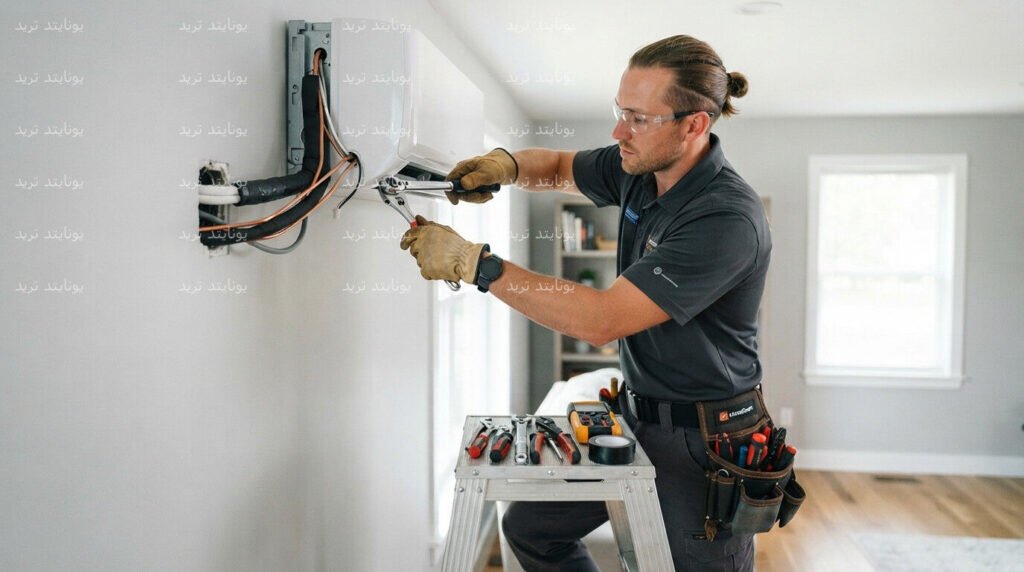
The quality of cooling inside homes directly depends on the accuracy Air conditioning installation Air according to the correct engineering standards. The installation process is not only limited to hanging the units, but also includes choosing the appropriate location and securing connections to ensure sustainable performance. This article aims to clarify the essential steps and necessary precautions that guarantee you optimal operation of the device throughout the summer.
Unit location selection strategy
Choosing the ideal location for the indoor and outdoor unit is the cornerstone for any cooling system to perform efficiently. It is always recommended to place the indoor unit in an area that provides balanced air distribution, away from direct heat sources such as kitchen ovens or bulky electronic appliances.
❓ Effect of steering angles on flow efficiency
The indoor unit must be installed so that the flow of cold air does not encounter fixed obstructions, to ensure its circulation throughout the room. Avoid placing the unit directly above doors, because this may lead to the loss of a large portion of the cooled air once the door is opened, which increases energy consumption.
Copper connections and thermal insulation foundations
Copper pipes are the lifeblood of the cooling system, so they are of practical quality Air conditioning installation It depends on the integrity of these connections. Copper pipes of appropriate thickness must be used and avoided bent at sharp angles that may cause choking of the refrigerant gas path, thus reducing compression efficiency.
❓ The importance of double thermal insulation
Each copper tube should be individually wrapped with high-quality thermal insulation to prevent water condensation. Correct insulation It prevents the leakage of cold into the external environment, and protects the pipes from being affected by direct weather factors, which significantly extends the life of the device.
Technical challenges during installation in different locations
Installation requirements vary based on the nature of the walls or available space, with each building requiring special treatment. For example, concrete walls need strong fasteners to withstand vibrations caused by internal fan operation, while fragile walls require additional reinforcement to ensure the stability of the bracket.
The diagram above shows the logical sequence of a process Air conditioning installation Air, starting from choosing the site all the way to the final operation stage to ensure that there are no leaks in the refrigerant gas.
It is a stage Establishing copper pipes Inside the walls are the cornerstone to ensure the efficiency of extensions, as they require extreme precision in determining paths and providing thermal insulation to protect the pipes from external factors. Adherence to technical standards when implementing this step prevents any future leaks and ensures the flow of refrigerant gas completely smoothly between the internal and external units.
Summary table of differences between installation types
| item | Professional installation | Random installation |
|---|---|---|
| Cooling efficiency | High and stable | Weak and wavering |
| Electricity consumption | Low and perfect | High as a result of effort |
| Shelf life | Very long | Short and prone to malfunctions |
| Noise | Quiet operating sound | Annoying vibrations and sounds |
Frequently asked questions
❓ How can I ensure the efficiency of the air conditioning installation after completion?
You can verify this by monitoring the stability of the room temperature after 30 minutes of operation, and ensuring that there are no abnormal vibration sounds. The pipes must also be checked to ensure that they are dry and that there are no water leaks.
After the installation phase is successfully completed, a role arises Air conditioning maintenance As a basic foundation for maintaining the efficiency of the device and avoiding sudden malfunctions over time. Adhering to a regular inspection and cleaning schedule extends the life of the air conditioner and ensures the continuity of fresh air flow with the lowest possible energy consumption.
Maintaining this ideal performance is not complete once the installation is completed, as it represents Air conditioning maintenance The basic foundation for increasing cooling efficiency and avoiding sudden malfunctions in the long term. Periodic inspection and cleaning of internal parts also contributes to reducing energy consumption and ensuring fresh and healthy air flow throughout the place.
These connections require great care in planning the paths of the cooling network, as it represents... Air conditioning duct extension According to precise engineering principles, the basic foundation for the smooth flow of the refrigerant without wasting energy. Choosing short copper paths and ensuring tight thermal insulation also contribute to protecting the system from cold leakage and raising cooling efficiency to its maximum levels.
Maintaining the efficiency of the device after its installation is not complete without continuous attention to its operation Air conditioning maintenance air periodically, as cleaning the filters and checking the refrigerant gas pressure contributes to avoiding sudden malfunctions. This regular inspection also ensures that energy consumption is reduced and the lifespan of the cooling units is extended for as long as possible.
It is a stage Establishing copper pipes The basic pillar that many people ignore, as extending it inside the walls requires extreme precision to ensure that no bends occur that may hinder the movement of the refrigerant gas in the future. Professional care and thermal insulation of pipe paths prevents moisture leakage and protects the system’s efficiency from deterioration over time.
Maintaining the device's efficiency is not complete once it is properly installed, as it requires a regular service schedule Air conditioning maintenance To ensure the cleanliness of the filters and the safety of the refrigerant gas. This continuous check helps avoid unplanned malfunctions and reduces energy consumption to a minimum.
A stage comes Establishing copper pipes As an essential step before installing the units, it requires extreme precision in choosing paths and providing thermal insulation to prevent gas leakage or moisture condensation. Paying attention to the quality of the internal installations ensures efficient flow of the refrigerant and protects the walls from damage in the long term.
❓ Why is evacuating the air from the pipes a critical step?
Vacuuming removes moisture and unwanted gases from the refrigeration cycle, preventing frozen ducts and damage to the air conditioning compressor. Neglecting this step will inevitably lead to a decline in cooling performance in the long term.
❓ Can the air conditioning be installed in a very high place?
Yes, but sufficient space must be provided above the unit to properly draw air, and to facilitate access to it later for periodic maintenance. Excessive height may make it difficult to clean the filters and reduce the efficiency of air distribution.
❓ How long does the standard installation process take?
It takes a process Air conditioning installation Traditionally, it takes between 3 to 5 continuous working hours, depending on the length of the pipe paths and the nature of the wall. Do not rush to request that the work be completed quickly, because accuracy ensures greater comfort.
❓ Does the length of the pipes affect the capacity of the device?
Yes, the longer the ducts are longer than the manufacturer's limit, the lower the cooling efficiency and the greater the stress on the engine. Adherence to the lengths specified in the operating manual ensures the best performance of the device.
Final evaluation
| Standard | Rating |
|---|---|
| Cooling quality | 5/5 |
| Energy consumption | 4.5/5 |
| Dependability | 4.8/5 |
Investing in Air conditioning installation It is carried out by specialists, saving you from many costly operational problems in the future. Always choose experienced technicians to ensure cooling performance that meets your expectations.
















Community dialogue
0 comments