
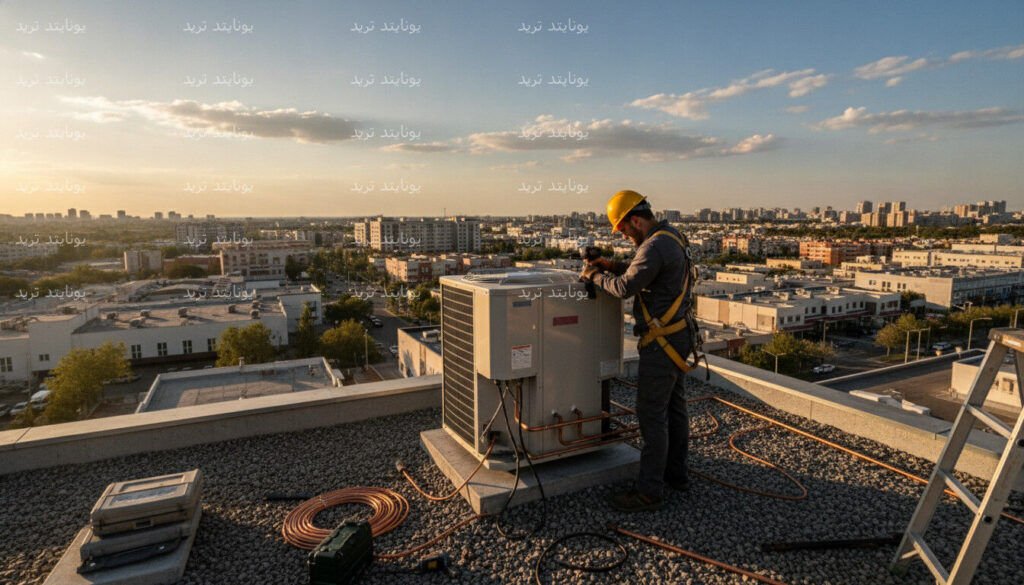
represents Air conditioning installation Professionally designed air is the basic guarantee for achieving high cooling efficiency and avoiding high electricity consumption. This application guide provides clear, practical instructions covering the stages of mechanical installation, ducting and emptying of the refrigerant cycle to ensure quiet and stable operation all year round.
What are the conditions for choosing an air conditioning installation site with high cooling efficiency?
Locating the two units requires careful consideration of the air path and ambient heat sources inside and outside the building. The indoor unit must be installed on a solid wall, leaving a distance of 15 cm below the ceiling to ensure easy air intake without suffocation in the upper path.
Furthermore, you should avoid placing the device facing sunny windows or near heating sources and kitchens. Improper distribution leads to temperature sensors giving inaccurate readings, forcing the compressor to operate continuously without periodic disconnection, which increases electrical energy consumption.
On the other hand, the outdoor unit must be installed in a well-ventilated place away from accumulated dust and direct sunlight. Leaving 70 cm in front of the condenser fan helps expel hot air efficiently, reducing the operating load on the engine and maintaining moderate gas pressure.
How are mechanical connections and copper lines prepared?
The technical preparation begins with making the wall passage hole with an external inclination of 5 degrees to facilitate the flow of natural condensation water. This thoughtful geometric slope prevents the accumulation of water inside the internal drain basin or the occurrence of any leaks that harm the wall paint and interior decorations.
In addition, handling copper tubing requires manual dexterity and the use of specialized bending tools to form a path free of jams and snap-tights. Mandatory technical equipment includes several basic points:
- Selection of approved copper diameters: Relying on accurate measurements identical to the factory catalog to ensure the proper hydraulic balance of the refrigerant gas and its flow speed.
- Complete thermal insulation: The intake tube and exhaust tube are wrapped with separate rubber insulators to prevent surface condensation and loss of valuable cooling energy.
- Attaching the holder to the water scale: Weigh the metal mounting base with extreme precision to avoid annoying mechanical vibrations during engine rotation at high speeds.
- Drainage of water via direct path: Direct the drain hose completely smoothly, free of sharp twists, to prevent sediment accumulation and blockage of the waterway.
This diagram shows the sequence of engineering procedures adopted to ensure proper assembly of all parts without neglecting any important technical step that may harm the cooling system later.
How does the vacuum process support the success of installing an air conditioner without malfunctions?
The process of emptying the system of air and atmospheric humidity is the basic foundation for protecting the compressor motor from damage and the accumulation of impurities. Air laden with water vapor mixing with cooling oil creates harmful acids that corrode coils and damage delicate valves.
Therefore, the technician must connect the vacuum pump to the service valve and run it for a period of no less than 20 continuous minutes. The negative pressure level is accurately measured with a micron scale to reach 500 microns, which is the standard limit for the path to be free of any non-condensable gases.
As a result, pressure readings stabilize at typical operating values, allowing the Freon to circulate with complete purity within the closed cycle. It should be noted that neglecting this procedure reduces the cooling capacity by more than 15% from the beginning of operation.
The previous indicators highlight the crucial role of adhering to air intake standards and accurately controlling pressures, as this is directly reflected in the sustainability of the system and the reduction of monthly energy bills.
What is the difference between professional installation work and random artistic practices?
The quality of operational performance varies according to the technician’s accuracy and application of standard standards while assembling the split air conditioner parts. For example, quick installation may seem tempting, but it causes frequent and costly breakdowns. The following table shows the most important practical differences between the two methods:
He promises Establishing cooling pipes Inside the walls is a critical stage that requires high engineering precision to ensure the smooth movement of Freon gas and avoid any bottlenecks that may lead to leakage or poor cooling in the future. Therefore, direct paths must be chosen with the least amount of bends, while the pipes must be completely thermally insulated to protect the system’s efficiency from external factors.
The efficiency of the device does not depend only on the completion of proper installation, but maintaining its stable performance requires continued procedure Regular air conditioning maintenance This includes cleaning filters and checking refrigerant pressures periodically. This constant care contributes to preventing the accumulation of impurities inside the evaporator coils and avoiding sudden malfunctions that drain energy and limit the lifespan of the cooling unit.
The process of laying the cooling network requires extreme care to ensure that the refrigerant flows smoothly and operating pressures are stable. So mastery Air conditioning duct extension According to engineering standards, it prevents the accumulation of oils inside the system and protects the compressor from fatigue and premature breakdowns, which enhances the lifespan of the entire device.
Quality installation is not complete without adherence to procedures Regular air conditioning maintenance Ensures sustained performance and doubles the device's rapid cooling capacity. Periodic inspection of the Freon gas system and cleaning of filters contribute to significantly reducing electricity consumption and protecting the compressor from sudden stopping at peak times.
The efficiency of the cooling system depends intrinsically on the accuracy of the stage Establishing copper pipes Inside walls, this requires choosing straight paths and avoiding sharp bends that may impede the flow of refrigerant. These pipes must also be thermally insulated with great care to prevent condensation and protect the structural structure from moisture, which ensures a longer life of the device and optimal performance.
The efficiency of the device depends not only on proper installation, but also adherence to procedures Regular air conditioning maintenance It is the mainstay for maintaining pure air flow and ensuring a longer compressor life. This includes cleaning filters and checking refrigerant levels regularly to avoid sudden breakdowns and keep energy consumption to a minimum.
The efficiency of the device depends not only on proper installation, but to maintain its stable performance requires the application of procedures Regular air conditioning maintenance It starts by cleaning the filters and checking the gas levels regularly. This continuous monitoring contributes to protecting the compressor from premature fatigue and ensures that energy consumption remains within its normal limits.
| Comparison standard | Professionally crafted installation | Random artistic practices |
|---|---|---|
| Unloading the cooling circuit | Full suction with vacuum pump up to 500 microns | Partial expulsion leaves moisture inside |
| Tighten the fastening nuts | Use a standard ergonomically specified torque wrench | A random connection tears the flap of the flap |
| Directing the drainage channel | Geometric slope of at least 5 degrees | Horizontal extension causes water pooling |
| Copper pipe insulation | Insulate each cooling line independently and tightly | Merging the two lines together within a common insulator |
| Stable power consumption | Standard consumption conforms to specifications | High amp draw and engine overheating |
What are the steps for a trial run to ensure cooling efficiency?
The final inspection begins with operating the cooling device for a continuous quarter of an hour to verify the stability of air flow and the balance of mechanical pressures. During this period, the temperature difference between the air entry and exit holes in the indoor unit should be measured, as the normal difference should range between 10 to 15 degrees Celsius.
He promises Establishing copper pipes The most vital stage in mechanical installations, as it requires choosing direct paths with well-studied bends to ensure smooth movement of the refrigerant gas. These pipes must also be thermally insulated with extreme precision to prevent moisture condensation and protect the walls from damage, which ensures sustainable performance and cooling efficiency in the long term.
The success of the cooling process depends fundamentally on Choose an installation location Air conditioning away from direct heat sources or places exposed to strong sunlight. You must also make sure to ensure sufficient space around the unit to allow air to circulate and facilitate regular maintenance, taking into account that the wall is strong enough to bear the weight of the device and avoid annoying vibrations during operation.
Additionally, the technician tests the drain line's ability to smoothly remove condensation by pouring a trial amount of water into the evaporator pan. The final approved procedures include several regulatory axes:
- Check Freon pressure readings: Ensure that the suction line pressure matches the standard readings for the type of refrigerant at the prevailing temperatures.
- Measuring the intensity of the electric current: Compare the ampere reading drawn with the permissible limits installed on the external identification plate.
- Mechanical balance control: Ensure that the outdoor unit is stable and that there are no vibrations or annoying noises while the fan and compressor are operating.
- Air flow calibration: Adjust the direction of the guided blades and distribute the cold throughout the room without leaving hot spots.
Frequently asked questions
❓ How long does it take to install a new home air conditioning?
The process typically takes between two and three hours for a separate unit in residential buildings. This specific period depends on the thickness of the walls, the ease of access to the location of the outdoor unit, and the length of the copper network path.
❓ Does the length of the copper path affect cooling efficiency?
Yes, path length has a significant impact; The ideal length ranges between 3 to 5 meters for most units. On the other hand, if the length exceeds 7 metres, a measured amount of Freon must be added to compensate for the pressure difference.
❓ How can we ensure that there is no refrigerant leak?
This is checked by using specialized soap foam on all connections and nuts or by precise electronic detection devices. The stability of the pressure gauge reading during the vacuum stage is clear evidence of the tightness of the seal.
❓ Why does the air conditioner drip water inside the room after turning it on?
Internal dripping is usually caused by improper outward tilt of the drain hose, a kink in the pipe path, or lack of thermal insulation in the copper piping directly behind the indoor unit.
❓ Can the air conditioning outdoor unit be placed directly on the balcony floor?
It is not recommended to place them directly on floors without rubber mounts that prevent transmission of vibrations and provide safe lifting. Raising the unit off the ground by 10 centimeters helps protect it from rainwater and provides ideal ventilation.
❓ What is the recommended temperature to set the device to save electricity?
It is recommended to set the thermostat at 24°C to achieve the optimal balance between recovery and reducing the electricity bill. This intelligent adjustment reduces mechanical stress on the compressor and extends its life.
Ensures that these precise principles are applied when... Air conditioning installation Air Protect your investment and provide a cool, comfortable atmosphere with minimal energy consumption. Contact qualified technicians who use sound engineering equipment to enjoy optimal cooling that lasts for many years without sudden malfunctions.
















Community dialogue
0 comments