
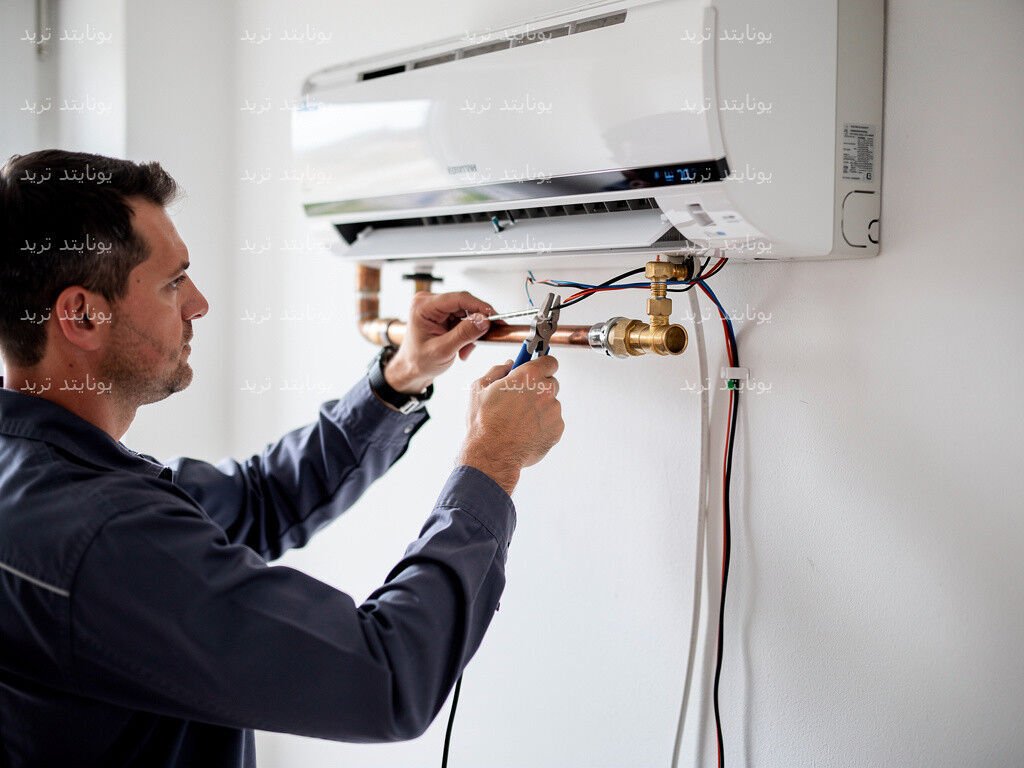
[Air conditioning installation](https://unitedtrad.com/wp-content/uploads/2026/10/auto_img_1791574817_455.jpg)!
Accomplishing an air conditioning installation in your residential or commercial space requires careful adherence to approved mechanical and engineering standards to ensure stable cooling. Proper installation helps protect compressor efficiency, reduce electrical energy consumption, and prevent refrigerant leakage over time. In this space, you will learn about the technical conditions and practical stages of installing the units, all the way to the final tests before actual operation.
## Quick Answer: What are the correct installation pillars?
Air conditioning installation is an integrated engineering process that includes installing the indoor and outdoor units, connecting copper refrigerant lines, and evacuating the circuit of air and moisture using a vacuum pump. Correct installation according to standard distances ensures maximum cooling efficiency and reduces energy consumption by up to 25% compared to random installation.
## Spatial criteria for choosing the location of the indoor and outdoor units
Choosing the location of the indoor unit depends on distributing the air smoothly and evenly within the room without obstacles. The indoor unit must be installed on a sturdy wall that can withstand weight and vibrations, leaving a distance of at least 15 centimeters below the ceiling to ensure that return air can be drawn freely. In addition, direct airflow should be avoided towards permanent seating areas to provide a comfortable thermal environment.
In contrast, the outdoor unit requires a shaded, well-ventilated location to facilitate the expulsion of heat from the condenser. Cramming the outdoor unit into narrow corridors or closed balconies will cause the gas pressure to rise and the compressor to stop due to thermal protection. Therefore, a distance of at least 30 centimeters must be left behind the condenser and one and a half meters at the front of the exhaust fan.
## Engineering foundation requirements for a successful air conditioning installation process
Field preparation begins with reviewing electrical loads and pipe diameters compatible with the cooling capacity of the air conditioner. It is necessary to allocate an independent circuit breaker from the main distribution panel sized to match the starting current of the compressor to avoid power outages. Furthermore, a suitable path must be provided for the condensate water drain line with a constant slope of at least one centimeter per linear meter to prevent water accumulation inside the evaporator.
– Choose a water drainage path with a natural slope away from sources of unpleasant odors.
– Determine the thickness of copper pipes approved to resist R410A or R32 refrigerant pressures.
– Providing an effective electrical grounding line to protect electronic panels from sudden currents.
– Isolate the gas and liquid lines separately using high-density thermal insulation materials.
## Stages of mechanical installation and tight connection of pipes
The process of connecting cooling lines is carried out with extreme mechanical precision by forming the ends of the pipes to specified tension sizes. Excessive tightening of the copper nuts causes the flange to crack and gradually leak gas, while weak tightening causes Freon to escape under high pressure. The following diagram shows the technical sequence adopted in modern systems to ensure quality performance:
📊 & ✓ A sequential path to successfully implement and complete the stages
It should be noted that adjusting the horizontality of the base supporting the indoor unit using a water level is a very critical step. As a result, condensation water flows smoothly into the drain without causing water overflow into the room or damage to home furnishings.
## Comparison between the results of precise geometric stabilization and random stabilization
The results of a professional installation differ significantly from a quick, random practice in terms of the lifespan and power consumption of the device. The following table shows a detailed comparison between the two methods:
Comparison item — Professional engineering installation — Random, ill-considered installation —
Cooling efficiency and temperature reaching — fast arrival with constant temperature — slow cooling and constant temperature variation —
Electricity consumption — economical consumption that matches the efficiency card — consumption increases by an additional 20-30% —
Life of compressor and components — Operating efficiently for more than 10 years — Premature breakdowns and rapid mechanical damage —
Noise and vibration level — Quiet operation, almost no vibration — Audible vibrations and high-pitched hum —
Tightness of the Freon circuit - Complete insulation and complete freedom from leaks - Frequent loss of gas every cooling season -
## The importance of emptying the air with the vacuum before turning on the cooling
The process of emptying the cooling circuit using a vacuum pump is a mandatory condition that cannot be waived to ensure the dryness of the internal pipes. Leaving moisture and atmospheric air inside the pipes causes them to react with the lubricating oil and form acids that corrode the compressor coils. Furthermore, non-condensable gases cause a sharp rise in condenser pressure, which constantly stresses the engine.
The protection of this system does not stop only when proper installation is completed, but it also represents [air conditioning maintenance]. Homes](https://unitedtrad.com/%d8%b5%d9%8a%d8%a7%d9%86%d8%a9-%d8%aa%d9%83%d9%8a%d9%8a%d9%81%d8%a7%d8%aa-%d8%a7%d9 %84%d9%85%d9%86%d8%a7%d8%b2%d9%84-%d8%a3%d8%b3%d8%b1%d8%a7 %d8%b1-%d8%b1%d9%81%d8%b9-%d8%a7%d9%84%d9%83%d9%81%d8%a7/) The basic foundation for increasing cooling efficiency and reducing energy consumption to its lowest levels. Regularly checking the refrigerant level and cleaning the filters and condenser helps avoid compressor fatigue, ensuring clean airflow and extending the device's service life for many years.
Achieving this ideal performance begins with the professionalization of the air conditioning extensions, which represent the backbone of the entire air system. Tight insulation and avoiding sharp bends ensure that the Freon paths are protected from invisible leakage. Choosing the appropriate geometric diameters and carefully installing the cooling lines also contributes to preventing hidden faults that may deplete the compressor’s capacity prematurely.
Therefore, air must be drawn in until the pressure gauge reaches a level of 500 microns, then the pump should be stopped and the reading should be monitored for 15 minutes to ensure that there are no microscopic leaks. On the other hand, the practice of disinfecting the lines by expelling part of the Freon to expel the air is a serious mistake that violates manufacturers’ standards and reduces the amount of gas in the system.
## Catastrophic mistakes that you must be careful of while installing a new air conditioner
Ill-conceived practices by unqualified technicians cause the air conditioner to be out of warranty and its essential parts to be damaged early. For example, some people make the mistake of bending copper pipes at sharp angles without using the bending zipper, which creates a bottleneck in the refrigerant channel and permanently reduces the flow efficiency. Avoiding these wrong practices is absolutely necessary to ensure the sustainability of the device:
– Neglecting to insulate weld joints or nut attachment areas with sun-resistant thermal insulation foam.
– Operate the device immediately without waiting to verify the stability of the oil at the bottom of the compressor after transportation.
– Connecting the control and electricity wires with thin sections that heat up during continuous operation at the height of summer.
Place the water drain hose inside open drains, which draws unpleasant odors into the evaporator.
## Frequently asked questions
## What is the standard distance allowed between the indoor and outdoor unit?
The recommended distance for most residential air conditioners is between 3 meters and 15 meters for the length of the ducting path. If the length is less than 3 meters, the compressor vibrations may be transmitted into the room, while a length exceeding 10 meters requires adding an additional amount of Freon calculated in grams according to the manufacturer’s catalog.
## How do I know that the installation of a home air conditioner was completed without gas leakage?
Tightness is verified by dry nitrogen pressure testing or by measuring the stability of the vacuum at a constant negative level for a sufficient period before opening the valves. In addition, the technician uses an electronic leak detector or special inspection foam around the connection nuts during the test run phase.
## Why should you not operate the air conditioner without vacuuming it?
Because the trapped air contains moisture and oxygen, which chemically react with the refrigerant oil to form an acidic slurry that closes the compressor valves. Operating the system containing air increases the operating pressure and draws a high electrical current, which greatly reduces the life of the device.
##Does the installation location of the outdoor unit affect electricity consumption?
Yes, placing the outdoor unit under direct sunlight or in an unventilated corner will cause the condenser temperature to rise. As a result, the compressor has to work twice as hard to remove heat, which raises your electricity bill and reduces cooling capacity at peak times.
## When should an additional amount of Freon be added after installation?
Modern units come pre-charged from the factory with enough gas for a specific pipe length, usually ranging from 5 to 7.5 metres. If the length of the copper line exceeds this specified distance, the technician must weigh and add an additional amount of Freon precisely according to the recommendations of the operating manual.
## Conclusion
Proper installation is the cornerstone of ensuring strong cooling performance and long-term operating life of your home's HVAC system. Always be sure to adhere to the technical rules and use certified technicians who own vacuum and digital torque measuring devices when installing air conditioning in your residence to ensure a comfortable and safe summer experience.
















Community dialogue
0 comments