
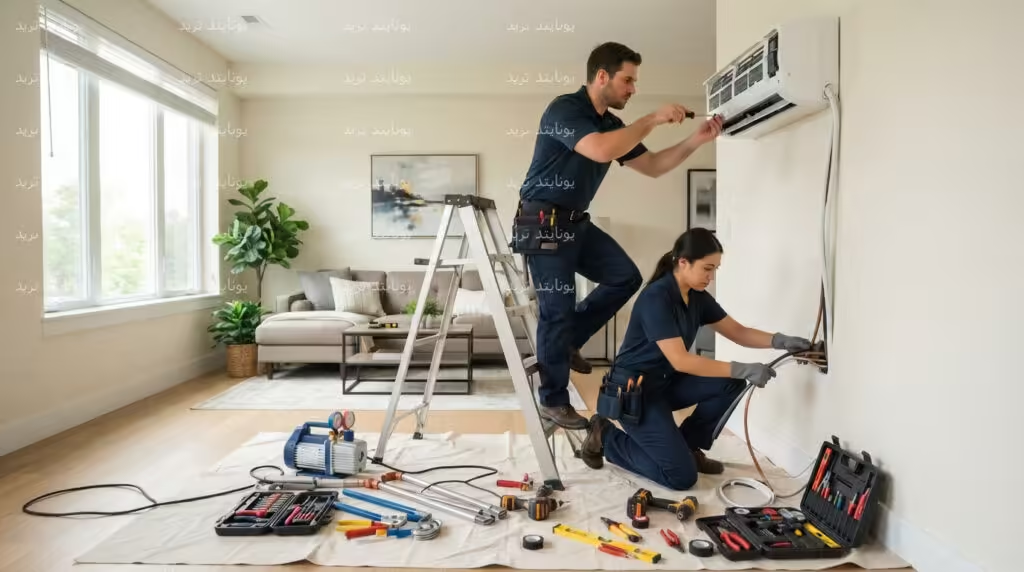
It is a process Air conditioning installation My Home is an essential step that goes beyond simply installing the unit on the wall, as the quality of cooling and the sustainability of the device depend entirely on the accuracy of the technical implementation. Adherence to engineering standards when dealing with cooling circuit components ensures that you avoid sudden malfunctions and achieves maximum efficiency in electrical energy consumption in the long term. This article aims to clarify the steps and principles that must be taken into account to ensure an ideal indoor environment.
Standards for engineering installation of units
requires Air conditioning installation Successful adjustment of the internal unit with the water balance with extreme precision to ensure its operation without technical problems later. A slight slope of not more than 2 mm must be left towards the drain side to avoid water accumulation and leakage into the room. This is a basic procedure that non-specialists ignore.
❓ Technical directions for drilling holes in the wall
The wall hole should be drilled at an angle of 5 to 10 degrees outward to ensure that condensation water drains efficiently. This angled orientation prevents moisture reflux or water pooling within the copper tracks, protecting the device's structure from premature corrosion.
The importance of air discharge in the refrigeration circuit
It represents the use of a vacuum pump known as Vacuum Pump An indispensable technical condition for completely withdrawing air and moisture from the cooling circuit. Neglecting this step directly leads to a decrease in cooling efficiency by up to 40%, with a high probability of compressor burnout during the first two years of operation as a result of chemical reactions of moisture with the cooling oil.
The previous diagram shows the correct path of the installation process, starting from the site and ending with the air vacuuming stage, which is the difference between professional performance and random work.
Comparison between conventional and inverter cooling systems
When planning an operation Air conditioning installation New, the trade-off between traditional devices and inverters emerges as a key factor in determining future operational costs.
| Advantage | Traditional air conditioning | Inverter air conditioning |
|---|---|---|
| Electricity consumption | High and variable | Low (savings up to 70%) |
| Compressor control | It works in disconnect and play mode | It operates at a continuous variable frequency |
| Thermal comfort | Wobbly | Fixed and stable |
| Initial cost | less | higher |
Inverter technology provides long-term economic value despite its high initial price, making it the ideal choice for areas with heavy use, while traditional devices remain an acceptable option for limited use.
The effect of regular care on the life of the device
Regular maintenance plays a pivotal role in extending the lifespan of the air conditioner, as it increases it from 5-7 years to 12-15 years when the correct standards are adhered to. Unmaintained appliances consume 30% to 40% more energy than those that undergo regular and regular cleaning.
A stage comes Establishing copper pipes As a very important foundational step, it requires extreme precision in the paths and welds to ensure the flow of refrigerant without any future leaks. Choosing appropriate diameters and insulating packaging prevents moisture condensation and protects the wall structure from damage, ensuring long-term operational efficiency of the device.
To ensure the continuation of this exemplary performance, it is important to take action Regular air conditioning maintenance Maintains compressor efficiency and prevents dust accumulation inside filters and internal coils. Early detection of refrigerant gas leaks and regular cleaning of vital parts extends the life of the device and prevents sudden drops in cooling power.
Requires application Correct installation principles Taking into account the Freon flow paths and adjusting the balance of the internal and external units with extreme precision to prevent annoying vibrations and refrigerant leakage. This technical commitment is directly reflected in doubling the cooling efficiency and protecting the compressor from thermal stress, ensuring the longest lifespan of the system with the lowest possible energy consumption.
Installing a home air conditioner requires careful avoidance of a series of... Technical errors to avoid It ensures that the system is protected from problems of refrigerant gas leakage or poor air flow inside the room. Ensuring that the indoor unit is installed at a deliberate inclination and that the copper pipe paths are adjusted prevents compressor fatigue and achieves the highest rates of cooling performance.
A stage comes Establishing copper pipes As the backbone of any successful air conditioning system, it requires extreme precision in choosing paths and ensuring thermal insulation to ensure efficient transfer of refrigerant gas without leakage. This prior procedure determines the stability of the device’s operational performance, which makes good planning for the extension network a fundamental pillar that cannot be overlooked in order to avoid any construction defects in the future.
To ensure the continuation of this ideal performance, it is important to take action Regular air conditioning maintenance It maintains the efficiency of the compressor and the cleanliness of the filters and air paths from any accumulated impurities. These regular preventive measures not only extend the life of cooling units, but also prevent sudden energy wastage and reduce the need for costly repairs.
To ensure the continuation of this exemplary performance, it is important Air conditioning maintenance Periodically and regularly as a preventive measure that protects the compressor from damage and maintains the purity of the filters and the quality of the internal air flow. Continuously checking refrigerant levels and cleaning the coils contributes to reducing electricity consumption and avoiding complex and costly repairs in the future.
- Clean filters every two weeks to ensure continuous fresh air flow.
- Replace air filters regularly every 6 months to save 5% to 15% on energy consumption.
- Check the levels of refrigerant (Freon) annually to ensure that there are no leaks.
- Wash the external unit to remove dust that hinders the heat exchange process.
Frequently asked questions
❓ How do I ensure the quality of installing a new air conditioner?
Make sure to use a water level when installing the unit, check the use of a vacuum pump before operating the device, and test for waste water leakage.
The real success of this system begins from one stage Establishing cooling pipes With great care, proper laying requires selecting the appropriate copper diameters and insulating them tightly to prevent refrigerant leakage or loss of coolness. The precise orientation of these paths also ensures that the unit is protected from moisture accumulation and excessive pressure, which increases the efficiency of heat exchange and extends the life of the device.
❓ Does the location of the outdoor unit affect cooling efficiency?
Yes, the unit must be installed in a well-ventilated place away from direct sunlight to ensure efficient heat exchange and reduce pressure on the compressor.
❓ Why does electricity consumption increase after installing a new air conditioner?
This is often due to poor thermal insulation of the room, a lack of Freon charge, or the temperature not being set to ideal levels (24 degrees Celsius).
❓ Is it possible to install air conditioning without performing a vacuum procedure?
No, neglecting the vacuum process leads to the presence of air and moisture inside the circuit, which reduces the cooling efficiency and negatively affects the lifespan of the compressor.
❓ What is the fundamental difference between regular and inverter air conditioning?
The difference depends on the compressor technology; The inverter works at a variable speed that saves energy, while the normal inverter works with a complete off-and-on system, which consumes a high starting current.
Final evaluation of the installation process
| Evaluation standard | Degree |
|---|---|
| Engineering precision in installation | 5/5 |
| Air discharge efficiency (vacuum) | 5/5 |
| Sustainability and energy saving | 4.5/5 |
| Overall rating | 4.8/5 |
Adhering to these technical steps guarantees you a successful investment in your air conditioner. Make informed decisions when selecting technicians and be sure to implement each stage accurately to enhance cooling efficiency and save maintenance and energy expenses in the future.
















TQTAG76 Community dialogue
0 comments