
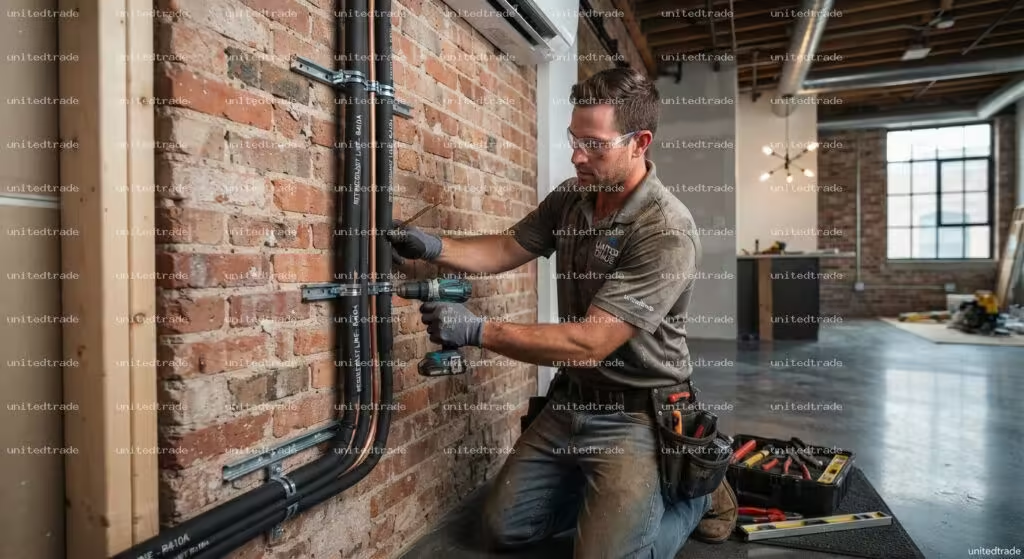
Engineering criteria for choosing appropriate diameters
The efficiency of the air conditioning system depends directly on choosing the diameters of copper pipes that are compatible with the capacity of the device, as choosing an inappropriate diameter leads to additional pressure on the air conditioning compressor, which reduces its lifespan. These diameters should be determined based on the device manufacturer's tables, taking into account the total path length between the indoor and outdoor unit.
The effect of path length on pipe diameter
In cases where the length of the copper wiring path exceeds five metres, it may be necessary to increase the diameter of the suction line piping to ensure that the Freon pressure reaches the required level. Neglecting this engineering rule leads to the phenomenon of loss of pressure, which actually translates into a weakness in cooling capacity and a significant increase in electricity consumption, as the device is forced to work for longer periods to reach the required temperature.
An illustrative table of pipe diameters according to air conditioning capacity
| Air conditioning capacity (tons) | Liquid pipe diameter (inch) | Intake pipe diameter (inch) |
|---|---|---|
| 1.5 tons | 1/4 | 1/2 |
| 2.25 tons | 1/4 | 5/8 |
| 3 tons | 3/8 | 3/4 |
| 4-5 tons | 3/8 | 7/8 |
The importance of inclined paths for water drainage
Establishing water drainage pipes is an integral part of the system Installing air conditioning ductsThe accuracy of its tendencies is often ignored. Any decline in the slope of the drain pipe may lead to water collecting at a certain point inside the wall or ceiling, causing internal leaks that later appear in the form of cracks in the paint or rot in the plaster.
Professional tips for extending drain pipes
- It is necessary to provide a slope of not less than one centimeter per linear meter to ensure the flow of water due to gravity.
- Use “W” connections instead of “T” connections if more than one device is gathered on a main drain line to reduce the chances of blockage.
- Test the drainage line by pouring a sufficient amount of water before closing the walls completely to ensure that the path is free of any obstacles or sharp bends.
- Secure the pipes with special clamps to prevent any collapse in the path over time.
Strategies for dealing with corners and turns
Sharp turns in copper pipes are considered one of the biggest causes of bottlenecks that hinder the movement of refrigerant gas. When performing foundations, you should avoid bending pipes at sharp right angles, and instead, you should use specialized pipe bending tools that ensure the pipe bends smoothly, maintaining its internal diameter. If a dent occurs in the pipe during installation, the entire damaged part must be replaced; Because repairing the dent does not restore the flow efficiency to its original state, but rather it remains a weak point that may lead to the leakage of Freon gas in the future as a result of the constant pressure at that point.
Also, care must be taken to separate the air conditioning pipes from any electrical extensions or other water pipes inside the wall to prevent annoying vibrations or unwanted interactions, and to install the pipes at close distances using strong plastic fasteners that prevent them from moving when the system is running.
It is a process Installing air conditioning ducts An essential step in the initial finishing stage, as it ensures that the cooling paths and water drainage lines are directed professionally to prevent external connections from appearing later. Pre-planning pipe paths directly contributes to preserving the aesthetic appearance of the indoor and outdoor units and reduces the chances of Freon leakage or drain blockage. In this article, we review in detail the engineering standards necessary to carry out this process with complete precision to ensure efficient cooling and longevity of the device.
Quick answer about installing air conditioning pipes
Installing air conditioning ducts It is the process of placing insulated copper pipes and water drainage lines inside walls or ceilings before the plastering and painting stage. This process requires accuracy in determining the appropriate pipe diameters for the air conditioning capacity and ensuring that there are sufficient inclinations in the drainage line to drain water and prevent its accumulation inside the device.
Choosing the correct materials and sizes for pipes
The success of installing air conditioning piping depends mainly on the choice of the type of copper used, as it is preferable to use cooled (thick) copper of reliable origin. Copper pipes must conform to international specifications to withstand high Freon pressures and prevent the occurrence of any microscopic cracks that may lead to refrigerant gas leakage over time.
Determine the appropriate diameters for each cooling capacity
Each air conditioning device requires specific pipe diameters based on its horsepower capacity. For example, 1.5 HP devices have different requirements from 3 HP devices. Using an inappropriate diameter negatively affects the air conditioning compressor and reduces the efficiency of the refrigeration cycle, leading to higher electricity consumption and insufficient cooling.
You can also benefit from additional related content via Air conditioning maintenance To expand your knowledge of this aspect.
Professional implementation steps on site
The foundation process must begin by determining the locations of the indoor and outdoor units very precisely based on the furniture distribution plan and the interior design of the building. After selection, thoughtful paths are broken into the walls with sufficient depth and width to accommodate the pipes with thermal insulation, taking care not to damage concrete columns or basic electricity cables.
For more details on this topic, you can see Air conditioning installation For additional information.
If you want to delve deeper into this aspect, we have dedicated separate content about Split air conditioning transfer Worth checking out.
To understand this point more deeply, we advise you to review Air conditioning installation Which covers the topic in more detail.
This aspect is related to another topic that is worth looking at, as choosing the ideal location for the indoor and outdoor unit. Choosing the appropriate place to install air conditioners is one of the crucial factors that affect the cooling efficiency and longevity of the device., as explained in Air conditioning installation steps.
It is worth noting a point related to this topic, as considerations for installation in the new location to ensure ideal performance. After the successful completion of the process of disassembling and transporting the split air conditioner, comes the reassembly stage, which is no less important than disassembly. website, and you can view full details via Dismantling and transporting split air conditioning.
It should be noted that there are additional useful details about this aspect that can be reviewed via Split air conditioning transfer.
You can also benefit from additional related content via Split air conditioning transfer To expand your knowledge of this aspect.
You can also benefit from additional related content via Air conditioning maintenance To expand your knowledge of this aspect.
For more details on this topic, you can see Air conditioning installation For additional information.
If you want to delve deeper into this aspect, we have dedicated separate content about Air conditioning maintenance Worth checking out.
- Measure the distance between the indoor and outdoor unit accurately to avoid unnecessary additional connections.
- Insulating copper pipes with thermal insulator (Armaflex) to prevent water condensation and protect copper from interacting with building materials.
- Test the pressure of the pipes with nitrogen before closing the walls to ensure that there are no leaks.
- Installing a water drainage line with a slope of no less than 1 centimeter per meter to ensure water flow.
Common technical errors during establishment
Many technicians make the mistake of not paying attention to the slope of the drain pipes, which leads to water accumulating inside the indoor unit and dripping onto the walls or floors. Another mistake that is no less dangerous is bending copper pipes in a sharp way, which causes suffocation of the Freon path and reduces cooling efficiency. Therefore, bending zippers or specialized bending machines must be used.
Comparative table of articles of incorporation
| item | Required specifications |
|---|---|
| Copper insulator | Black rubber insulator 10-15 mm thick |
| Drain pipe diameter | PVC with a diameter of at least 25-32 mm |
| Pressure test | Nitrogen pressure of at least 400 PSI |
| Control wires | Insulated copper wires of 1.5 mm or more |
The importance of choosing the correct path for pipes
Laying out air conditioning ducts requires choosing the shortest and most appropriate path possible between the indoor and outdoor unit to reduce pressure losses. The longer the distance or the more corners and turns, the greater the load on the cooling pump, making a straight and unobstructed path the ideal choice to ensure stable and silent performance of the device.
Frequently asked questions
What is the ideal time to start installing air conditioning ducts?
The ideal time is after the completion of the brickwork and before the start of the plastering and electrical work, to ensure that the tracks are integrated into the walls without the need for additional cracking.
Can air conditioning ducts be installed inside floors?
It is not preferable to pass air conditioning pipes inside the floors because they increase the length of the path and make future maintenance difficult. It is always preferable for the paths to be through false ceilings or inside walls.
Why should thermal insulation be used for pipes?
The thermal insulator prevents the phenomenon of condensation that leads to the appearance of moisture spots on the walls, and it also maintains the temperature of Freon inside the pipes to ensure efficient cooling.
What happens if the pipes are compressed before installation?
Pressure testing with nitrogen before closing is the most important step; If there is any hole or weak welding, it will appear immediately before the pipes become buried inside the walls.
conclusion
Investing in proper installation of air conditioning ducts will give you long-term peace of mind and protect your home from moisture problems and annoying air conditioning leaks. Always make sure to choose a specialized and certified technician and use original materials to ensure the best performance of the air conditioners in your home.
















TQTAG76 Community dialogue
0 comments