
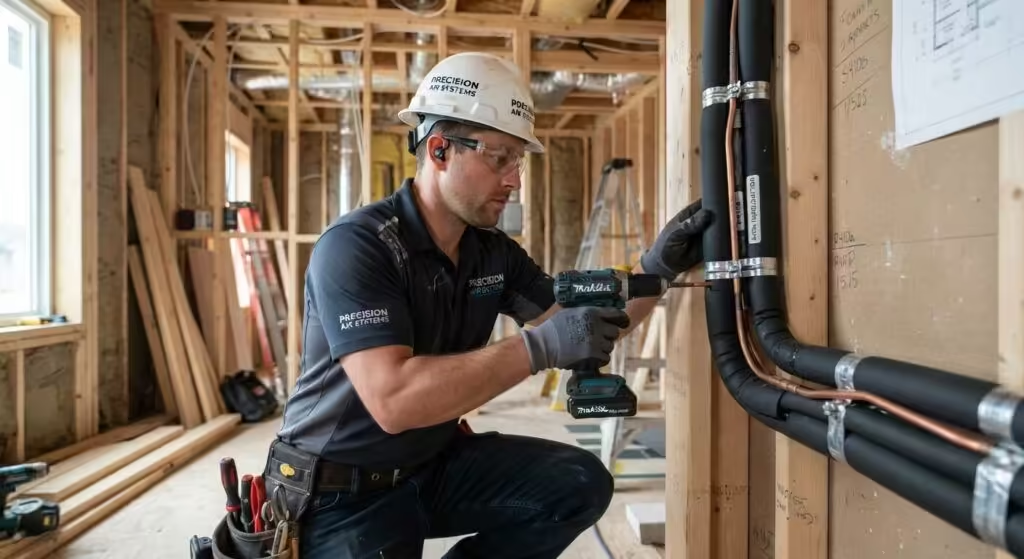
Common foundation mistakes and how to avoid them
Many contractors or homeowners make technical errors during the foundation phase, the results of which may not appear until years later, costing the homeowner huge sums of money for repairs. The most prominent of these errors is not calculating the correct inclinations of the water drainage pipes, as the path must be inclined towards the water drain to avoid the reflux of liquids inside, which leads to water leaking from the internal unit and damage to the gypsum decorations.
Another mistake is the sharp bends of the copper pipes, as some technicians tend to bend the pipes strongly, which causes a bottleneck in the refrigerant flow stream, and this directly reduces the efficiency of the system. Professional pipe benders should always be used to ensure that the pipe diameter remains the same without any narrowness in the path.
Technical comparison table for pipe diameters
The choice of piping diameter depends on the air conditioning capacity measured in horsepower (BTU), as choosing an inappropriate diameter for the required capacity affects gas pressure and oil flow. The following table shows the relationship between the device's capacity and the appropriate diameter of copper pipes:
| Air conditioning capacity (hp) | Liquid line diameter (in.) | Gas line diameter (in.) |
|---|---|---|
| 1.5 hp | 1/4 | 3/8 |
| 2.25 hp | 1/4 | 1/2 |
| 3 hp | 3/8 | 5/8 |
| 4-5 hp | 3/8 | 3/4 |
Pressure testing standards before closure
Walls should never be sealed or concrete poured before ensuring that the connections are secure, so the pressure testing stage is a crucial stage. The test includes the following steps:
- Using inert nitrogen gas to compress pipes at a rate ranging from 300 to 400 pounds per square inch.
- Leave the pipes under pressure for at least 24 hours to monitor the indicator.
- Use a soapy foam solution on all welding points to ensure there are no microscopic leaks.
If any decrease in the pressure gauge reading is observed, this means there is a defect in the welding or a hole in the copper pipes that must be addressed immediately before completing the finishing work. This procedure protects the home from future crushing costs, and ensures that the system operates at maximum efficiency once the units are installed.
Managing routes and distributing electrical points
The piping route must be planned in advance so that it does not intersect with other electrical or plumbing installations. It is preferable to place air conditioning ducts in overhead paths out of the reach of future screw drilling. An electrical supply point (air conditioning switch) must also be provided next to the location where the indoor unit is installed, making sure that the section of the electrical wire matches the capacity of the device, as high-power devices require wires with a larger diameter to avoid overheating and electrical fires, God forbid.
Installing Air Conditioning Ducts: An essential guide for anyone planning to install split or concealed air conditioning systems in their new home. Careful planning and preparation of the copper tracks before the final finishing stage ensures high cooling efficiency and protects your walls from future cracking. In this article, we review with you the technical steps necessary to implement the establishment correctly in accordance with international quality standards.
Quick answer
Installing air conditioning pipes is the process of preparing copper tracks and water drainage pipes inside the walls before the plastering and finishing stage. This process begins by determining the locations of the internal and external units, then extending the thermally insulated pipes with well-studied paths to ensure the efficiency of the device’s operation and to avoid any water leaks in the future.
Pre-planning and determining unit locations
The first stages of work begin with precise identification of the locations of the indoor and outdoor units to ensure ideal air distribution within the rooms. It is necessary to use an architectural plan that shows the distribution of furniture and room entrances to avoid placing the air conditioner in places that may cause annoying air currents for users.
The importance of engineering study of paths
The distance between the indoor unit and the outdoor unit must be calculated accurately to ensure that the air conditioning compressor operates within the limits permitted by the manufacturer. If the distance is very long, the cooling efficiency may be weakened, so it is always preferable to make the paths as direct as possible to reduce pressure loss.
Selection of high-quality materials and materials
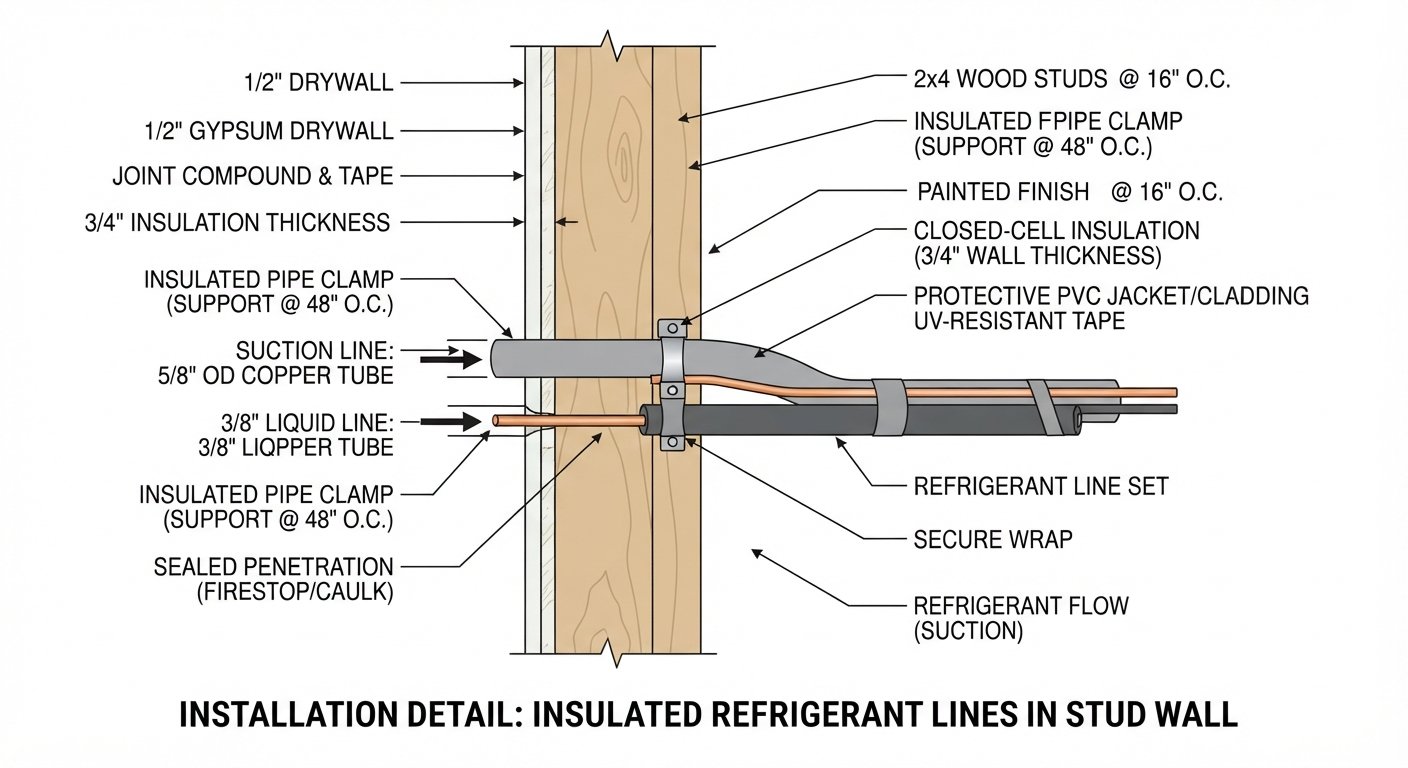
The durability of the air conditioning system depends on the quality of the copper used in the foundation. Therefore, copper pipes of approved thickness and conforming to standard specifications must be chosen. High-quality copper withstands high refrigerant pressures and prevents tiny holes or leaks that may not appear until years of use.
The foundation stage is the cornerstone that ensures the air conditioner works at the highest efficiency, so care must be taken to set the correct inclinations of the drainage pipes to prevent water accumulation and avoid leaks that may harm the structure of the house. Adherence to precise engineering standards in this step directly contributes to... Increase cooling efficiency Extending the life of the device.
- Use copper pipes with a thickness of at least 0.8 mm for small diameters.
- Cover the pipes with thermal insulator (Armaflex) of appropriate thickness to prevent water condensation.
- Ensure the quality of the electricity cables used in the foundation to withstand high loads.
- Installing water drainage pipes with precise inclinations to ensure that fluids flow and do not accumulate.
Implementation of foundation and stress testing
The foundation process is carried out by cutting channels in the walls to a suitable depth that ensures the protection of the pipes from any future excavation work. After extending the pipes, there comes a very important stage, which is the pressure test using nitrogen to ensure that the paths are free of any leaks before closing the walls permanently.
| stage | Action required |
|---|---|
| Planning | Determine air conditioning locations based on room area |
| Extension | Installation of thermally insulated copper pipes |
| Testing | Pressurize the system with nitrogen to ensure the integrity of the welds |
| Protection | Cover the pipes with a cement layer after ensuring the pressure |
Avoid common mistakes while working
Many people fall into the trap of neglecting the tendencies of drain pipes, which leads to water dripping into the rooms after a period of operation. In addition, care must be taken not to bend the copper pipes sharply (kinking), as this leads to suffocation in the refrigerant gas path and negatively affects the life of the compressor.
United Trade's advice for installing air conditioning ducts
United Trade Company for the establishment of air conditioning piping provides professional solutions based on the use of modern measuring devices to ensure the accuracy of the work. United Trade's air conditioning installation offers provide a long warranty on extensions, giving the customer peace of mind from leaking problems or poor performance later on.
Frequently asked questions
How is the path of air conditioning pipes determined?
The path is determined based on the shortest possible path between the indoor and outdoor unit, taking into account the required slopes for water drainage and avoiding intersection with electrical extensions.
Can pipes be installed after finishing?
It is very difficult to install pipes after finishing because they require significant cracking in the walls and distortion of the decor, so it is always recommended to work during the black frame stage.
What is the importance of thermally insulating copper pipes?
Insulation prevents the formation of water droplets resulting from condensation on the surface of cold pipes, which protects the walls from moisture and mold and keeps the gas cool.
Does the length of the pipes affect the performance of the air conditioner?
Yes, the longer the ducts are longer than the manufacturer's manual, the less efficient the cooling will be and the more stress will be placed on the engine, which can shorten its life.
What is the difference between copper pipes and aluminum pipes?
Copper is the best choice and is more resistant to high pressures and lasts much longer than aluminum, which may corrode and break easily.
Final evaluation of incorporation services
| Standard | Rating |
|---|---|
| Technical quality | 4.8/5 |
| Adherence to specifications | 5/5 |
| Speed of implementation | 4.5/5 |
| Value for price | 4.7/5 |
At the conclusion of this article, we emphasize that establishing air conditioning ducts: an indispensable guide for any homeowner who aspires to a stable, high-performance air conditioning system. Always make sure to choose specialized technicians and follow the technical steps mentioned to ensure that your money is invested in the correct establishment.
















TQTAG75 Community dialogue
0 comments