
Common foundation mistakes and how to avoid them
Many homeowners and contractors make fundamental mistakes during the construction phase that lead to costly breakdowns later. One of the most prominent of these mistakes is not adhering to the appropriate pipe diameter for the capacity of the air conditioner, as using pipes with a smaller diameter than required leads to increased pressure on the compressor, which significantly reduces its lifespan. Also, neglecting to clean the pipes from the inside before welding may lead to impurities or dust entering the cooling cycle, causing the thermal expansion valve to become clogged.
Steps for periodic inspection of pipes
Pressure testing must be performed using nitrogen gas and not regular air to ensure that the system is free of moisture, with the pipes left under pressure for a period of not less than 24 hours to monitor any decrease in the indicator. Any minor leak, even if it is not noticeable at first, will lead to a shortage of Freon gas and deterioration of the air conditioner's performance shortly after actual operation.
Materials used in installing pipes and their standard specifications
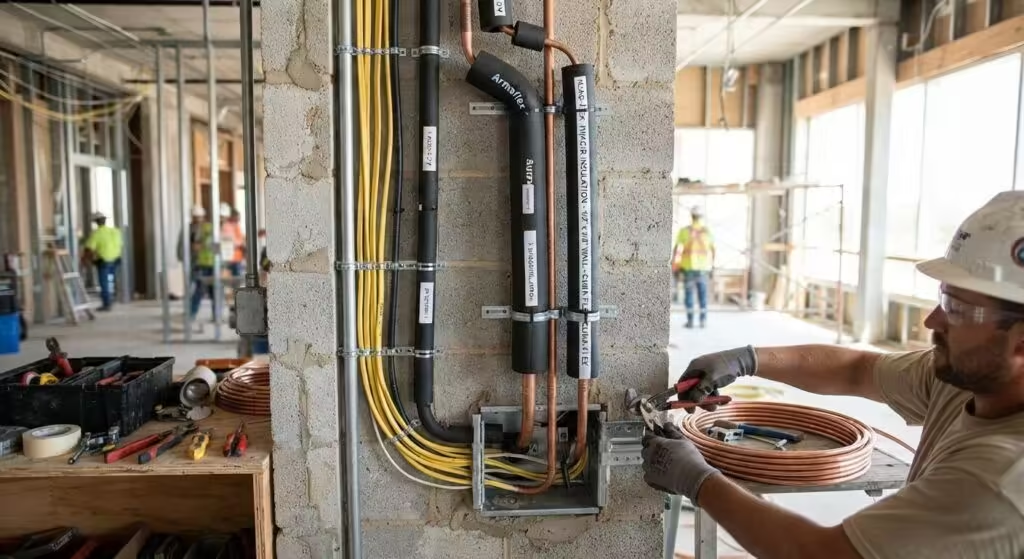
Depends on quality Installing air conditioning ducts Mainly on the type of copper used. Care must be taken to use high-purity copper (Soft Copper), which is specially designed for cooling systems, and which is characterized by its ability to withstand without cracking when bent. Thermal insulation also plays a crucial role in the efficiency of the system, as it is preferable to use high-thickness “Armaflex” insulation, especially in areas with high temperatures, to ensure that no heat exchange occurs with the surrounding environment.
| Component | Required specifications | Its artistic importance |
|---|---|---|
| Copper pipes | Thickness not less than 0.7 mm | Withstand high gas pressures and prevent corrosion |
| Pipe insulation | Closed cell elastic | Prevent condensation and maintain gas temperature |
| Control wires | Thermal insulated copper | Ensure signal transmission between indoor and outdoor unit |
| Drainage pipes | Polypropylene (PP) | Resisting chemical reactions and preventing leakage |
Engineering planning of pipe paths inside the walls
Proper planning of foundation paths requires taking into account the architectural distribution of the building. The piping distance should not exceed the maximum allowed by the device manufacturer, because increasing the length leads to a decrease in cooling efficiency and requires additional charging of refrigerant gas and lubricating oil. It is always preferable to make the path with as few sharp bends as possible, because they create resistance to the flow of gas and oil, which increases electricity consumption. When air conditioning paths intersect with electrical or plumbing extensions, a sufficient safety distance must be maintained to ensure that no interference or difficulty occurs in future maintenance work. Prior coordination between the site engineer and the air conditioning technician prevents cracking in the walls after plastering or painting work is completed, which saves additional unplanned costs.
Installing air conditioning ducts It is the most important stage in preparing residential units and offices to ensure that air conditioning devices operate with high efficiency in the long term. This process depends on planning the copper and insulation paths in a precise geometric manner that prevents refrigerant gas leakage or water condensation inside the walls. By following professional foundation standards, you will protect your property from moisture and ensure optimal air distribution without the need for costly modifications later.
Quick answer
Installing air conditioning ducts It is the process of installing a network of insulated copper pipes inside the building walls during the construction phase to connect the indoor unit to the outdoor unit. This process is intended to conceal mechanical and electrical connections and provide a safe and efficient path for refrigerant and condensate water drainage.
The importance of engineering planning for air conditioning paths
Pre-planning piping routes prevents bottlenecks in gas flow and facilitates future maintenance. The technician must locate the indoor unit away from direct heat sources while ensuring proper inclination of the water drainage pipes.
Determine the locations of indoor and outdoor units
Installation locations should be chosen so that they are easily accessible for periodic cleaning without impeding the movement of furniture or spoiling the decor of the room. The distance between the two units plays a pivotal role in the efficiency of the compressor, so it is preferable to reduce the lengths as much as possible to ensure optimal cooling pressure.
Materials and technical specifications required for foundation
Choosing copper pipes of approved thickness and high purity reduces the risk of corrosion and gas leakage over time. High-quality thermal insulation (foam) must also be used for each individual copper pipe to prevent condensation, which over time leads to moisture spots on the walls.
| Article | Job | Required specifications |
|---|---|---|
| Copper pipes | Coolant transfer | High purity and suitable thickness for capacity |
| Thermal insulation | Prevent condensation | Fireproof double insulation |
| Drainage pipes | Condensation water drainage | PVC pipes with a slope of at least 1% |
| Electrical cables | Supplying the unit with electricity | Copper wires matching loads |
Steps to implement foundation inside the walls
The installation process is carried out according to carefully considered steps to ensure that no sharp bends occur that may affect the flow of gas inside the pipes. The steps begin by determining the path, then cutting the wall deeply enough, and installing the pipes while ensuring the integrity of the insulation at all points.
Cooling efficiency does not depend only on the efficiency of the device, but also depends vitally on strategies Air distribution Inside closed spaces to ensure that coolness reaches every corner. Concentrating furniture or curtains in front of the air outlets leads to blockage of air flow, which places undue additional pressure on the system and reduces its operational capacity.
Pressure testing and ensuring the integrity of the lines
Before completely sealing the walls, a nitrogen pressure test must be performed to ensure that there are no leaks in the welded joints. This procedure is the only safety valve that guarantees that the air conditioning system will operate at full capacity without the need to break down the walls after completing the finishes.
Common mistakes to avoid when installing air conditioning pipes
The most common mistake is ignoring the angle of inclination of the drain pipe, which leads to water accumulating and backflowing inside the indoor unit. Furthermore, combining copper pipes with power cables into one narrow path may cause electromagnetic interference problems or difficulty in repair work.
- Do not insulate copper pipes separately for each line.
- Using thin copper pipes that cannot withstand the pressures of modern refrigerant gas.
- Neglecting to perform a nitrogen test before plastering the walls.
- Ignoring proper inclination of water drainage pipes.
- Leave the ends of the pipes open, allowing dust and impurities to enter.
Frequently asked questions
What is the ideal time to start installing air conditioning ducts?
The ideal time is after the completion of the brickwork and before starting plastering or painting work to ensure the accuracy of the paths.
Does the length of the pipes affect the performance of the air conditioner?
Yes, the longer the copper piping is longer than the manufacturer's recommendation, the lower the cooling efficiency and the greater the load on the compressor.
Why should copper pipes be insulated separately?
Independently insulating each tube prevents heat exchange between the intake line and the exhaust line, keeping the gas cool and preventing watery condensation.
How do I ensure that the air conditioning drain pipes are not clogged?
It must be ensured that there is sufficient inclination of the pipes away from sharp corners and that a cleaning hole must be provided if the distance is very long.
Can pipes be installed in floors instead of walls?
It is always preferable to install it in walls for ease of maintenance and to protect it from pressure resulting from movement, but it can be placed in floors if strong mechanical protection is provided.
Evaluation of technical standards for establishment
| Standard | Rating |
|---|---|
| Quality of materials used | 5/5 |
| Accuracy of pressure tests | 5/5 |
| Thermal insulation efficiency | 4.5/5 |
| Ease of maintenance in the future | 4/5 |
| Overall rating | 4.6/5 |
Investing in Installing air conditioning ducts Professionally, this will save you a lot of trouble and high costs in the future. We always advise you to seek the help of certified technicians to ensure that all engineering standards are implemented and to preserve your investment in air conditioning devices for as long as possible.
















TQTAG76 Community dialogue
0 comments