
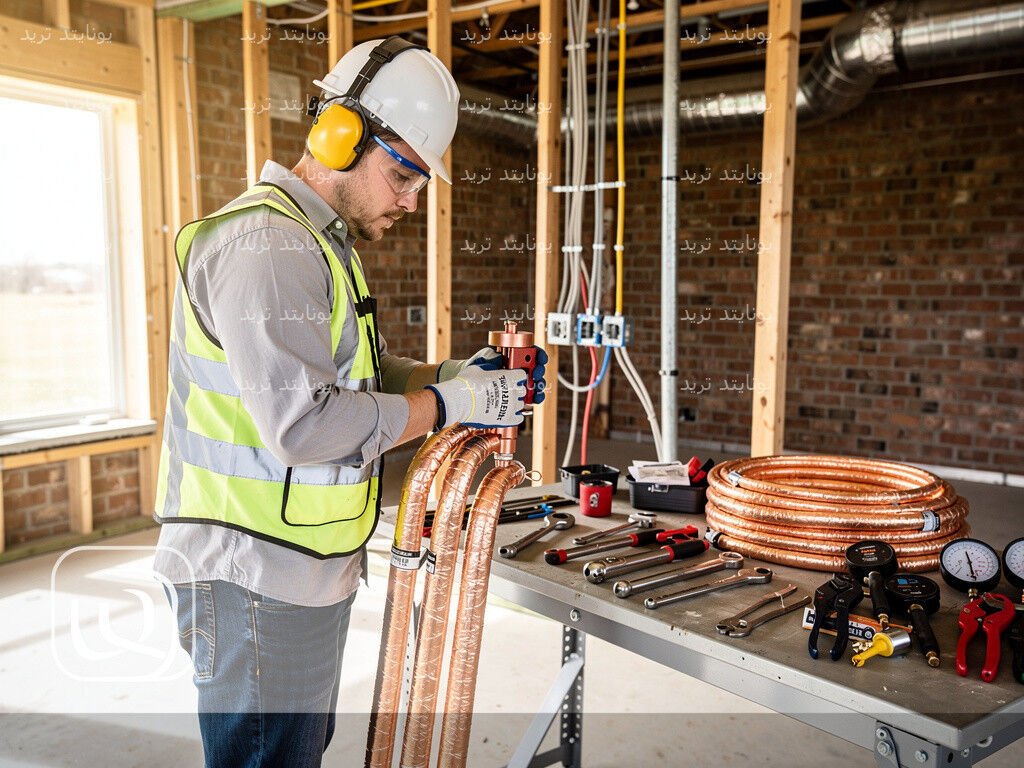
requires Establishing pipes Air conditioning must be carefully engineered during the first finishing stages to protect the facility from the dangers of refrigerant gas leakage or damage to the walls due to water condensation. This article provides an integrated practical guide that explains the standard criteria for choosing copper diameters, determining wall burial paths, and proper insulation methods to achieve the highest operational efficiency of cooling devices and reduce future maintenance costs.
Quick answer
Establishing pipes Air conditioning is the process of preparing and burying insulated copper lines, connecting cables and water drainage paths inside walls or false ceilings before the plastering and painting stage. This procedure ensures that the cooling system is protected from leakage, provides a smooth flow of the refrigerant compound, and maintains the internal architectural appearance of the building without the need for subsequent cracking.
What is the importance of advance engineering planning for cooling networks?
Early planning is the cornerstone of avoiding the dangers of moisture and concrete corrosion. In addition, pre-distribution of pipe paths determines the exact electrical loads for each room, preventing overloading of breakers and saving energy.
Buildings that lack proper preparation are exposed to problems with clogged condensate lines and paint damage. Moreover, the regulated installation facilitates unit replacement or upgrade without damaging the decorations, and provides stable operating pressure for the compressor thanks to the well-thought-out paths.
Technical standards for selecting copper ores and insulation materials
The quality of the foundation materials determines the lifespan of the entire air conditioning system, as high-purity copper resists vibration and high refrigerant pressures. Therefore, engineers always recommend using copper pipes that are free of internal welds and manufactured according to international standards to avoid the occurrence of microscopic pores through which gases can escape.
Approved copper pipe specifications
Korean or South African copper represents the first choice for residential and commercial projects, due to its uniform thickness and high ability to withstand the operating pressures of modern Freon such as R410A. It should be noted that diameters vary depending on the device's capacity, as 1.5 HP devices require suction and expulsion lines in sizes of 1/4 and 3/8 inches, while larger devices require diameters starting from 1/2 to 5/8 inches.
Thermal insulating properties of Armoflex
Closed elastic foam insulation, commercially known as Armoflex, prevents heat transfer and water condensation around the cold line. Accordingly, the thickness of the insulating wall must not be less than 9 mm to 13 mm, and each copper line must be insulated separately to prevent heat exchange between the hot intake and exhaust lines.
Steps for preparing the wall paths of the pipe network
The actual track preparation stages begin after the completion of the construction work and before the start of the cement plastering work. As a result, opening the tracks with automated slotting equipment ensures an even depth that prevents the pipes from protruding beyond the level of the finished wall.
- Determine the level of the indoor unit accurately, taking into account leaving a distance of no less than 15 centimeters from the ceiling to ensure free air intake.
- Use the electric missile to cut paths in the bricks at least 5 centimeters deep and wide enough to accommodate the pipe bundle without compression.
- Install plastic protection bushings at the penetration points of concrete walls to protect the insulation and copper from direct contact with the hard edges.
- Secure the package inside the duct using galvanized metal locks fixed with solid bolts at intervals not exceeding 50 centimetres.
Establishing air conditioning pipes in accordance with water drainage requirements
The condensate water drainage path constitutes a vital part that is no less important than the refrigerant gas pipes, as any error in the inclination angles leads to water flooding into the rooms. For example, proper foundation requires maintaining a constant downward slope at a rate of at least 1 centimeter per linear meter towards the main drain point insulated with a siphon that prevents the backflow of unpleasant odors.
1-inch diameter high-density PVC pipes used for drainage are buried and sheathed to protect them from accidental breakage during finishing work. On the other hand, relying on poor-quality spiral hoses inside the walls leads to algae accumulation and blockage of the path that is difficult to clean later.
Comparison of different piping systems
Extension methods vary according to the building's structural structure and room distribution. The following table shows the fundamental differences between the most common styles:
As a culmination of the establishment phase, the most important executive step begins Air conditioning installation The air is in accordance with strict technical standards that ensure that the internal and external units are installed in precise alignment to prevent vibrations. This process includes precise deflation and tightly tightening of copper connections to avoid any refrigerant escape, which maintains compressor efficiency and extends system life.
This sound engineering foundation cannot be completed without developing an integrated, periodic plan that guarantees action Regular air conditioning maintenance To prevent blockage of drainage paths and detect any decline in cooling efficiency early. This constant inspection of copper components and connections helps avoid sudden breakdowns and maintain the life of the device at the lowest possible operating cost.
The durability of the installations depends entirely on the technical mastery of the connection and formation processes during installation, as avoiding bottlenecks and leakage problems requires following a manual Welding and bending of copper pipes According to calculated temperatures and precise bending angles. This commitment ensures that the integrity of the inner diameter and wall thickness is maintained, allowing a free and stable flow of refrigerants under the highest operating pressures.
The efficiency of the entire mechanical system depends on proper procedures Installation of copper pipes This ensures stable cooling pressures and prevents leaks in the long term. This includes adhering to precise cutting and shaping techniques, in addition to applying inspection steps and tight mechanical fixation to avoid line vibration and welding spots being affected.
As a culmination of the establishment phase, the most important executive step begins Air conditioning installation According to the approved technical requirements to ensure the stability of the cooling cycle and the integrity of the connections. This process includes installing the internal and external units with extreme precision, conducting pressure tests and emptying air from the circuit to prevent moisture accumulation inside the pipes.
Operational efficiency and avoiding sudden malfunctions that may drain the budget later. This system is not complete without scheduling periodic procedures that include: Building air conditioning maintenance Regularly check Freon pressures and clean filters and condensers, ensuring fresh air flow and extending the life of the cooling units.
Operational efficiency that lasts for many years without sudden malfunctions. Despite the accuracy of the initial establishment, the sustainability of performance remains dependent on adherence to procedures Regular air conditioning maintenance Detect early any drop in gas pressure or blockage in drains. This continuous check ensures that the compressor is protected from thermal stress and maintains efficient fresh airflow within architectural spaces.
| Extension system | Implementation method | Most important features | Relative cost |
|---|---|---|---|
| Direct wall burial | Vertical cracks in bricks and tight insulation | Complete concealment of the network and ease of connecting units | Medium |
| Hanging with false ceilings | Tracks inside suspended ceiling mounts | Complete flexibility in maintenance and replacement of lines | High |
| External paths with duct | Extension over the facades inside protection ducts | Fast installation and no cracking of walls | Economical |
Common errors that lead to failure of cooling lines
Some unqualified technicians make catastrophic mechanical errors that cost huge amounts of money to repair after the paint and decoration are finished. Avoiding these wrong practices ensures the safety of the mechanical system for many years without a decrease in cooling efficiency.
These foundational preparations culminate in the implementation of a step Air conditioning installation According to the approved technical principles to ensure the stability of the cooling cycle and increase the efficiency of energy consumption. This includes installing the indoor and outdoor units with precise balances, tightly attaching the copper mesh and completely evacuating the air through the vacuum pump to prevent moisture inside the system.
- Manually bending the pipes at sharp angles, which causes suffocation of the Freon channel and burning of the compressor coils due to lack of flow.
- Using adhesive that is not intended to connect thermal insulation joints, which leads to moisture leakage and the appearance of mold spots on the walls.
- Neglecting to close the ends of the pipes with tight caps during the foundation phase, which causes dust and cement to enter the closed circuit.
- Collecting the intake and exhaust lines within a single insulating jacket, destroying the thermodynamic efficiency of the gas.
Inspection and pressure testing procedures before structural closure
Dry nitrogen pressure testing is the separation step before covering the cracks with cement, where inert gas is pumped at pressures exceeding 350 psi. As a result, the technician detects any microscopic leaks by using precise gauges and vent detection foam on joints and welds.
The system must be left under nitrogen pressure for a period of no less than 24 continuous hours and the pressure indicator must be monitored for stability throughout the period of whitening work. Accordingly, it is ensured that the pipes are not accidentally punctured by gypsum board screws or other workers' tools on site.
Frequently asked questions
What is the best time to install air conditioning ducts?
The best timing is after completing the walls and before starting the cement plastering work and basic plumbing and electrical installations. This timing allows for easy drilling of tracks without damaging the finish or architectural decoration.
How is copper protected from damage during finishing?
Protection is achieved by installing the pipes well within the depth of the wall, and closing the copper ends with temporary soldering or copper plugs to prevent the entry of dust and moisture. They are also buried inside protective plastic pipes in cross-junction areas.
Is the installation of air conditioning pipes for inverters different from normal ones?
Yes, inverter devices require additional high-quality signal and grounding cables to communicate between the indoor and outdoor units. In addition, inverter systems require greater copper wall thickness to withstand constant differences in refrigerant flow pressure.
What is the maximum allowable length of copper track?
The recommended maximum length for most discrete devices ranges from 15 to 25 meters depending on device capacity and manufacturer's instructions. Exceeding these lengths without adding compressor oil and additional Freon will result in engine damage and poor cooling.
Why are the suction line and ejection line insulated separately?
Each line is individually insulated to prevent heat exchange between the cold refrigerant returning and the warm liquid exiting the condenser. Combining them within one insulator reduces the efficiency of the device at a significant rate and increases electrical current consumption.
Requires success in Establishing pipes Air conditioning: Literal adherence to engineering standards and insulation quality to ensure maximum thermal comfort and reduce energy consumption in the future. Start now by examining your routes and hiring professionals to ensure a safe and sustainable cooling network.
















Community dialogue
0 comments