
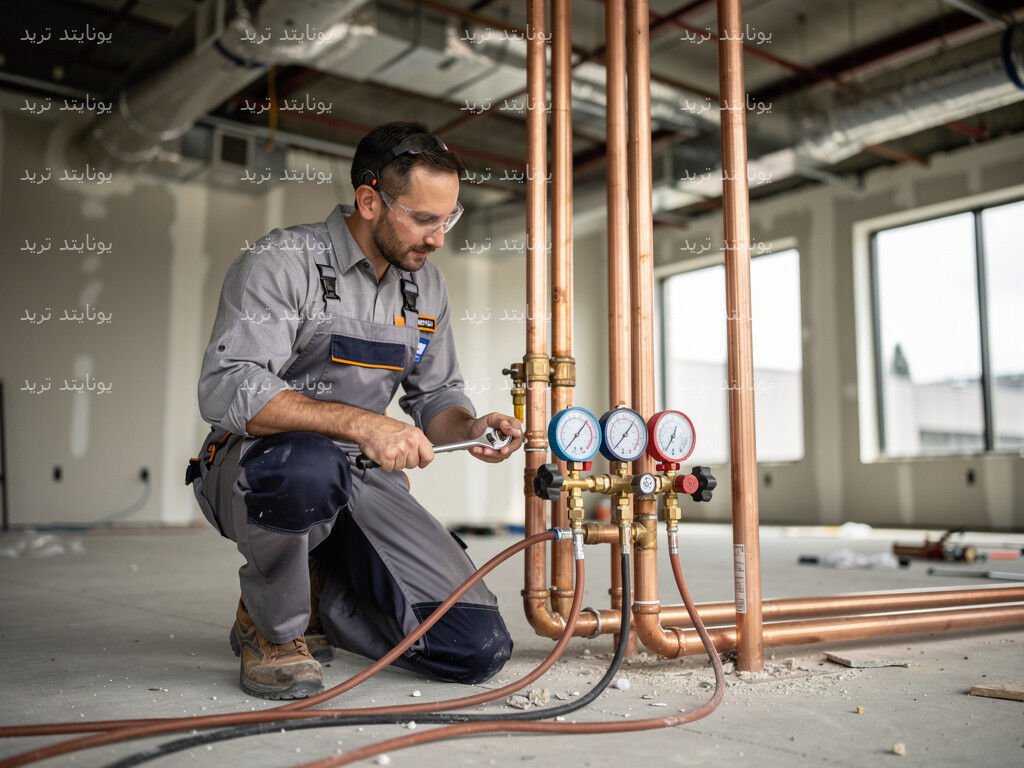
[Establishing air conditioning ducts](https://unitedtrad.com/wp-content/uploads/2026/10/auto_img_1791573802_263.jpg)!
table of contents
– [The most common mistakes while extending cooling paths](#toc-heading-1)
– Determine the appropriate path and heights for the internal and external units
– Frequently asked questions about buried cooling networks
-Quick answer
– Technical standards for selecting copper ores
– Steps to accurately implement the installation of air conditioning piping
– Common errors in mechanical installations
– Summary of technical standards for establishment
– Professional tips to avoid maintenance costs
– Frequently asked questions
– Final evaluation of foundation standards
## The most prominent common mistakes while extending cooling paths
Many inexperienced technicians make fundamental errors during the field work phases, which results in a significant decline in the performance of cooling units after short periods of operation. Some of these wrong practices lead to damage that is difficult to correct later without causing serious damage to the finishes and interior decorations.
– Manually bending pipes without the use of specialized bending devices, which results in partial suffocation in the internal duct and impedes the smooth flow of Freon gas.
– Neglecting to provide a suitable inclination angle for the water drainage pipes resulting from condensation, which causes water leakage and stagnation inside the walls and damage to the paint.
– Combining the intake line and the expulsion line within one thermal insulator, which is a common mistake that causes a negative heat exchange that reduces the efficiency of the refrigeration cycle by a significant percentage.
– Leaving the ends of the pipes exposed during construction and plastering work, allowing dust, sand grains, and cement residues to enter the closed circuit.
## Determine the appropriate path and heights for the indoor and outdoor units
Establishing air conditioning ducts requires an engineering layout that takes into account the vertical and horizontal distances between the unit installed inside the room and the one placed outside, as these distances control the stability of the oil pressure inside the compressor.
## Making oil traps in vertical paths
When the outdoor unit is at a much higher level than the indoor unit, the lubricating oil has difficulty returning to the compressor due to gravity. To address this matter, a U-shaped bend is made approximately every five to seven vertical meters to ensure the oil flows and stabilizes within the mechanical circuit without exposing the moving parts to direct friction.
## Frequently asked questions about buried cooling networks
## What is the ideal time to leave the pressure under control before burial?
It is preferable to leave the pressure gauges connected to the network for a period of not less than twenty-four full hours, while recording the initial reading and comparing it with the final reading to ensure that there is no slight decrease indicating microporosity in the welding points.
## Is it possible to modify the pipe route after the completion of the conch work?
Modifying the path after plastering is very complex and expensive, and requires direct crushing of the plaster and block layers, and may expose the copper pipes to twisting or sudden damage, so it is necessary to approve the final drawings before beginning the installation work.
## What is the appropriate diameter of the outer plastic protective case?
The choice of the diameter of the outer case depends on the size of the two copper lines and the thickness of the insulation surrounding them in addition to the electrical signal cables. A diameter ranging between fifty to seventy-five millimeters is usually used to facilitate the pulling process without excessive pressure.
The stage of establishing air conditioning ducts is considered the cornerstone of any home cooling system, as it is the hidden network that ensures the flow of the refrigerant between the internal and external units with high efficiency. Many homeowners ignore the details of this process, which later leads to Freon leaks or annoying water condensation inside the walls. By following the right engineering principles from the beginning, you can protect your investment and avoid the onerous routine maintenance costs that often result from poor initial installation.
##Quick answer
Installing air conditioning ducts is the process of extending insulated copper pipes inside walls or ceilings before the finishing stage to connect the cooling units together. The quality of this process relies on the use of high-thick copper, durable thermal insulation that prevents condensation, and careful nitrogen pressure testing to ensure the tracks are free of leaks.
## Technical standards for selecting copper ores
The quality of copper used in the foundation is the element that most affects the life of the entire air conditioning system. The matter is not limited to just choosing a copper pipe, but rather focus on the diagonal thickness that can withstand high operating pressures without being exposed to punctures or kinks during laying.
## The importance of copper wall thickness
It is always preferable to use copper with an internationally approved thickness, as thin pipes operate under high Freon pressure and are susceptible to explosion or corrosion over time. The thick copper withstands sharp bends at corners without reducing the internal diameter of the path, ensuring smooth refrigerant flow throughout the life of the device.
##Choice of thermal insulation material
Thermal insulation surrounding copper is not just a cover, it is a barrier that protects against condensation that leads to rotting of the walls. You must choose high-density insulation materials that are resistant to fire and moisture, and make sure to cover the entire length of the pipes without leaving any part exposed, because small voids in the insulation are the primary cause of water drops that appear on ceilings after a period of use.
## Steps to accurately implement the installation of air conditioning ducts
The extension process requires advance planning of air conditioning paths to avoid intersection with electrical or plumbing extensions. Implementation begins with precisely determining the locations of the internal units, taking into account drainage tendencies to ensure that water exits easily. Then, pipes are installed and secured within the walls.
Perhaps avoiding these mistakes begins with being aware of the sound engineering standards required by the stage of installing a highly efficient air conditioner, starting from the precise calculation of distances to precisely adjusting the bending angles to avoid obstructing the flow of the refrigerant. Implementing these technical controls ensures that the system is protected from leaks and enhances its lifespan and overall level of performance.
## Pressure testing stage
After laying the pipes and before closing the walls completely, a pressure test must be performed using dry nitrogen gas. This step leaves no room for chance, as the pipes are pressurized at high pressure and the meters are monitored for a period of no less than 24 hours. If the indicator decreases, this means there is a leak that must be addressed immediately before sealing the walls with plaster or decoration.
To avoid exacerbating these operational problems, there is an urgent need to perform periodic air conditioning maintenance to early detect any bottlenecks in gas lines or hidden leaks that may impair the efficiency of compressors. This continuous inspection ensures that structural defects are addressed before they turn into serious mechanical failures that drain energy and shorten the life of the system.
The precise placement of air conditioning ducts within the walls is the vital artery that ensures the long-term efficiency of cooling systems, as these hidden paths protect the structural structure from moisture damage and leaks. Paying attention to the quality of materials and insulating them perfectly before closing the walls provides you with complete peace of mind and avoids high costs resulting from forced maintenance later.
The quality of the air conditioning system does not stop only at the safety of extending the paths, but also extends to periodic inspection of the electrical circuits and adjusting the cooling efficiency before entering the peak seasons. Addressing common faults early helps reduce energy consumption and protects mechanical components from excessive stress. This routine procedure ensures that the units are protected from damage and provides balanced performance that gives your air conditioner a longer life and sustained efficiency.
In order to avoid the exacerbation of these problems after the completion of establishment, there is an urgent need to carry out periodic air conditioning maintenance work to early detect any blockages or leaks in the cooling lines. This regular technical procedure helps maintain the efficiency of the compressor and ensure the flow of cold air at the highest possible operating power without sudden breakdowns.
The implementation of any project requires the adoption of precise standards, starting from the proper selection of paths until the completion of the installation of air conditioning with integrated operational efficiency that ensures stability of the refrigerant pressure. The life span of the system is linked to the proper installation of the internal and external units and adjusting the water drainage outlets to prevent any future leaks.
Protecting these systems and extending their operational life requires the implementation of regular and comprehensive air conditioning maintenance programs immediately after establishment and initial operation are completed. Periodic inspections contribute to the early detection of cooling media leaks or path blockages before they escalate into costly malfunctions that affect the efficiency of the entire building.
The success of this system requires adherence to precise standards during the air conditioning installation. The correct steps begin with choosing the shortest path for the pipes to avoid a drop in the pressure of the refrigerant. The suction and exhaust lines should also be completely insulated to prevent thermal condensation and ensure the highest operational efficiency of the device.
📊Illustration of the path of steps Step 1 Locating the units ↓ Step 2 Purchasing certified copper ↓ Step 3 Extending paths and slopes ↓ Step 4 Welding the connections ↓ Step 5 Successful nitrogen pressure test ↓ Final stage Closing the walls ✓ A sequential path for the successful implementation and completion of the stages
## Common errors in mechanical installations
Many people make fatal mistakes while installing air conditioning pipes, the most notable of which is bending the pipes in an unprofessional manner that leads to narrowing the internal diameter. This tightening causes additional pressure on the air conditioner motor, which significantly reduces its lifespan and significantly increases electrical energy consumption.
– Leaving long distances between the pipe mounting supports, which leads to their collapse.
- Using poor soldering connections that do not conform to technical specifications.
– Neglecting to provide an independent path to drain water away from electricity cables.
– Not cleaning the copper from the inside before extending it, which allows dust to enter the system.
## Summary of technical standards for establishment
The most important points that must be available to ensure a successful and sustainable establishment can be summarized in the following table, which shows the difference between professional establishment and traditional unreliable methods.
Technical item - Required specifications - Objective of establishment -
Copper thickness — not less than 0.8 mm — withstand high gas pressure —
Thermal insulation — closed-pore rubber foam — prevent condensation and moisture —
Pressure test - Nitrogen gas for 24 hours - Ensure there is no leakage -
Drainage tendencies — at least 1% — water comes out smoothly —
## Professional tips to avoid maintenance costs
Your investment in choosing a specialized technician and original materials when installing air conditioning ducts will save you huge sums of money later. You must monitor the welding process yourself or through the site engineer, and ensure that all connections are made using high-quality silver, as silver ensures a much stronger bond than regular welding and prevents cracks in the connections over time and temperature changes.
## Frequently asked questions
## What is the appropriate time to start installing air conditioning pipes?
Work begins immediately after the brickwork is completed and before plastering and interior finishing work begins. This stage allows the technician to bury the pipes inside the walls safely and aesthetically, preventing the need for breaking later.
## Does the length of the pipe path affect the efficiency of the air conditioner?
Yes, excessive length directly affects cooling performance, as the pipes lose part of their coolness as the length of the path increases. It is always preferable to reduce distances as much as possible and adhere to the maximum pipe length recommended by the device manufacturer.
## How do I ensure that no water leaks from the pipes inside the rooms?
Make sure to install excellent quality thermal insulation and cover the entire pipe without any gaps. In addition, there must be a proper slope in the water drain pipe to ensure that it flows out and does not back up into the indoor unit.
## Can used pipes be used in foundations?
It is strictly prohibited to use used pipes, as old pipes may contain dust or impurities inside them, or may have been subjected to invisible mechanical stress. Saving on this item often leads to costly compressor breakdowns later.
## Why should nitrogen pressure be tested before sealing walls?
Nitrogen testing is the only way to detect minute leaks that are not visible to the naked eye. If the walls are sealed and then a leak is discovered, you will have to tear down the entire walls to repair the defect, which is very expensive.
## Final evaluation of foundation standards
To ensure an ideal cooling system, the foundation stages must be evaluated based on the following criteria that ensure quality for the value invested.
Evaluation criterion — Rating (out of 5) —
Quality of copper ores — 5/5 —
Pressure test accuracy — 5/5 —
Quality of thermal insulation — 4.5/5 —
Professionalism in implementation and installation — 4.5/5 —
Overall rating — 4.75/5 —
Taking care of the installation stage of air conditioning ducts is the most important step to ensuring the comfort of your home for many years. Make the decision to choose original materials and expert labor, and you will feel the difference yourself in the cooling efficiency and quietness of the system.
















Community dialogue
0 comments