
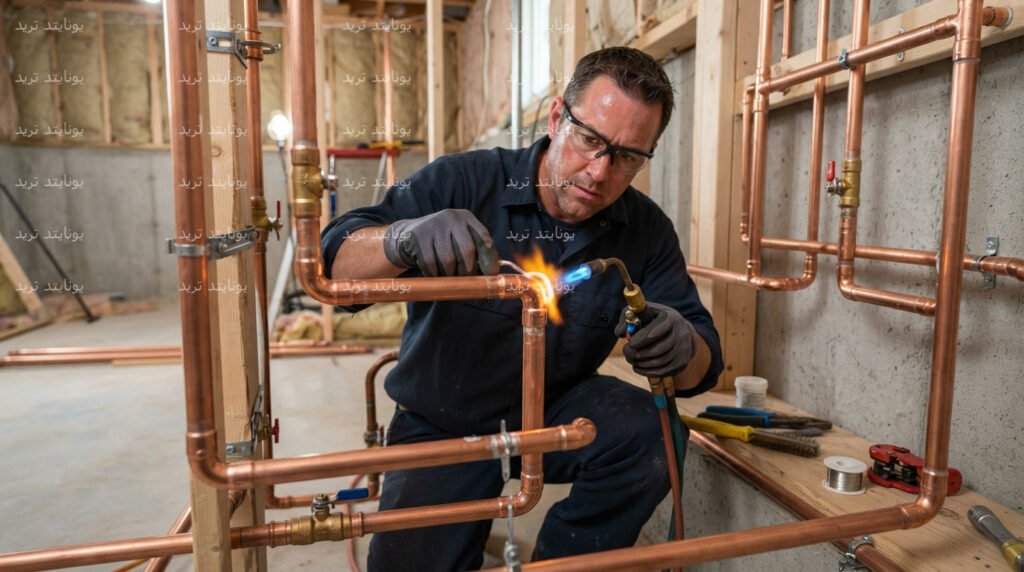
practical Installation of copper pipes It represents the basic foundation for ensuring the efficiency of air conditioning systems and preventing recurring malfunctions in the future. This article aims to explain the precise technical standards that must be followed during construction, highlighting approved materials and proper welding techniques. Adherence to these engineering rules ensures sustained cooling performance and protects your equipment from compressor fatigue caused by common installation errors.
Quality standards for materials used in extensions
Depends on quality Installation of copper pipes Directly ensures that materials comply with international standard specifications to ensure they can withstand high operating pressures. It is always recommended to rely on pipes that meet specifications ASTM B280 Or Japanese standard JIS-H3300 To obtain the best quality and purity of copper. Using poor quality materials exposes the system to the risk of internal corrosion and refrigerant leakage over time.
❓ The importance of high-density thermal insulation
Thermal insulation is an integral part of the foundation process, as it prevents water condensation inside the walls and protects pipes from external factors. Insulation of some type must be used Armaflex With a thickness ranging from 3/8 to 1/2 inch for maximum possible protection. This insulation keeps the refrigerant cool and prevents heat loss, which increases the overall efficiency of the system and extends the life of the piping.
Determine the diameters of pipes according to the air conditioning capacity
The diameter of the pipe must be chosen very precisely based on the capacity of the air conditioner in tons or horsepower according to the official manufacturer’s catalog. Choosing inaccurate sizes directly leads to compressor fatigue, causing a noticeable weakness in cooling performance. The following table shows a summary of the most important standards and technical specifications approved for professional establishment operations.
| Technical standard | 🏆 Editor's choice | Required specifications |
|---|---|---|
| Copper type | ASTM B280 ✓ | Globally approved |
| Insulation thickness | 1/2 inch ✓ | High density |
| Welding inside the wall | ✗ Forbidden | High risk |
| Nitrogen use | ✓ | Essential for protection |
| Overall evaluation | ★ 9.8/10 | Complete professionalism |
Important note: You must ensure that you obtain official approval from the air conditioner manufacturer before starting the installation to ensure that the warranty period applies to the device and installations. Skipping this step may result in losing free maintenance rights in the future, so make documenting the work a top priority.
Professional welding techniques to prevent leaks
It is strictly prohibited to perform any welding inside the walls to avoid the possibility of future leaks that will be difficult to access and maintain. requires Installation of copper pipes High skill in using welding flame with pass Nitrogen gas Inside the pipes during the operation. This step prevents the formation of internal oxides that often lead to system blockage and subsequent compressor damage.
The previous steps illustrate the optimal path for carrying out the work, as it begins with a careful inspection and ends with a final test to ensure that there are no pressure leaks before closing the walls permanently.
Advantages and disadvantages
Features:
- Ensuring the continuity of cooling with high efficiency for many years.
- Protect the compressor from damage resulting from incorrect operating pressures.
- Preventing water condensation and damage to walls thanks to good insulation.
- Maintaining the value of the official warranty for approved devices.
Disadvantages:
The quality of cooling depends directly on the accuracy of choosing the thickness of the copper pipes and their professional thermal insulation, as this insulation prevents moisture leakage and maintains the pressure of the refrigerant gas within the closed cycle. The delivery process also requires high skill in use Welding techniques With copper to ensure tight connections and prevent any future leaks that may affect the device’s performance.
It requires a stage Installing air conditioning ducts Careful planning of the expansion paths and choosing the appropriate diameters to ensure the flow of refrigerant without stress on the compressor. During installation, care should also be taken to protect the pipes with tight layers of thermal insulation to avoid condensation and the leakage of cold into the walls.
Requires implementation of Air conditioning installation With high efficiency, great care is taken to adjust the paths of the cooling lines and install the internal and external units according to precise scales to avoid vibrations and Freon leakage. Close inspection of insulation and electrical connections also contributes to enhancing the device’s ability to quickly cool and prolonging its lifespan to the maximum possible extent.
Maintaining cooling efficiency is not limited to the quality of the foundation alone, but rather requires continuous procedures Regular air conditioning maintenance For early detection of any possible leakage in Freon lines. This regular inspection helps clean filters and condensers and protects the compressor from stress, extending the life of the system and ensuring the highest possible air flow.
The efficiency of cooling systems depends fundamentally on the accuracy Installation of copper pipesThe correct selection of pipe diameters and the adoption of approved welding techniques ensure that the refrigerant flows completely smoothly. Durable thermal insulation also plays a crucial role in preventing thermal loss, which enhances the operational life of the system and prevents any future leaks that may affect overall performance.
Adhering to these engineering rules guarantees you sustainable cooling performance, as the journey begins with choosing copper pipes of approved thickness and quality that can withstand high refrigerant gas pressures without leaking. As you promise Precision welding techniquesAway from random traditional methods, the actual guarantee is to protect the Freon cycle from any impurities that may hinder the efficiency of the entire system.
Far from the establishment stage, it remains Air conditioning maintenance Regularly ensures the continuity of this high performance and avoids premature wear of internal components. Regular checking of refrigerant levels and cleaning of filters significantly reduces the possibility of sudden leaks, extending the operating life of the device and maintaining optimal cooling efficiency.
It requires a stage Installing air conditioning ducts Careful planning of the extension paths and choosing the appropriate diameters in accordance with the capacity of each cooling device. This engineering procedure helps avoid sharp bends that may impede refrigerant flow or cause sudden leaks over time, enhancing the operational stability of the system as a whole.
The importance of the system does not stop only at the establishment stage, but extends to include Regular maintenance programs Which contributes to prolonging the operational life of the device. Conducting regular preventive inspection prevents dust accumulation and Freon leakage, ensuring continued cooling efficiency and avoiding expensive repair costs.
It requires a stage Installing air conditioning ducts Careful planning of the expansion paths and choosing the appropriate diameters to avoid any drop in the pressure of the refrigerant. This procedure also requires carefully insulating the lines and installing them tightly inside the walls to protect them from moisture and mechanical damage in the long term.
- Higher initial establishment cost compared to uncertified raw materials.
- It requires trained workers and specialized technicians to ensure that standards are implemented.
- Difficulty in correcting errors after completing the plastering or painting process.
❓ Editor's judgment and final rating
The overall rating for the process is 9.6/10. Investing in high-quality materials and applying stringent installation standards is an imperative choice for anyone looking for sustainable cooling performance. This option is specifically suitable for new buildings and villas that seek to maintain the efficiency of their equipment and reduce regular maintenance bills.
The subsequent phase of network extension requires the implementation of steps Air conditioning installation According to precise engineering standards, the internal and external units are securely fixed. This procedure ensures lossless integrity of the refrigerant flow, enhancing energy efficiency and protecting the entire system from vibration and high pressure problems in the long term.
Frequently asked questions
❓ What are the risks resulting from not insulating copper pipes?
Failure to insulate the pipes leads to water condensation around them, causing moisture in the walls and damage to the paint, in addition to a decrease in cooling efficiency due to energy loss.
❓ Can copper pipes be installed with a diameter smaller than the recommended one?
No, you must adhere to the pipe diameter specified in the air conditioner catalog; Because using a smaller diameter increases the operating pressure and causes the compressor to wear out quickly.
❓ How do I ensure that copper pipes do not leak?
The real guarantee comes from conducting a careful pressure test of the pipes before closing the walls, completely refraining from welding inside the wall, and using approved copper materials.
❓ Why is nitrogen gas used during welding?
Nitrogen gas is used to prevent the formation of copper oxides inside the pipes, which deposit over time and lead to clogging of the expansion valves and damage to the refrigeration cycle.
❓ When should old copper pipes be replaced?
It is recommended to replace the pipes if they show signs of corrosion, have lost their elasticity, or when an air conditioner with a significantly higher cooling capacity than the previous one is installed.
Follow these technical directions when implementing Installation of copper pipesYou will ensure optimal cooling performance and avoid high maintenance costs. Do not hesitate to request a specialized technician to evaluate the extensions and ensure that they comply with the required specifications.
















Community dialogue
0 comments